







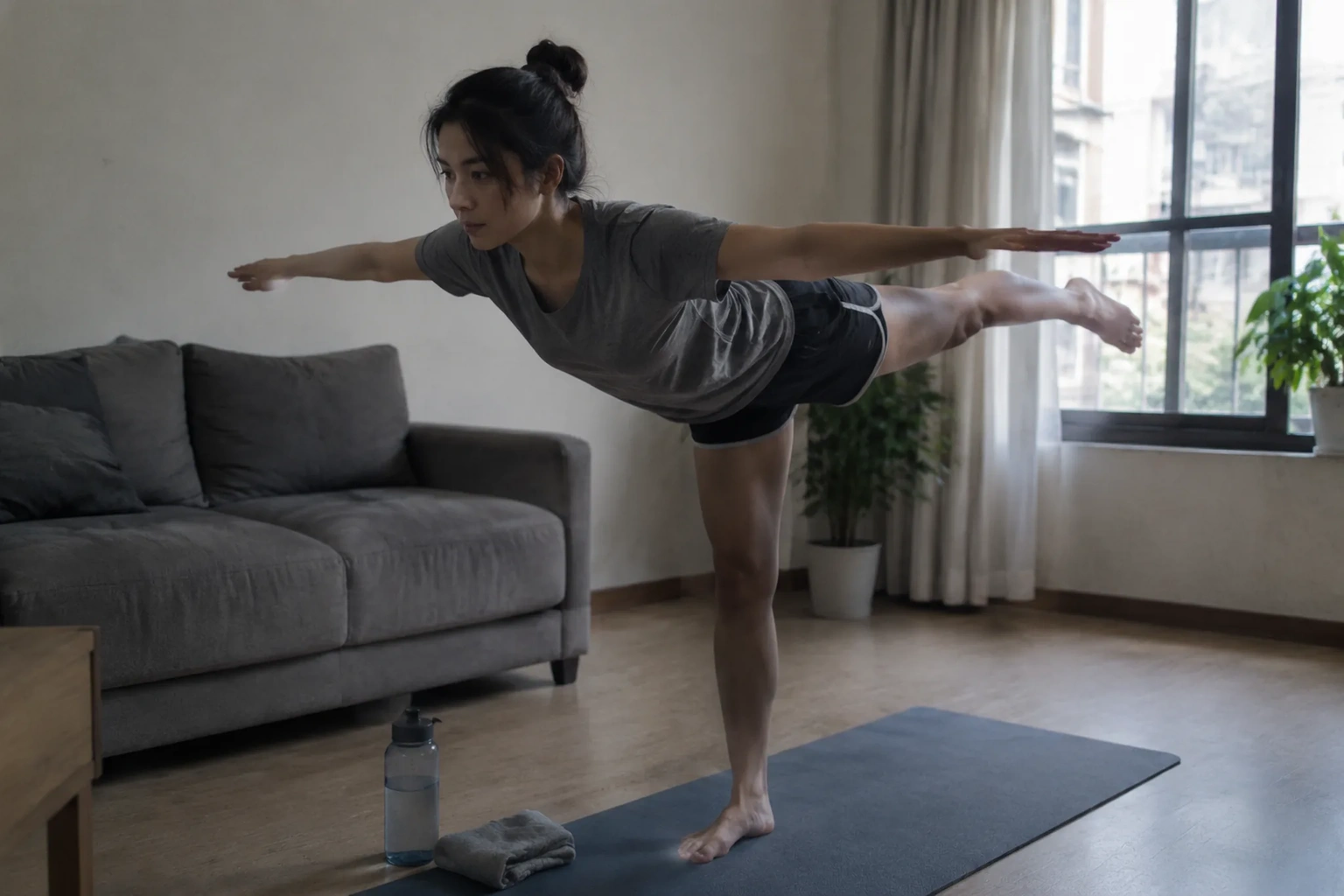
Balance training has a marketing problem. Search for it and the results split into two unsatisfying camps: glossy gym content built around unstable surfaces and $200 boards, or clinical handouts written for people recovering from a hip replacement. Neither speaks to the ordinary adult who wants to stop wobbling while pulling on socks, who notices a hand drifting toward the counter more often than it used to, who would like to descend a flight of stairs without treating the railing as a load-bearing structure.
The home version of this work needs almost nothing. A wall, a chair, a doorway, a couple of throw pillows, and enough floor space to stand in. What it needs more than equipment is a clear-eyed understanding of what balance actually is, because the standard advice (stand on one foot, hold thirty seconds, switch) captures maybe a fifth of it.
Balance Is Three Separate Systems Wearing One Coat
The body keeps itself upright using three inputs. Vision reports where the horizon sits. The inner ear reports head position and acceleration. Proprioception, the pressure sensors in feet and joints, reports how weight is distributed against the ground. The brain blends all three continuously, and when one degrades, the others compensate.
This matters for training because each system can be challenged separately. Closing the eyes removes vision and forces the other two to work harder. Standing on a cushion or folded blanket muddies the foot's pressure signals. Turning the head during a hold disrupts the inner ear's reference frame. A routine that only ever does eyes-open, firm-floor, still-head standing trains one configuration and leaves the rest untouched.
There is also a strength layer. Ankle muscles make the small rapid corrections that keep a standing body from tipping. Hip muscles handle the larger saves. Anyone who has watched a person in their eighties catch a stumble with a quick side step is watching hip strength do its job a half-second before a fall.
The Wall Stand: Start With the Feet
Begin barefoot, or in socks on a non-slip floor. Stand an arm's length from a wall, feet together, and let the knuckles rest lightly on the wall for security. The first task has nothing to do with holding a pose: it is finding where the weight sits. Most people stand with the load pushed toward the balls of the feet. A balanced stance carries weight through the middle of the foot, with the toes relaxed enough to lift individually.
Spend a full minute just shifting: forward toward the toes, back toward the heels, side to side. The aim is a felt map of the foot's contact patch. This dull-sounding minute does more for balance than a month of distracted one-leg stands, because the corrections all originate there.
Then narrow the stance: heel of one foot touching the big toe of the other, a tightrope walker's line. Hold thirty seconds with the wall within reach. When that feels steady, lift one foot a few inches off the floor for ten seconds and set it down. Alternate five times per side. The hand hovers near the wall the whole time, ready but not gripping.
Removing Vision Without Falling Into the Doorframe
Once the one-foot stand is comfortable with eyes open, close them. The change is startling. A pose that felt solid becomes a slow, constant negotiation, the body swaying in small arcs while the ears and feet argue about vertical. That argument is the training.
Keep the wall contact at shoulder height for the first several sessions, fingertips only. Ten seconds with eyes closed is a reasonable starting dose; thirty is a milestone. The same sequence applies to the tightrope stance: feet in line, eyes shut, wall within reach, thirty seconds.
Two safety notes, offered plainly. Position a chair or counter on the open side as well, so a wobble in any direction meets something. And do this barefoot on a firm floor, not on carpet, where the foot's pressure sensors get muffled and the whole exercise turns vague.
The Folded Blanket and What It Teaches the Ankle
A folded blanket or a firm throw pillow, an inch or two thick, makes a crude wobble board. Stand on it with both feet, then progress to one foot. The unstable surface forces the ankle to fire constantly, and the first few attempts usually reveal how lazy a flat-floor stance had become.
This is the point where many home routines overreach. Balance boards and foam pads get added too early, and the body responds by stiffening the whole leg, which defeats the purpose. The blanket works because it is mild. The corrections stay small and continuous instead of becoming a wrestling match.
Start with both feet on the blanket, thirty seconds, eyes open. Work toward one foot, ten seconds per side, before ever closing the eyes on this surface. Progress should feel boring. Boring means the nervous system is adapting rather than bracing.
Turning the Head While the Feet Stay Still
Daily life rarely demands balance with a fixed gaze. Looking over a shoulder to check for traffic, turning to answer someone across a room, glancing down at a step: all of these rotate the head and scramble the inner ear's reference while the feet must hold.
Stand in a doorway, hands on the frame at hip height, feet in the tightrope line. Turn the head slowly left, then right, five times each way, and notice whether the body follows the head. It usually does. The hands on the frame catch the drift. Progress by removing the doorway and allowing the hands to hover, then by adding a slow look up and down, which challenges a different set of inner-ear canals than side-to-side turning.
The doorway frame is worth keeping in the routine even after the hands come off, because it converts a living room into a balance gym with no purchase, no storage, and no assembly.
Sit-to-Stand: The Strength Half of the Equation
Standing balance work has a quiet dependency: the hip and thigh muscles have to be strong enough to execute the saves. A chair covers this without a single weight.
Sit toward the front of a sturdy chair, feet flat, and rise without using the armrests. Ten slow repetitions. The slow part matters; dropping into the seat and popping up trains momentum, while a controlled descent trains the eccentric strength that governs lowering into a car seat or onto a low step. Progress by folding the arms across the chest, by slowing to a four-count down, and eventually by rising from a lower surface, like a step or a stack of firm cushions.
Anyone who has tried to stand from a soft sofa after a long movie knows this strength is the practical foundation of not falling, and it fades quietly through the forties and fifties without any obvious warning.
Walking a Line Down a Hallway
Static holds train one narrow slice of balance. Walking is the other half, and the hallway is the arena. Set a line of tape, or use a floorboard seam, and walk heel to toe along it with the arms out to the sides. Ten steps forward, turn, ten back. The arms come down as control improves.
Then add the disruption that real walking contains: walk the line slowly, then at a brisker pace, then while counting backward from twenty, then while carrying a mug of water. Each layer recruits a different resource, and the last one, the full mug, teaches the exact skill of carrying something across a room without spilling, which is a balance test disguised as a chore.
Why Two Minutes a Day Beats Two Hours on Sunday
The nervous system adapts to frequency, not duration. A balance session that runs two minutes, done most days, will change a person's steadiness faster than a ninety-minute class on the weekend. The reason is unglamorous: the gains come from repeated small errors followed by corrections, and the body needs recovery between bouts to consolidate them.
A workable weekly shape: wall stand and one-foot holds on Monday, Wednesday, and Friday; fold in the blanket work twice a week; add head turns and the hallway line on the remaining days; keep sit-to-stands at three sets of ten, three times weekly. Total time, most days, under ten minutes.
The obvious objection is that ten minutes feels like nothing. It is nothing, which is precisely why it survives a busy week, and why it keeps working after the novelty of a new routine has worn off.
Where Home Balance Work Stops and a Professional Starts
Home exercises carry a person a long way. They do not replace an assessment after a fall, a spell of dizziness, or a diagnosis that affects the feet, such as neuropathy. Recurrent vertigo, unsteadiness that comes on suddenly, or any fall without a clear cause deserves a conversation with a doctor rather than a new routine off the internet.
The distinction is simple to hold in mind. A person training to stay strong and steady is doing maintenance. A person who has already lost some steadiness, or who feels the room spin, is doing repair, and repair wants a professional's eyes on the specific deficit before the blanket and the hallway line get any use.
The equipment list, in the end, is a wall, a doorway, a chair, a folded blanket, and a length of tape on the floor. Everything else is a matter of showing up for two minutes on a Tuesday, when nobody is watching and the stakes are exactly the ability to keep doing that.





















