







Push-ups occupy a strange place in the fitness imagination. They are the move everyone remembers from gym class, the one that shows up in movies as a punishment, and the one most often attempted by people who have not exercised in years and then abandoned after four shaky repetitions. That reputation is partly deserved and partly a misunderstanding of what the movement actually asks of a body.
For someone new to exercise, the question is not whether push-ups are good. They are. The question is which bodyweight movements a beginner can actually perform, week after week, without wrecking a shoulder or losing interest by Thursday. That list is shorter than the internet suggests, and it looks different from the one printed on most workout posters.
The case for starting with a wall
A wall push-up is the most underrated movement in beginner fitness. Stand an arm's length from a flat wall, place both palms at chest height, and lean in until the nose nearly touches the paint. The angle is gentle, perhaps twenty degrees from vertical, and the load on the wrists and shoulders is a fraction of what a floor push-up demands.
What makes the wall version worth defending is that it trains the same pattern as the floor version: shoulder blades gliding around a stable ribcage, elbows tracking back at roughly forty-five degrees, the whole body moving as one plank rather than folding at the hips. A person who spends three weeks on wall push-ups and then moves to an incline learns the pattern cleanly. A person who starts on the floor often learns to sag and strain instead.
The ego problem is real. Wall push-ups look easy, and beginners tend to skip them. But the movement is a rehearsal, and rehearsals are where form gets set.
Incline push-ups and the kitchen counter
The natural next step is the incline push-up, performed with the hands on a kitchen counter, a sturdy desk, or the third step of a staircase. Hands at counter height put the body at roughly forty-five degrees, which loads the chest and triceps meaningfully without demanding full bodyweight.
This is the sweet spot for most new exercisers. A counter push-up allows eight to twelve clean repetitions, which is the range where strength actually accumulates. The counter also provides a psychological benefit: it is in the home, it is always available, and it takes ninety seconds to complete a set while the kettle boils.
One caution worth stating plainly: kitchen counters are not all built the same. A cheap particleboard counter with an overhanging edge can flex or crack under repeated loading. Door frames and solid walls are safer surfaces. The step of a staircase is sturdier than it looks, provided the hands are placed well back from the nose of the tread.
The squat, done slowly and without weight
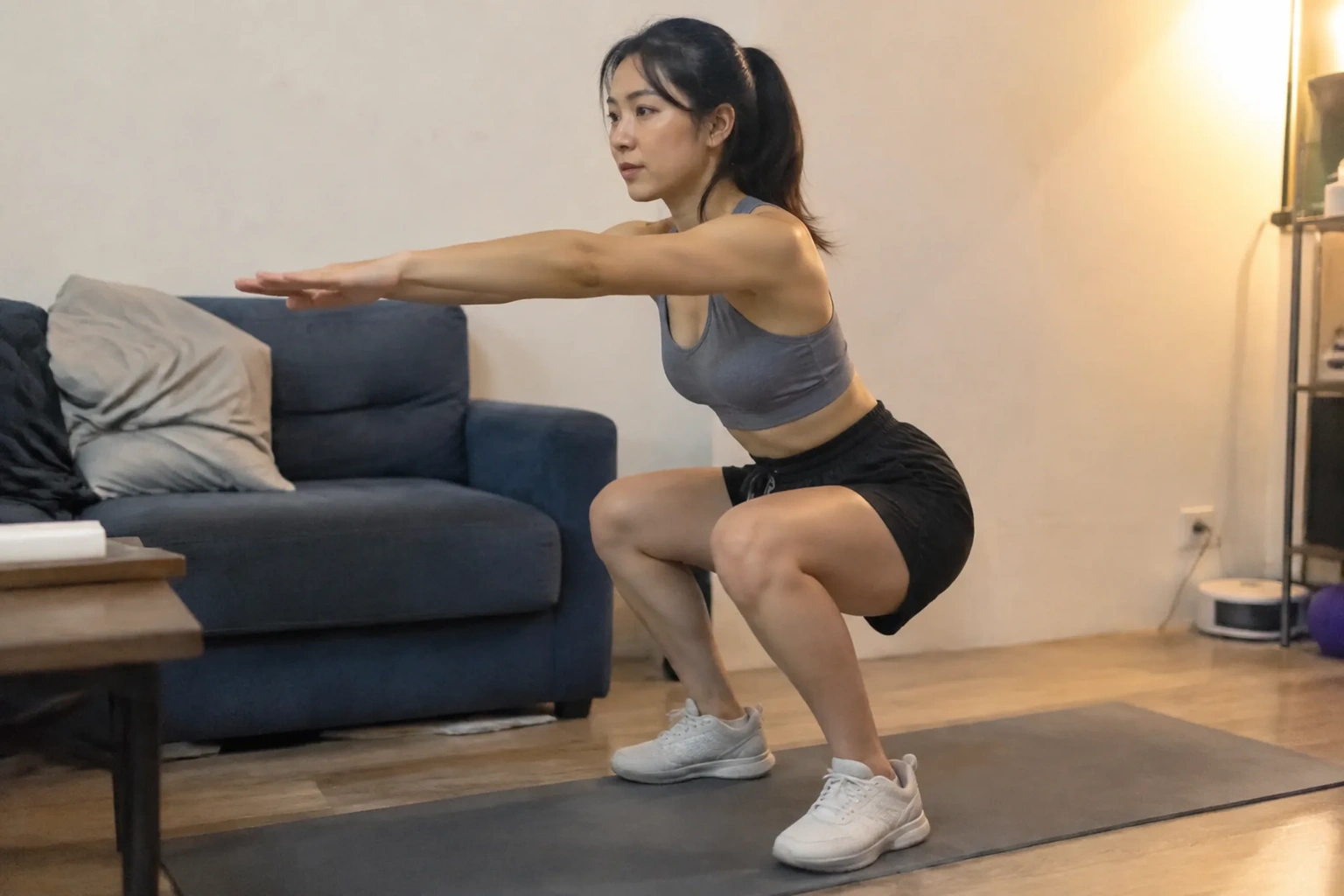
Bodyweight squats get dismissed as too easy, which is usually a sign the person doing them is moving too fast. A squat performed over three full seconds on the way down and one on the way up, with a pause at the bottom, will leave a beginner's thighs burning after ten repetitions.
The version that suits new exercisers best is the box squat: lower the hips back and down until they touch a chair seat, then stand. The chair acts as a depth gauge and a confidence prop. Most people new to squatting have lost the pattern entirely after years of sitting, and the chair gives them a target that does not require guessing where parallel is.
Heels stay flat. Knees track over the middle toes. The chest stays tall enough that the person could read a sentence written on the wall in front of them. These cues are simple, and they cover most of what goes wrong.
Glute bridges and the lower back question
Lying on the floor and lifting the hips sounds like the least athletic movement imaginable. It is also one of the most useful for anyone who sits for a living, because it trains the glutes to do work that the lower back has been quietly absorbing for years.
The setup matters. Heels close to the seat, about a hand's width away. Press through the heels, not the toes. Lift until the hips form a straight line from knee to shoulder, then stop; lifting higher arches the lower back and defeats the purpose. Two sets of ten, with a two-second squeeze at the top, is plenty for a first month.
A single-leg version, with one foot lifted off the floor, is the next progression. It is harder than it looks and exposes side-to-side weakness quickly. That asymmetry is worth knowing about, even if it is not worth fixing in the first week.
The plank held for less time than feels impressive
Planks have been oversold as a test of toughness. A two-minute plank is not a fitness milestone; it is usually a sign that the hips are sagging and the shoulders are shrugged. For a beginner, twenty seconds of a well-organized plank beats ninety seconds of a bad one.
The cues are few. Elbows under shoulders. Ribs pulled down toward the hips so the lower back does not dip. Squeeze the glutes as if holding a coin between them. Breathe. If the hips drop or the breath stops, the set is over, regardless of the clock.
An easier entry point is the plank from the knees, which reduces the lever length and the load. It is not a lesser exercise. It is the same exercise with a shorter body to hold up.
Dead hangs and the grip nobody trains
A dead hang is exactly what it sounds like: grab a pull-up bar with both hands and hang, feet off the ground, for as long as the grip holds. It requires no pulling strength, only the willingness to dangle.
For a new exerciser, the dead hang builds grip endurance and decompresses the shoulders in a way that few other movements do. Ten seconds is a reasonable start. The bar has to be reachable, which usually means a doorway pull-up bar or a low bar at a park. Hanging from a bar that requires a jump to reach is a shoulder risk worth avoiding in the first months.
The hang also reveals something useful: whether one side of the body lets go before the other. Most people find their grip fails on the same side every time. That is a data point, not a crisis.
What to skip in the first month
Burpees, jump squats, and full floor push-ups all appear on beginner lists and all deserve to be postponed. Each demands a coordination or a joint tolerance that a new exerciser has not yet built. Burpees in particular combine a squat, a plank, a push-up, and a jump into one movement, which means a beginner practicing them is mostly practicing compensation patterns.
Plyometric work, the jumping and landing kind, is best left for a body that has spent a few months learning to decelerate its own weight. The knees and ankles of a sedentary adult are not prepared for repeated impact in week one, and the soreness that follows tends to end the experiment entirely.
How a week of these movements fits together
Three sessions a week is enough. A simple structure: two sets of counter push-ups, two sets of box squats, two sets of glute bridges, and one or two short planks. Rest sixty seconds between sets. The whole session takes fifteen minutes and leaves the person tired but not wrecked.
The temptation, always, is to add more. More repetitions, more movements, more days. Beginners who add too much in the first fortnight are the ones who quit in the third week with a sore shoulder and a vague sense of failure. The body adapts to repeated, moderate stress. It does not adapt well to a sudden, enthusiastic pile-on.
Progress in these movements looks unglamorous: a counter push-up becomes a stair push-up, a box squat becomes a slow bodyweight squat, a twenty-second plank becomes forty. The changes are small enough to be missed by anyone not keeping a note. That note is worth keeping.
The soreness that arrives two days later
New exercisers are consistently surprised by delayed soreness, the ache that shows up a day or two after a session and lingers. It is normal, it fades, and it is not a sign of damage. It is also not a sign of progress; soreness tracks novelty more than it tracks adaptation.
The practical response is to move gently on the sore day rather than to rest completely or to repeat the session. A walk, some easy squats, a few wall push-ups. Blood flow helps. Heroic second sessions do not.
If soreness lasts more than four days, or if it sharpens rather than dulls, that is a signal to back off and, if it persists, to have a professional look. Most beginner soreness resolves on its own. The exception is worth respecting.
A bodyweight routine that survives a bad week
The movements above share one quality that matters more than any of their training effects: they can be done in a hotel room, a small apartment, or a living room with a coffee table pushed aside. No equipment, no commute, no membership fee. On a week when work runs late and the gym is impossible, a person can still do two sets of counter push-ups and a plank before bed.
That portability is the real argument for bodyweight training as a starting point. Consistency is the hardest part of beginning, and the movements that survive a bad week are the ones that get done. The person who trains three times a week for six months with counter push-ups and box squats will be stronger, more mobile, and more confident than the person who bought a rack and used it twice.
The floor push-up will come. It usually takes six to ten weeks of consistent incline work before a full repetition feels controlled rather than desperate. When it does arrive, it will be a single clean rep, and it will feel like something earned. The wall, the counter, and the chair will have done their quiet work by then.





















