







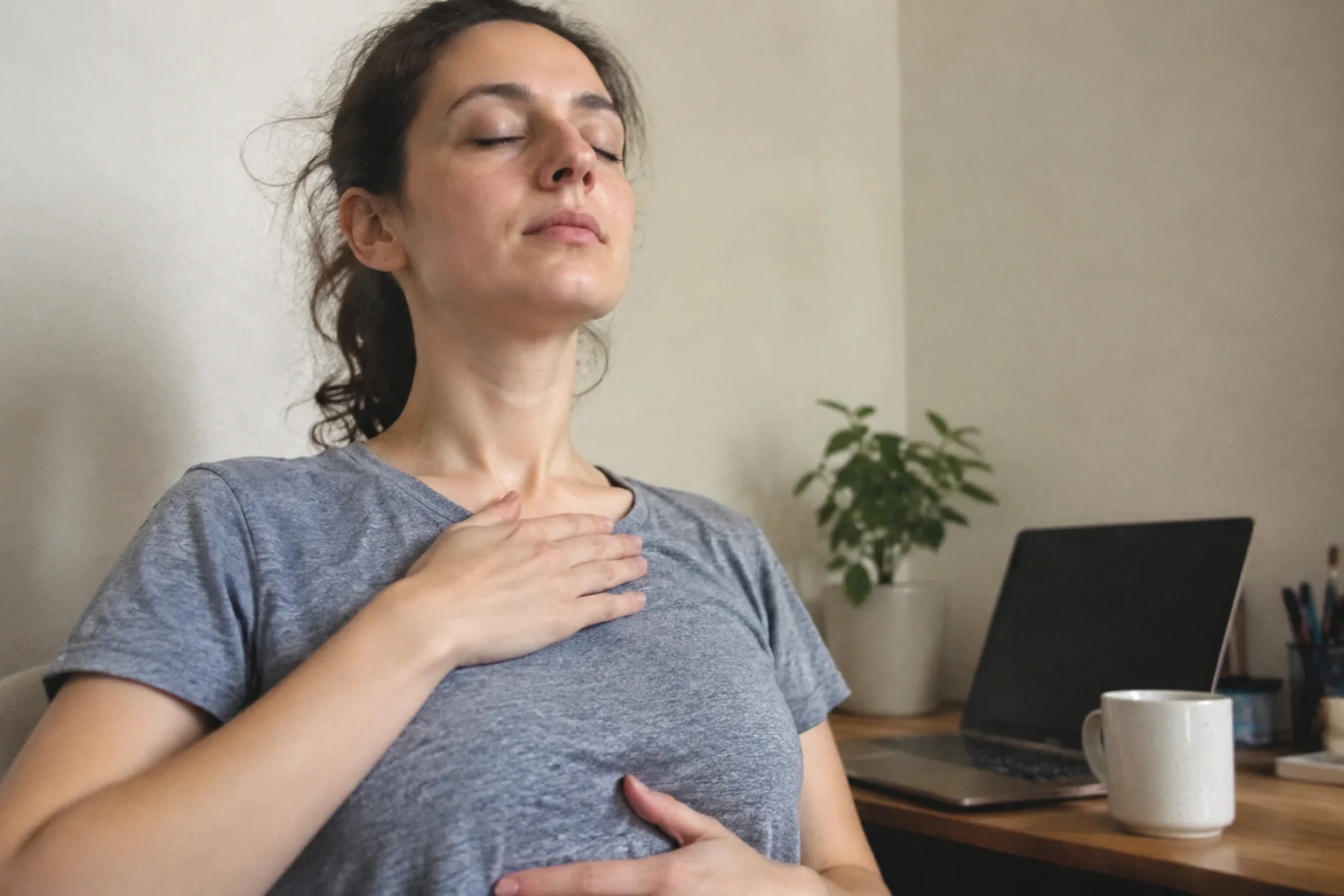
The average adult breathes somewhere between 12 and 20 times a minute without thinking about it. Across a 16-hour waking day, that is roughly 15,000 to 20,000 breaths, almost none of them noticed. A person can go weeks without food and days without water, but the count for air runs in minutes. And yet the one physical process that keeps everything else running is the one almost nobody practices.
Breathing exercises carry a reputation problem. They get filed under wellness, alongside cold plunges and mushroom powders, which means the people who would benefit most from them, the ones with back-to-back meetings and a phone that will not stop buzzing, tend to skip them. That is a mistake worth correcting, because the useful breathing work is not mystical. It is closer to stretching: small, boring, physical, and effective within about ninety seconds.
What Slow Breathing Actually Changes
The physiology is well established and modest. When a person breathes slowly, particularly with a longer exhale than inhale, heart rate tends to drop and the nervous system shifts toward a calmer state. This is the parasympathetic side of the autonomic system, the branch that handles rest and digestion. It is not a cure for anything. It is a dial, and slow breathing nudges the dial.
The practical upshot is that a few minutes of deliberate breathing can lower the physical feeling of agitation before a difficult conversation, a presentation, or a dentist's appointment. It will not fix the underlying problem. It will make the next ten minutes more workable. For busy days, that is usually enough.
One caution worth stating plainly: people with certain heart or lung conditions, or those prone to panic attacks, should treat intense breath-holding exercises with care and check with a doctor first. The exercises below are gentle, but a person who feels dizzy should stop and return to normal breathing.
The Four-Count Exhale for a Desk That Never Goes Quiet
Start with the simplest exercise, because simple is what survives a busy day. Sit as is. No cushion, no crossed legs, no app. Inhale through the nose for a count of four. Exhale through the nose or mouth for a count of six. Repeat for ten breaths. That is it.
The count matters less than the ratio. The exhale should be longer than the inhale, and the breath should be quiet enough that a person at the next desk cannot hear it. Ten breaths take roughly a minute and a half. A minute and a half is a meeting running long, an elevator ride, a kettle boiling.
The mistake most people make is trying to breathe deeply. Deep breathing often means breathing big, and big breaths through the mouth can leave a person lightheaded. The target is slow and low, air moving into the belly rather than the chest. A hand on the lower ribs helps: if the hand rises, the breath is landing in the right place.
Box Breathing in the Two Minutes Before a Hard Call
Box breathing has a clean structure that suits the moments before something stressful. Inhale for four counts. Hold for four. Exhale for four. Hold for four. Repeat four to six times. The evenness of the counts is the point; it gives the mind a small task to occupy itself with while the body settles.
This is the exercise Navy SEALs have popularized, and the reason it travels well is that it can be done in a hallway, a parked car, or a bathroom stall without anyone noticing. The holds are short enough that most people tolerate them fine. A person who has never held a breath deliberately should start with a two-count hold and build up.
There is a specific use case worth naming. The two minutes before a phone call that has been dreaded all morning. Box breathing will not make the call go well. It will keep the voice steady and the hands still, which is often the difference between a competent conversation and a shaky one.
Alternate Nostril Breathing and the Commute
Alternate nostril breathing is older than any wellness trend, rooted in yogic practice, and it has one advantage over the other exercises: it requires both hands, which means it cannot be done while scrolling a phone. That enforced pause is half the benefit.
The mechanics are simple. Close the right nostril with the thumb, inhale through the left. Close the left nostril with the ring finger, release the right, exhale. Inhale through the right, close it, exhale through the left. That is one round. Five or six rounds is plenty.
Traffic lights make a natural timer. A red light lasts long enough for two or three rounds. A person who does this at every red light on a twenty-minute drive will arrive with a measurably different nervous system than the one who spent the drive rehearsing arguments. The exercise does not shorten the commute. It changes who shows up at the end of it.
Why Belly Breathing Fails on the First Try
Most adults breathe into their chests, using the muscles of the neck and upper ribs. This is shallow breathing, and it is what stress teaches. Belly breathing, where the diaphragm does the work and the belly moves outward, is what infants do naturally and what most adults have to relearn.
The first attempt usually fails because the person tries too hard. Lying flat on the floor with one hand on the belly and one on the chest is the classic reset. The goal is for the belly hand to move and the chest hand to stay mostly still. It feels strange for a week, then it feels obvious.
This is the foundation exercise. The others build on it. A person who cannot get air into the belly will struggle to make any of the counting exercises feel natural, because the breath will keep catching high in the chest. Ten slow belly breaths in bed before sleep is the lowest-effort place to start, since the body is already horizontal and the mind is already winding down.
The Physiological Sigh for When the Chest Tightens
Some moments do not allow for counting to four. A sudden spike of anger in a meeting. A near-miss on the highway. A message that lands badly. For these, there is the physiological sigh, which is the fastest of the exercises and the least dignified-looking, which is why it is best done turned away from an audience.
The technique: two inhales through the nose, the second a short top-up breath on top of the first, then a long slow exhale through the mouth. Two or three of these will bring the heart rate down within seconds. The double inhale reinflates the tiny air sacs in the lungs and the long exhale does the calming work.
This one earns its place because it can be done mid-sentence, mid-stride, mid-anything. It is the emergency brake. The other exercises are maintenance; this one is roadside repair.
Anchoring the Practice to Something Already Happening
The single biggest reason breathing exercises fail is that they live in a separate compartment labeled "wellness," which is the compartment a busy person never opens. The fix is to attach the exercise to something that is already happening, so it rides along on an existing habit.
Some reliable anchors: the first red light of the morning commute. The moment the laptop lid closes at the end of the day. The ninety seconds after the coffee maker starts. The walk from the parking lot to the office door. Each of these is a doorway that is already there, and the breathing exercise just walks through it.
This is why the counting exercises beat the apps. An app is a separate destination, and separate destinations get skipped. A red light is not optional. A coffee maker is not optional. The breathing attaches to the thing that cannot be avoided.
What a Month of Ten-Breath Days Does and Does Not Do
The honest expectation after a month of doing ten slow breaths a day, anchored to a red light or a coffee maker, is small and real. The person is not transformed. The person notices, on some afternoon, that the shoulders are not up around the ears, and that the jaw is not clenched, and that the inbox has not been checked in twenty minutes without a spike of panic.
What the practice does not do is replace sleep, exercise, or a doctor's visit. It does not dissolve anxiety disorders or fix a bad job. It is one small lever among many, and it works best when treated as unremarkable, the way a person treats washing hands or stretching after sitting.
The metric worth watching is not the number of breaths. It is the number of times a person catches themselves mid-pattern, notices the chest is tight, and chooses the long exhale instead of the sharp reply. That choice, repeated across a month of ordinary days, is the whole point. The breathing is not the destination. The pause it creates is.





















