







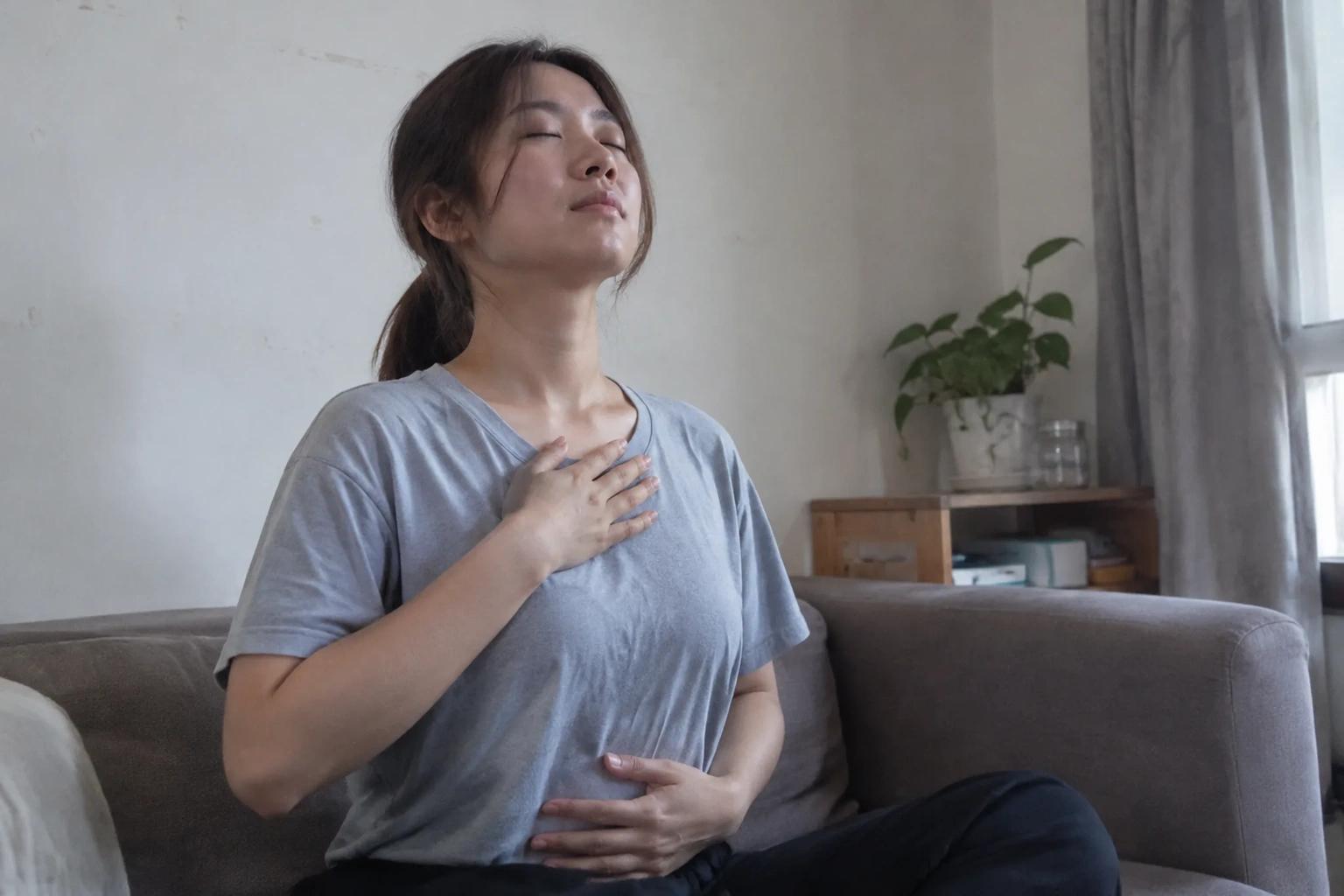
A phone timer set for four minutes, a chair, and a closed door. That is the entire apparatus of the most common breathing exercise sold to busy people, and it costs nothing except the willingness to sit still while the mind protests. Meditation, by contrast, has accumulated centuries of ceremony, dozens of competing schools, and a small industry of apps charging monthly fees for guided sessions. The two practices get lumped together constantly, recommended in the same wellness articles, prescribed by the same tired advice to "just breathe." They are not the same tool, and the difference matters enormously for anyone trying to fit either one into an ordinary Tuesday.
What a breathing exercise actually asks of the body
Breathing exercises are mechanical. They give the nervous system a task with a shape: inhale for a count, hold, exhale longer, repeat. Box breathing runs four counts in, four hold, four out, four hold. The physiological sigh doubles the inhale and stretches the exhale. Alternate-nostril breathing plugs one side and then the other. Each variant has a rhythm, and the rhythm is the point.
The body responds to that rhythm with unusual speed. A slow exhale tends to nudge the heart rate down and loosen the grip of the stress response, a general effect most people can feel within a minute or two of steady practice. Nobody needs to believe in anything for a long exhale to work. That is the appeal. A person can be skeptical, annoyed, and mid-argument, and the breathing still does its quiet work.
This is also why breathing exercises are so easy to teach. A firefighter can learn box breathing in a stairwell. A nurse can run a physiological sigh between patients. No philosophy attaches to the technique, no commitment to a worldview, no cushion required.
Meditation asks the mind to do something harder
Meditation uses breath too, often as an anchor, but the assignment is different. The practitioner sits with whatever arrives, notices it, and returns attention to the anchor without judgment. Sounds intrude. A grocery list surfaces. The knee aches. The work is the returning, done over and over, for twenty minutes or forty.
That returning is a skill, and like most skills it starts badly. Early sessions feel like failure: the mind wanders constantly, the timer seems frozen, and the whole exercise produces more frustration than calm. Teachers warn about this, and the warning helps, but the first month of meditation is genuinely unpleasant for many people. It is training, and training has a cost.
The payoff people describe, when it comes, is a looser relationship with their own thoughts. A person who has practiced for a year still gets angry, still worries, still lies awake occasionally. The difference is a small gap between the feeling and the reaction, a fraction of a second in which a choice becomes possible. That gap is the whole prize, and it takes months to appear.
The clock decides more than the technique
Practical fit comes down to minutes and circumstances far more than to spiritual preference. A breathing exercise can run in ninety seconds and still register. Four minutes is generous. It survives interruption, works in a parked car, and never requires a quiet room, which is why it slots into the gaps of a crowded day so easily.
Meditation wants a longer, protected block. Ten minutes is a starter dose; twenty is the common baseline. The session also demands a certain kind of attention that a person cannot fake: sitting down distracted and checking the timer every thirty seconds defeats the exercise. The mind has to be willing to stay put, and willingness is not always available at 6:40 in the morning before a school run.
A useful test: count the number of moments in a normal weekday when a person can close a door and be unreachable for ten minutes. If the answer is zero, meditation is a weekend practice at best, and breathing exercises are the realistic daily option. If the answer is two or three, both are on the table.
Breathing handles the acute spike; meditation handles the slow drift
The two tools target different timescales, and mixing them up produces disappointment. Breathing is a fire extinguisher. It works on the surge, the moment before a difficult conversation, the jolt of a bad email, the 3 a.m. wake-up with a racing pulse. Sixty seconds of a long, slow exhale can pull a person back from the edge of a spiral. Nothing else in the toolkit acts that fast.
Meditation addresses the baseline. It slowly reshapes how a person relates to stress over weeks and months, lowering the frequency of those spikes and softening their intensity. The effect is invisible day to day and obvious in retrospect, the way a year of walking to work shows up in a flight of stairs.
Someone who wants to stop yelling at their kids during the evening rush will get more from a breathing exercise deployed in the moment than from a meditation practice that never quite reaches the kitchen. Someone who wants to feel less chronically wound up across an entire season needs the slower work, and a breathing exercise alone will not deliver it.
A hybrid that most people stumble into
In practice, the two overlap more than the marketing suggests. Long exhales appear inside meditation instructions. Many guided meditations begin with three slow breaths to settle the body before the real work starts. A person who practices breathing exercises daily often notices, after a few weeks, that the pauses between breaths have grown longer and that sitting still no longer feels quite so intolerable. The on-ramp to meditation frequently runs through breathwork.
The reverse also happens. Experienced meditators report that their practice has made them better at catching a stress response early, which means the breathing exercise gets deployed sooner, before the spike fully forms. The two skills reinforce each other in a way that neither sales pitch mentions.
When the breath itself becomes the obstacle
One caution belongs here, stated plainly and without alarm. For a minority of people, focused attention on the breath produces the opposite of calm: dizziness, tightness, a sense of panic, or a feeling of being disconnected from the body. This reaction is real and reasonably well documented in meditation communities, and it tends to surprise people who were told breathing was universally safe.
The usual advice applies: stop, open the eyes, and return attention to something external. People with a history of panic attacks or trauma may find that breath focus triggers rather than soothes, and a different anchor, such as the soles of the feet or the sounds in the room, often works better. This is a reason to treat both practices as experiments rather than prescriptions.
The entry cost of each practice, in real terms
Breathing exercises cost almost nothing to learn. A single clear description of box breathing, read once, is enough to start. The skill ceiling is low, which is a feature: there is not much to get wrong. Progress is immediate and legible, felt in the body within a session or two.
Meditation has a much steeper entry. Learning to sit without fidgeting through the first ten minutes takes weeks. Guidance helps, whether from an app, a teacher, or a book, and the guidance costs either money or patience. The payoff curve is flat for a long stretch before it bends upward, which is why so many people quit in month two and conclude they are bad at it.
Neither cost is a reason to avoid the practice. The point is to match the entry cost to the available commitment. A person with ninety seconds and no teacher gets a real benefit from breathwork. A person with twenty minutes and a stubborn streak gets a much larger one from meditation, eventually.
A concrete way to split the week
The most workable arrangement for a busy adult looks unglamorous. One breathing exercise, chosen and fixed, deployed whenever the pulse jumps: before a meeting, after a difficult call, in the car before walking into the house. Four minutes, no app, no cushion. That handles the acute spikes.
Then a short meditation block on the days that allow it, ten minutes on a Tuesday and a Thursday, twenty on a Sunday morning. The consistency matters more than the length. A person who sits for ten minutes twice a week for six months will notice the gap between feeling and reaction widening, slowly, in a way that is easy to miss and hard to fake.
The split is not a compromise. It reflects the actual architecture of the two practices: one built for speed, one built for depth. The person who insists on meditation alone will white-knuckle the spikes, and the person who insists on breathing alone will wonder why the underlying tension never lifts. Both tools, used where each one works, cover the whole day rather than half of it.
The morning that reveals the answer
Picture a specific morning: alarm at 6:15, a child who refuses socks, a laptop that will not connect, a calendar already running late by 8:30. There is no twenty-minute window in that morning. There is a ninety-second window in the bathroom with the door locked, and that window belongs to the breathing exercise.
Now picture the same person on a Saturday, coffee gone cold, house quiet, a full thirty minutes before anyone needs anything. That window belongs to sitting practice, and it is the only window of the week shaped like it. The honest answer to which practice fits the day is that most days contain only the first window, and the second window has to be built deliberately, protected, and defended against the hundred small things that will try to fill it.
Choose the tool the day can actually hold. A four-minute breath in a locked bathroom beats a twenty-minute meditation that never happens, and a Saturday sit that does happen beats both. The person who manages one of each, week after week, ends up with something neither practice delivers alone: a fast response for the spike and a slow change underneath it, built out of the minutes the day was willing to give.





















