







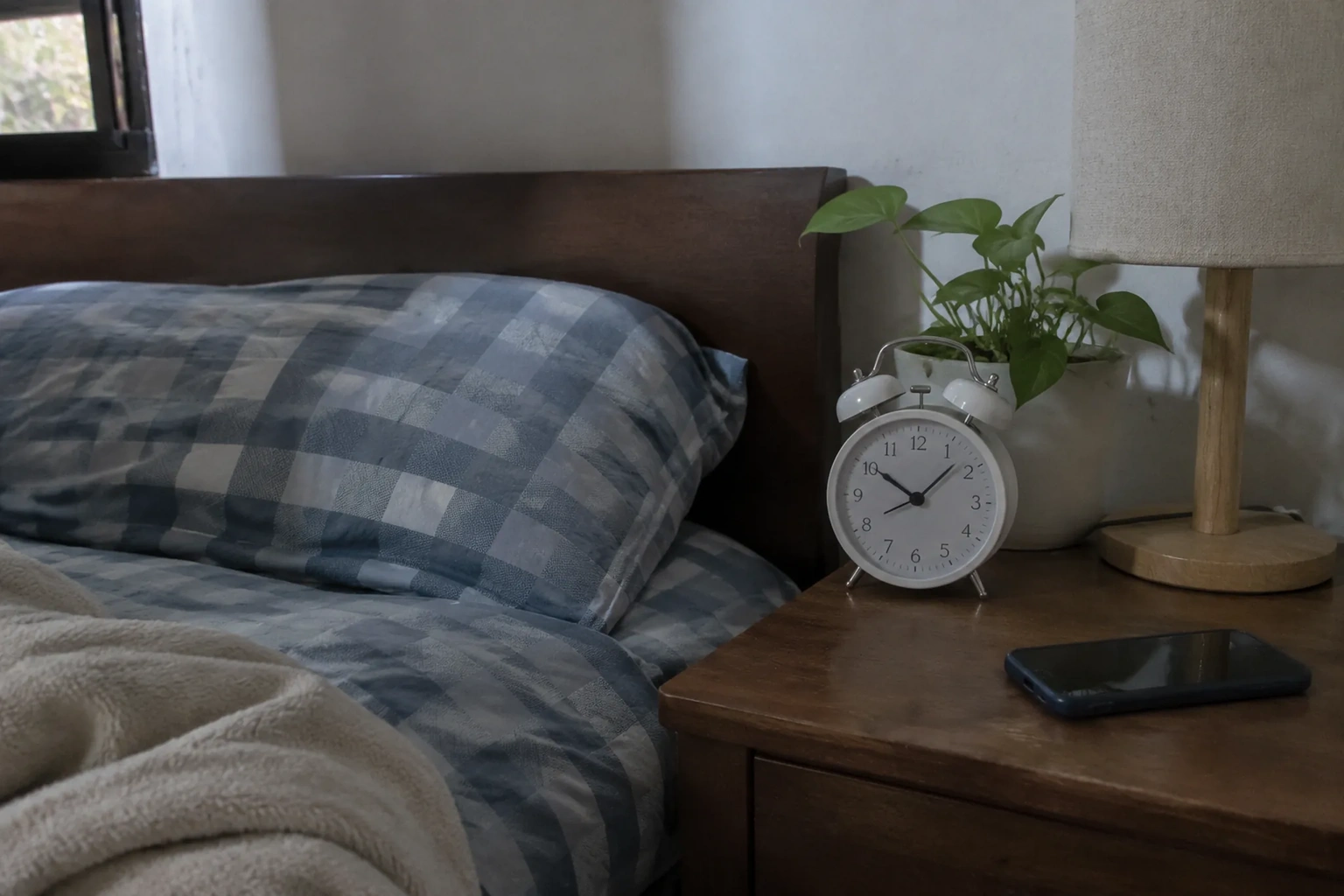
Mattresses are where the money goes. Walk into any bedding store and the sales floor is a wall of them, queen after queen, some priced like a used car. The sheets and pillows and lamps get pushed to the back. That ordering is backwards. A person can sleep well on a cheap mattress and sleep badly on a good one, because the mattress is only one part of a system that also includes light, temperature, texture, and sound. The parts of that system that cost the least get the least attention, which is convenient if the goal is better rest on a small budget.
What follows is not a shopping list. It is a tour of the cheap variables.
The bed is a network of small surfaces
Start with the sheet against a person's skin, which is the only surface the body actually touches for eight hours. Most people buy sheets by thread count, a number printed in large type on packaging and almost entirely meaningless. Thread count can be inflated by counting every ply of a multi-ply yarn, so a 600-count sheet may be made of coarser thread than a 300-count one. The number that matters more is the feel of the weave: percale, which is crisp and matte, versus sateen, which is smooth and slightly shiny and holds heat. A cotton percale sheet set in a simple solid color can be found for the price of a dinner out, and it will change the feel of a bed more than a new pillowcase pattern ever could.
Then the pillow. Pillows fail gradually, and the failure is easy to miss because a person sleeps on the same sagging pillow for years without noticing the slow collapse. A cheap fix is to fold a bath towel into a firm rectangle and slide it under the pillowcase as a booster, which raises the head and fills the hollow where a shoulder digs in. A better fix is a new pillow, but the point is that a pillow does not need to be expensive to work. A flat, firm pillow and a thin one used together often beats one thick pillow, because the stack can be adjusted.
Darkness is a cheap upgrade
The single most underrated sleep aid costs almost nothing and hangs over the window. Light is a powerful signal to the body, and the eyelids are thin; a street lamp or an early summer sunrise can reach the retina and nudge the brain toward wakefulness before the alarm. Blackout curtains are sold as a premium product, but a pair of cheap blackout panels, or even a dark sheet hung behind a regular curtain, cuts a surprising amount of light. The curtains do not need to match the room. They need to reach past the window edges and overlap in the middle.
Smaller lights matter too. The little standby glow from a router, a television, a charging cable, a smoke detector: each is dim, and together they add up to a room that is never truly dark. A strip of electrical tape over the brightest ones takes two minutes. A folded cloth over a clock radio does the same job. The effect is not dramatic on the first night. It becomes noticeable after a week, when the body stops getting a faint early-morning signal from the corner of the room.
The warmth problem is usually a bedding problem
Overheating is one of the most common reasons people wake in the middle of the night, and the fix is rarely a new air conditioner. It is usually a question of layers. A heavy duvet traps heat; a lighter quilt or a couple of thin blankets lets a person adjust through the night without waking fully. The trick is to build the bed so it can be shed in stages: a sheet, a light blanket, a heavier layer on top, each easy to kick off at two in the morning. A person who sleeps hot can keep a lighter top layer and a warmer one folded at the foot of the bed.
Fabric matters here as much as weight. Synthetic fills and polyester sheets hold warmth and moisture close to the body. Cotton and linen breathe. A cheap cotton quilt from a discount store will often sleep cooler than a costly down comforter, because the down traps more heat against the skin. The goal is not to be cold. It is to stay near the temperature where the body stops sweating and stops shivering.
A cheap white-noise machine is a cheap fan
Sound is the other sense that keeps a person awake, and the market answer is a dedicated white-noise device or a phone app. The cheaper answer is a small fan, which does the same job and moves air at the same time. The steady hum of a fan covers the irregular sounds that actually wake people: a car door, a dog, a neighbor's television, a partner's phone buzzing on a nightstand. Irregular noise is what jolts the brain; a constant low wash of sound smooths the spikes.
The fan does not need to point at the bed. Aimed at a wall or a corner, it still fills the room with a soft, even noise. A cheap box fan on its lowest setting is often too loud; a small desk fan or a tower fan on low is closer to the right level. Earbuds and earplugs work too, but they press on the ear and can fall out, and a fan has the advantage of being something a person does not have to manage in the dark.
The bedside table is a sleep tool
Most bedrooms have a nightstand cluttered with charging cables, a half-full glass, a stack of books, and a phone face-up. The phone is the problem. A screen glowing at close range late at night is a bright light source and a source of low-grade alertness, and putting it face-down on a nightstand still leaves it within arm's reach. The cheap upgrade is a small, boring clock, the kind with red digits, and a charging spot across the room. The clock gives the time without a feed attached to it.
There is a second, less obvious tool on the nightstand: a small notebook and a pen. Racing thoughts are a common reason people lie awake, and writing them down, even badly, in the dark, moves them out of the head and onto paper. A person does not need to solve anything at midnight. The act of recording a worry is often enough to let the mind set it down for the night.
The pillowcase and the wash cycle
Clean bedding is a sleep upgrade that costs only the price of detergent and a load of laundry. Pillowcases collect oil and skin cells and dust, and a stuffy nose at night is often a sign that the case has gone too long between washes. Washing sheets and pillowcases once a week, in hot water, is a cheap habit with a real effect on how a bed feels and smells. Two sets of sheets make it easy: strip one, put the other on, wash the first when convenient.
The same logic applies to the pillow itself. Pillows can often be washed, at least the synthetic kind, and a pillow that has been through the machine comes out fuller and fresher. Check the care tag first. A pillow that cannot be washed can be aired in the sun, which does less but is better than nothing.
A routine is the cheapest upgrade of all
None of the objects above matter much without a schedule that gives the body a cue. The body runs on rhythm, and a consistent bedtime and wake time, even on weekends, does more than most products on the market. The cheap version of a sleep routine is a short, fixed sequence: dim the lights an hour before bed, put the phone away, read something on paper, turn off the fan last. The sequence itself becomes the signal. After a couple of weeks, the body starts to expect sleep at that point in the evening, the way it expects lunch at noon.
The budget angle here is real. A person can spend a great deal on a mattress and still lie awake, because the mattress is not the whole system. The cheap variables, the sheet, the pillow, the dark window, the fan, the notebook, the routine, are the ones that can be changed this week for the price of a few groceries. The mattress can wait.
One last cheap thing: the temperature of the room. A bedroom kept a few degrees cooler than the rest of the house helps the body drop into sleep, and the cost of turning down a thermostat is often less than the cost of a new duvet. A person who wakes too hot at night can test the theory by opening a window for one week and seeing what happens. The body gives its answer quickly, and the answer usually costs nothing.





















