







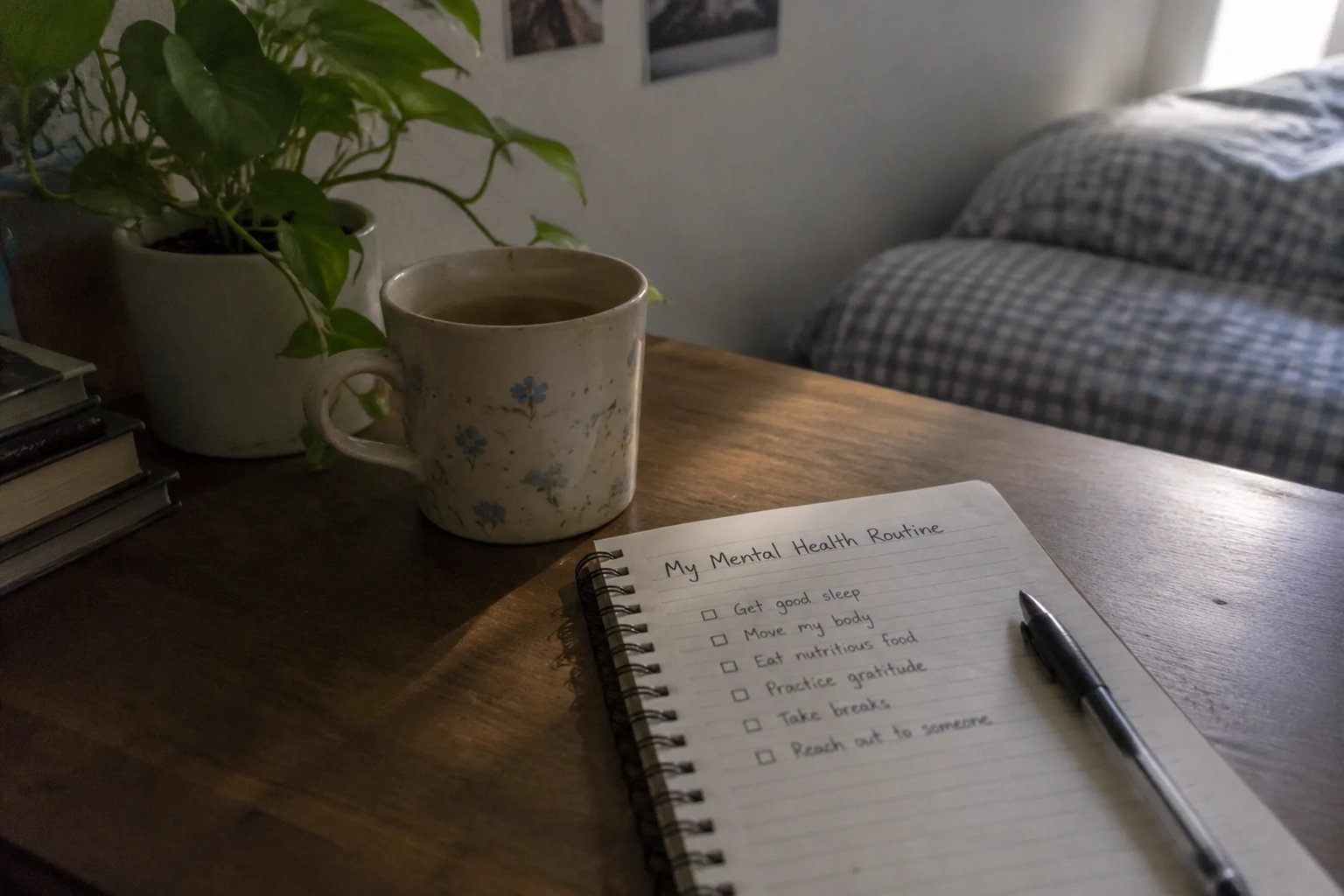
The most common piece of mental health advice is also the least useful: build a routine. It arrives without instructions, as if the word itself were the method. A routine for what, on what days, at what hour, and what happens on the Wednesday when the whole thing collapses? The advice rarely says, which is why so many people build a beautiful schedule in January and abandon it by the first week of February.
A routine that survives contact with a bad week looks different from the one sketched in a notebook during a good mood. It is smaller, less symmetrical, and built around the days a person actually has rather than the days they wish they had. The work of keeping it is mostly the work of deciding what counts as a minimum, and accepting that the minimum is allowed to be almost embarrassingly small.
What follows is not a program. It is a set of observations about why mental health routines fail and what tends to hold when the rest falls away.
The January schedule is a fantasy of an uninterrupted life
Most routines are designed for a week with no surprises in it. The plan assumes the alarm goes off, the commute is ordinary, the mood holds, and the evening has an empty hour in it. That week exists maybe four times a year.
A plan built for the best case shatters on the first bad day, and the shattering gets read as personal failure. The person concludes they lack discipline when the real problem is that the plan was never designed to absorb disruption. A schedule with no slack in it is not a routine. It is a performance, and it is graded harshly.
The fix is structural rather than moral. Any routine worth keeping needs an explicit answer to the question: what is the version of this that happens on a terrible day? If there is no answer, the routine has no floor to stand on.
Motivation arrives after movement, not before it
A widespread assumption holds that the sequence runs: feel better, then do the thing. In practice the order tends to reverse. A short walk taken while feeling flat often produces a slightly better afternoon, and the improvement is what makes the second walk possible. Waiting for the mood to arrive first is a reliable way to wait a long time.
This matters for routine design because it means the barrier to entry has to be absurdly low. A ten-minute walk counts. Two minutes of standing outside counts. The point of the small version is not that it is impressive but that it is startable on a day when nothing else is.
Once a person has done the small version several times, the larger version becomes available. The small version is the door. People quit routines because they try to enter through the wall.
Habit stacking works because it borrows an existing trigger
New behaviors need a cue, and most people try to supply the cue from willpower. Willpower is an unreliable alarm clock. A more durable approach attaches the new behavior to something that already happens without fail: the coffee, the commute, the walk to the mailbox, the moment after brushing teeth.
The formula is dull and effective. After the coffee is poured, two minutes of quiet. After the workday ends, a lap around the block before touching the phone. The existing habit does the remembering, and the new behavior rides along on it.
This is why routines built around fixed anchors tend to survive and routines built around intentions tend to evaporate. The anchor does not care about mood. It shows up on the bad days, which is precisely when the routine needs to show up too.
Three categories cover most of what a mental health routine is actually for
The phrase covers a wide range of practices, and the vagueness is part of why people flounder. Most of the useful content falls into three buckets.
First, regulation: the things that bring the nervous system down a notch. A few minutes of slow breathing, a walk, time outside, a shower, stretching. These are short, physical, and repeatable. They do not solve problems. They change the state a person is in while facing the problem.
Second, connection: contact with another person, however small. A text, a call, a shared meal. Loneliness is a slow corrosive, and a routine that includes a regular point of contact with someone else does quiet, cumulative work.
Third, processing: the practices that let a person make sense of what is happening. Journaling, therapy, a conversation with a friend who listens well, a few minutes of reflection at the end of the day. This bucket is the one people skip when they are busy, and it is the one that keeps the other two from becoming pure management.
A routine that has something from each category, even in miniature, is doing real work. A routine that has only regulation is a coping strategy. A routine that has only processing is a lot of thinking with no relief. The three need each other.
A routine with no slack is a second job
There is a failure mode that looks like success: the routine so complete, so scheduled, and so demanding that maintaining it becomes its own source of stress. The person who meditates for thirty minutes, journals for twenty, exercises for an hour, and reads before bed has built a structure that requires a very good day to complete. The first interruption produces guilt, and guilt is a poor foundation for anything.
The alternative is to design the routine at roughly sixty percent of capacity. That leaves room for the days when energy is low, the schedule is crowded, or the mood has gone sideways. A routine that fits the average day will be kept. A routine that fits the ideal day will be admired and then abandoned.
The minimum version is the routine, and the full version is the bonus
This is the single most useful reframe available. Most people treat the full routine as the standard and the reduced version as a failure. The order should be reversed. The minimum version is the actual commitment, and the larger version is what happens when conditions allow.
A minimum for a daily walk might be putting shoes on and going to the end of the block. A minimum for journaling might be one sentence. A minimum for connection might be a single message. The minimum is not a lesser version of the routine. It is the routine, and it is what gets done on the days that matter most.
This reframe removes the all-or-nothing trap. The day is not a pass or a fail. The day is either the full version, the minimum version, or a rest day, and all three are legitimate parts of a routine that is meant to last years rather than weeks.
Tracking should be forgiving, or it should not happen
Many people add a tracking system and watch the routine die within a fortnight. A grid of checkmarks is satisfying for about ten days. Then a missed day appears, the streak breaks, and the whole apparatus starts to feel like evidence of failure. The tracker becomes an accuser.
If tracking helps, keep it simple and make it about pattern over months rather than perfection over days. A note at the end of each week about what happened is often more useful than a daily checkbox, because it captures context: the routine slipped because of a work deadline, or held because the walk moved to the morning. The context is the useful part. The streak is not.
The routine has to be rebuilt, and that is normal
People tend to treat a lapse as proof that the routine was never real. In practice, routines fall apart regularly. A move, an illness, a new job, a hard month, and the structure that worked in March is gone by June. The skill worth developing is not the ability to never lapse. It is the ability to restart without drama.
Restarting well means going back to the minimum version, not the full one. It means picking the one anchor that is easiest to restore and letting the rest wait. A person who can rebuild a routine in a few days, without a period of self-recrimination, has something more durable than a perfect streak. They have a practice that survives change.
Sleep is the foundation that most routines ignore
A mental health routine built on top of chronic sleep debt is a house on sand. Mood regulation, patience, and the capacity to do any of the practices described above all depend on a nervous system that has rested. A consistent wake time, even on weekends, does more for most people than any single journaling practice.
This is unglamorous and easy to skip because sleep feels like the absence of effort rather than a practice. It is a practice. Protecting a wake time, dimming the evening, and keeping the phone out of the last twenty minutes before bed are routine behaviors in the most literal sense, and they make every other part of the routine easier to sustain.
A routine that lasts a year is made of practices small enough to be boring
Look at what a durable routine actually contains and it is almost never impressive. A short walk most mornings. A few minutes of quiet with coffee. A weekly call with a friend. One sentence in a notebook at night. A consistent wake time. None of these would make a compelling story, and together they quietly change the texture of a year.
The temptation is always toward the dramatic version, because the dramatic version feels like it is doing something. The small version feels like it is doing nothing, which is why people abandon it before it has a chance to work. The small version is doing the work. It is just doing it slowly, in the background, on the days when nobody is watching and nothing feels like progress.
A person who has kept a modest routine for a year has not done anything remarkable on any single day. They have done something remarkable across three hundred and sixty-five of them. The routine was never the point. The point was becoming someone who could be relied on by themselves, quietly, on the ordinary Tuesdays as much as the good ones.





















