







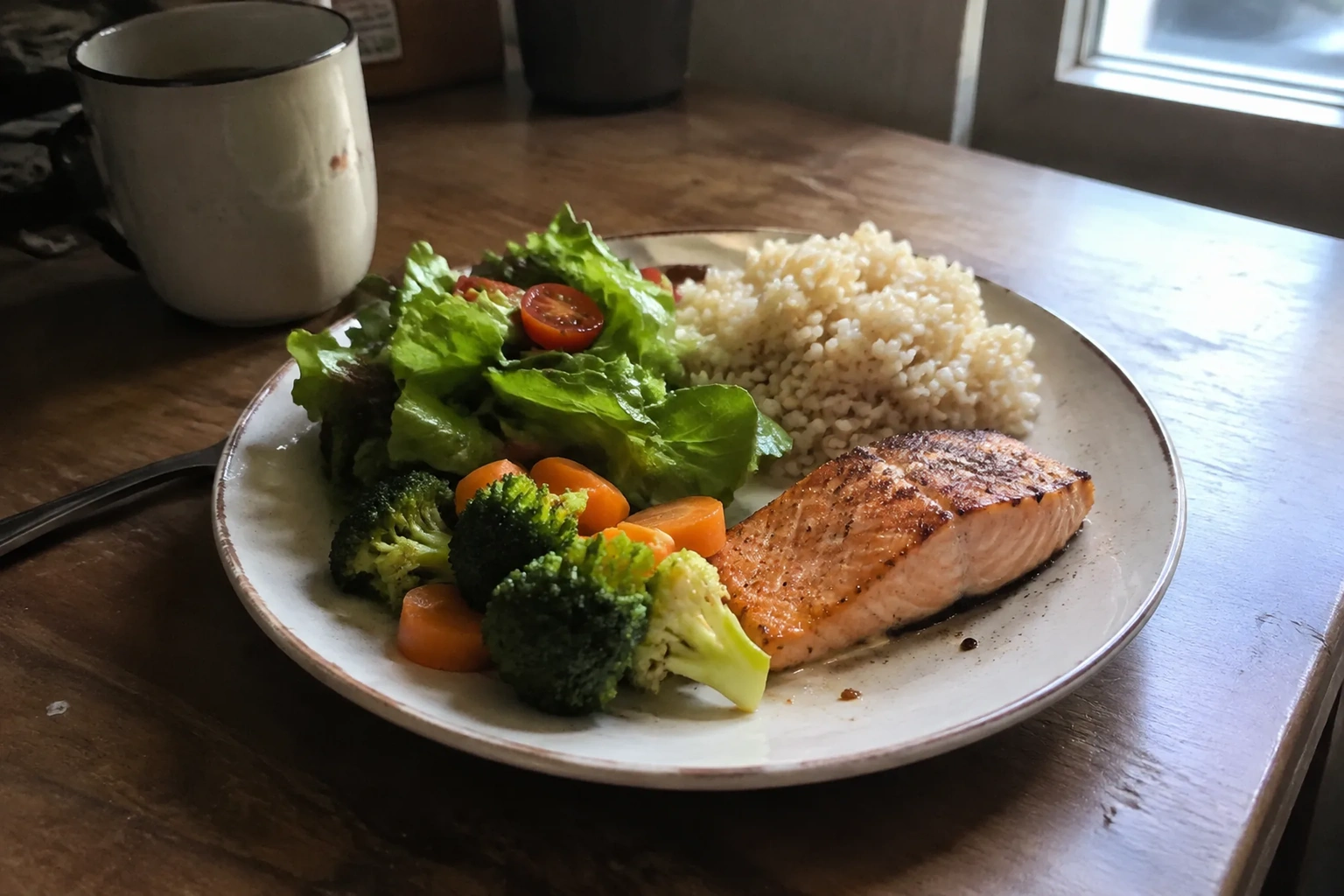
A dinner plate has one job, and it is not to look good on a shelf. It has to carry food from the table to the mouth without the food sliding off, without the rim crowding the fork, and without the whole arrangement feeling like a physics problem. Most plates sold today are designed for photographs. A smaller number are designed for eating. The gap between those two categories is where most gut trouble at the table quietly begins.
The phrase "works with your gut" gets used loosely. It usually means food that digests easily. But the plate itself is part of the equation, and almost nobody treats it that way. Portion geometry, rim depth, surface texture, and the order in which food sits on the ceramic all shape how fast a meal is eaten, how much is eaten, and how the stomach feels an hour later. A plate that fights the eater produces a rushed, messy meal. A plate that cooperates produces a slower one. That difference is not decorative.
The diameter problem nobody mentions at the registry
Dinner plates have grown. A standard mid-century dinner plate measured around 9 to 10 inches across. The current default in most big-box sets runs 10.5 to 11.5 inches, and the "charger" style pushes past 12. The change happened gradually, driven by restaurant plating and the visual logic of a full table setting, and it went largely unremarked because a bigger plate looks generous.
It also changes how much food lands on it. A larger surface invites a larger serving, and the eye calibrates fullness against the rim rather than against hunger. A person serving onto an 11-inch plate will typically mound more food than the same person serving onto a 9-inch plate, and will feel less satisfied doing it, because the plate still looks underfilled. The gut registers the consequence hours later.
For anyone managing digestion, the practical move is a smaller dinner plate than the set suggests. Nine to ten inches is enough for a full meal. The plate should look crowded when the meal is properly portioned. That mild visual crowding is a feature.
Rim width decides how the fork travels
A wide rim steals real estate from the well. On a plate with a 2.5-inch rim, the actual eating surface on an 11-inch plate is only about 6 inches across, which is smaller than a salad plate. Food stacks against the rim, the fork scrapes the curve, and the last third of the meal becomes an exercise in chasing peas.
A narrow rim, an inch or less, keeps the well broad and the eating surface flat. The plate still has a border, but the border does not intrude. This matters more than most buyers expect, because a wide rim looks elegant in a store and turns hostile at the table. The hand holding the fork has to work around geometry that was never designed for it.
There is a secondary effect. Plates with wide rims tend to have shallower wells, because the rim consumes the depth. Food spreads thin, cools faster, and dries at the edges. A meal that goes cold in ten minutes gets eaten faster, and eating faster is one of the reliable ways to end up with a heavy stomach.
Depth, slope, and the case for a shallow bowl-plate
Flat plates are good for some meals and bad for others. A piece of fish, a pile of greens, a slice of bread: flat works. A stew, a grain bowl, a curry with sauce: flat betrays. The liquid runs to the rim, the rice sits in a puddle, and the eater spends the meal corralling instead of eating.
The compromise shape is a shallow bowl-plate, sometimes sold as a "pasta bowl" or "coupe plate," with a well depth of roughly half an inch to an inch and a gentle slope rather than a hard crease where the well meets the rim. The slope matters. A hard crease traps food and makes the last bites awkward to lift. A gentle curve lets the fork slide under rice and sauce without a fight.
For anyone who eats a lot of stewed, braised, or grain-based meals, which is to say most people cooking for digestion, a set of shallow bowl-plates will do more for the experience than any single flat dinner plate. They hold sauce, they keep heat longer because the food is deeper, and they let a meal be eaten at a civil pace.
Surface texture and the sound of a fork
Glazed porcelain is smooth and easy to clean. It is also loud. A fork dragged across a high-gloss glaze produces a sound that sits right at the edge of unpleasant, and many people unconsciously speed up their eating to avoid making it. Matte finishes and slightly textured stoneware dampen that sound. The difference is small and real.
Texture also affects how food behaves. A very smooth glaze lets a wet piece of fish slide; a lightly textured surface gives a little grip. This is not a reason to buy rough pottery that scrapes the fork, but a satin-matte finish hits a useful middle. It looks less like a hotel banquet plate, and it eats better.
The unglazed foot of a stoneware plate is a separate matter. It can scratch a wooden table and it absorbs water in the dishwasher over years. A plate with a fully glazed foot, or a small unglazed ring that stays dry, will last longer and behave better.
Weight in the hand, weight on the table
A heavy plate feels substantial and reads as quality. It also changes how a meal is eaten. Thick stoneware retains heat well, which is a genuine benefit for a slow eater, but it is tiring to lift, and it makes the plate harder to angle toward the fork. A very heavy plate encourages the eater to leave it flat on the table and lean in, which rounds the shoulders and shortens the meal.
Thin porcelain, by contrast, is light and easy to tilt, but it loses heat quickly and can feel fragile. The useful middle is a plate of moderate weight, roughly 1.5 to 2.5 pounds for a dinner plate, with a foot ring that gives it stability without bulk. A plate should feel solid under the hand and still be liftable with one wrist.
There is a practical test in the store. Hold the plate at the angle it would sit if a person were eating from it on a sofa, tilted maybe 30 degrees. If the food would slide, the plate is too flat or too glossy. If the wrist strains, it is too heavy. If it feels balanced and the rim does not cut into the palm, it is close to right.
The loaded plate and the order of operations
How food is arranged on the plate affects digestion more than most people credit. A plate loaded edge to edge with no gaps produces a rushed meal, because there is no visual resting point. A plate with a clear half-inch border of empty ceramic around the food looks composed and slows the eater down. This is the one place where a narrow rim earns its keep twice: it frames the food and it leaves room for the eye to rest.
The order matters too. Wet items placed at the center, with dry items at the edge, keep the plate from becoming a puddle. Starches go down first if there is sauce, because they soak and hold. Proteins go on top or beside. This is basic kitchen logic, but it is also plate logic, and a plate with a broad flat well makes the arrangement easy. A plate with a narrow, steep well forces everything into a pile.
What a cooperative plate actually looks like
The specification is unglamorous. A dinner plate of 9.5 to 10.5 inches across, with a well that is at least 7 inches wide, a rim of an inch or less, a depth between a quarter inch and half an inch for flat plates and up to an inch for bowl-plates, a satin-matte or lightly textured glaze, moderate weight, and a glazed or dry foot ring. That is the whole brief.
It will not photograph like the wide-rimmed charger in the catalog. It will not stack as neatly as a thin porcelain coupe. It will, however, hold a meal without drama, keep sauce where sauce belongs, and let a person eat at a pace the stomach can follow. Plates are tools. The good ones disappear under the food, and the meal is the only thing left to notice.





















