







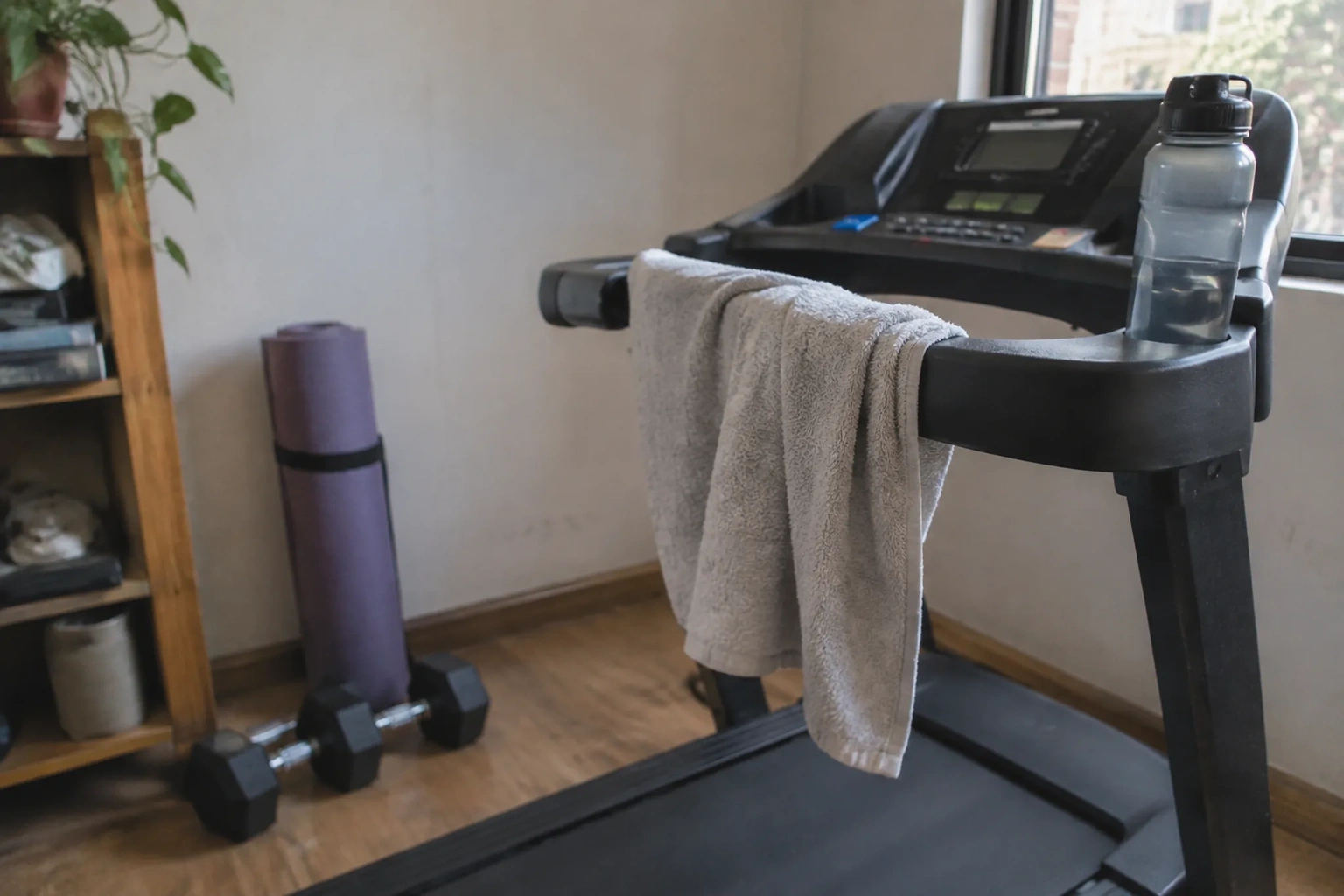
An eight by ten foot patch of rug, a ceiling fan, and eleven inches of clearance on either side of a coffee table. That is the entire geography of cardio training for a large number of people, and the fitness industry has mostly decided those people do not exist. Every program assumes a basement, a garage, a gym floor with rubber tiles and a squat rack in the corner. The result is a quiet epidemic of people who believe endurance work requires space they will never have, so they skip it entirely and settle for walks around the block.
This is wrong, and not in a motivational-poster way. Cardio endurance is built by elevating heart rate and holding it there for sustained periods, then recovering, then doing it again. Almost none of that depends on square footage. It depends on knowing which movements can be performed in place without slamming into furniture and on structuring them so the cardiovascular system stays under load. A person with four feet of clearance and a decent pair of shoes has enough room to train for a 10K, or at least to build the engine for one.
The clearance problem, measured honestly
Before anything else, a person needs to measure the actual space. Not guess at it. Stand in the room and hold arms out to the sides. If fingertips brush a wall or a lamp, that dimension limits lateral movement. Step forward and back; whatever distance is available without touching anything is the working footprint. Most apartments yield something between six and twelve square feet of truly clear floor, which is enough for stepping, marching, squatting, and shadow boxing, but not enough for burpees with a jump or any exercise that travels forward.
The ceiling matters too. A low ceiling in a basement or attic rules out overhead movements and anything with a jump. The floor matters: carpet is forgiving for stepping but punishing for pivoting, and a bare hardwood floor on an upper story turns jumping jacks into a noise complaint waiting to happen. A yoga mat helps with grip and muffles some impact, but it does not solve the noise problem. Neighbors hear the thud through the joists, not through the mat.
Movements that stay inside a small box
The exercise vocabulary for confined spaces is larger than most people expect. Marching in place, high knees, step touches, lateral shuffles within a two-foot lane, squat pulses, reverse lunges held in place, shadow boxing, standing mountain climbers (knees drive up rather than feet driving back), and low-impact jumping jacks done with a step-touch instead of a hop. Add a single step or a stack of books as a platform and the options widen: step-ups, step-touch combinations, and incline push-ups with hands on the step.
What unites these movements is that the body stays over a fixed point. The center of mass shifts up and down or side to side, but never travels more than a foot in any direction. That constraint is also what makes them useful for endurance: because there is no momentum to carry the body forward, the muscles do more work per repetition, and heart rate climbs faster than it would during a jog at the same perceived effort.
One practical test for whether a movement belongs in a small-space session: perform it slowly once and watch how far the hips travel. If the answer is more than a stride, cut it. If the answer is almost nothing, keep it.
Why intervals beat long slow sessions here
Continuous steady-state work in a small room is miserable. Twenty minutes of marching in place with no variation is a test of boredom tolerance as much as cardiovascular capacity, and most people quit before the heart rate benefits accumulate. Interval work solves that. Thirty seconds of high knees, thirty seconds of rest, repeated for ten or fifteen rounds, delivers a genuine cardiovascular stimulus in the same footprint and keeps the mind engaged because the task changes constantly.
The structure matters more than the specific exercise. A simple template: pick three movements, cycle through them for forty seconds each with twenty seconds of rest, repeat the cycle four times. That is twelve minutes of work. Add a warm-up and a cool-down and the whole session runs under twenty minutes. Three of those per week, sustained for two months, will move the needle more than most people expect from a routine that never leaves a rug.
There is a real argument, in fact, that confined-space interval training is superior to outdoor jogging for building raw cardiovascular capacity in beginners. The reason is mechanical: high knees, step touches, and squat pulses recruit more muscle mass per minute than jogging does, and heart rate responds to muscle recruitment. A person who cannot jog a mile without stopping can often complete a fifteen-minute interval session in a living room and feel genuinely worked.
The step as a force multiplier
A single step, roughly eight to twelve inches high, is the most useful piece of equipment in a small-space cardio setup. It costs almost nothing, stores against a wall, and converts a flat-footed session into one with real vertical work. Step-ups at a steady pace for two minutes will drive heart rate as effectively as a slow jog, and the movement is quiet enough for an apartment floor.
Step work also solves a specific problem: the lack of a hill. Outdoor runners use incline to raise intensity without increasing pace. A step provides the same effect indoors. Alternating lead legs, adding a knee drive at the top, or holding a pause at the top of each rep all increase the load without requiring more floor space. A step plus a wall for balance is a complete lower-body endurance station.
For those without a commercial step, a sturdy stack of books, a low bench, or the bottom stair of an interior staircase works. The requirement is stability, not height. A wobbly surface turns a cardio session into a balance drill, which is not the goal.
Keeping the heart rate honest without a screen
Most people overestimate their effort during confined-space work because there is no distance feedback to argue with them. A watch that tracks heart rate solves this, but not everyone has one. A workable substitute is the talk test: during the work interval, a person should be able to speak a short sentence but not hold a conversation. If full sentences come easily, the intensity is too low. If speech is impossible, the interval is too hard for sustained work and should be shortened.
Breathing rhythm is another honest signal. Controlled nasal breathing during the work interval suggests the pace is sustainable. Mouth breathing that turns ragged within ten seconds suggests the interval is too long or the movement is too demanding. Adjusting the interval length, not the movement, is usually the right fix. A person who can do forty seconds of high knees but not sixty should do forty and add a round rather than push through sixty and quit the session early.
Progression when the room does not change
The room stays the same size forever. The body does not. Progression in a confined space comes from four levers: duration, density, complexity, and load. Duration is the simplest: add one round per week until the session reaches a ceiling that fits the available time. Density means shortening rest periods while keeping the work intervals the same. Complexity means adding a coordination demand, such as a step-touch with a reach or a squat with a lateral step. Load means holding a weight, wearing a pack, or using a resistance band.
Most people plateau in small-space training because they only pull the duration lever. Adding rounds indefinitely turns a twenty-minute session into a forty-minute slog, and motivation collapses. Pulling the density lever is usually more effective: the same twelve rounds, but with fifteen seconds of rest instead of twenty, produces a harder session in the same time. Pulling the complexity lever keeps the mind engaged, which matters more in a confined space than most training advice admits.
The load lever deserves caution. Holding weights during fast stepping or high knees changes the movement pattern and increases joint stress in ways that are not always obvious until the next morning. A resistance band around the thighs during lateral shuffles is a gentler way to add load while keeping the movement controlled.
What eight weeks of living-room intervals actually produces
A realistic expectation, based on general exercise physiology rather than any specific study: resting heart rate drops by a handful of beats per minute, stair climbing becomes noticeably easier, and the perceived effort of a brisk walk falls. The change is not dramatic in the way a marathon training block is dramatic, but it is real and it is measurable. The person who could not complete three rounds of forty-second high knees in week one is often completing six rounds by week six.
The larger gain is structural. Once a person has a working cardio routine that fits inside their actual living space, the excuse disappears. There is no commute to the gym, no weather to negotiate, no equipment to assemble. The session is fifteen minutes and it happens between the couch and the coffee table. That proximity is the reason the routine survives past the third week, which is where most fitness resolutions die.
A final concrete image: a person standing in a narrow strip of floor between a bookcase and a window, stepping up onto a low stool, knee driving to hip height, then down, then up again, breathing hard, watching the clock for the forty-second mark. The room is small. The engine being built inside it is not.





















