







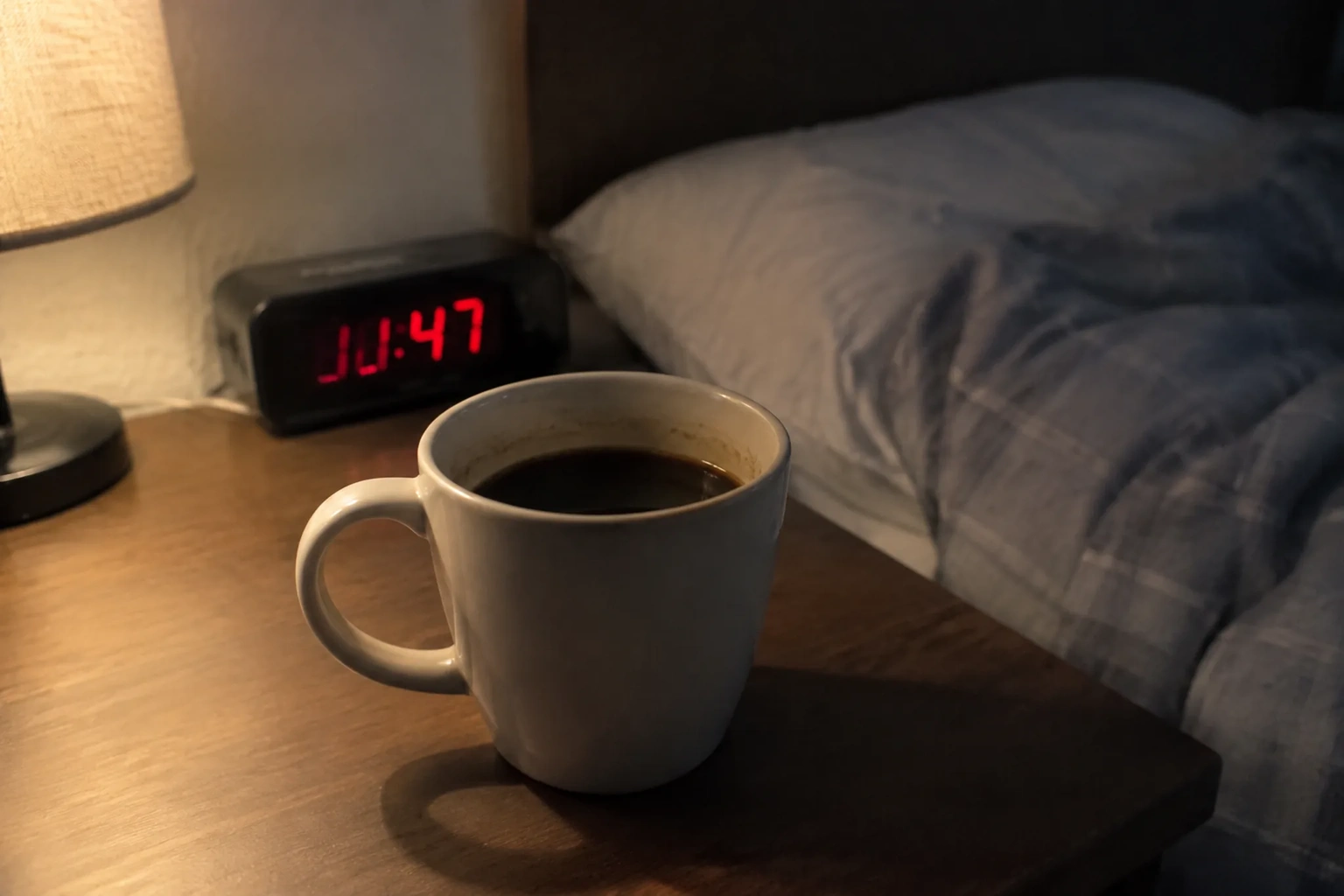
Half-life figures get thrown around loosely in caffeine conversations, as if the body were a clock with a clean dial. A typical adult metabolizes roughly half a dose of caffeine in about five hours, though the range across healthy adults is wide enough to swallow a lunch break, with some clearing it in three and others taking closer to seven. That single number, quoted in a hundred wellness posts, hides the thing that actually matters for sleep: the tail. Caffeine does not vanish at the five-hour mark. It decays, and the last quarter of a dose lingers long after the obvious buzz has passed.
A cup of drip coffee at 2 p.m. carrying 95 milligrams still leaves roughly 24 milligrams in the bloodstream around midnight. That is a quarter of a cup, sitting in the system at the hour when the brain is trying to downshift. Most people cannot feel 24 milligrams. They can feel the sleep that follows it.
Why the afternoon cup outlasts the afternoon
The popular framing treats caffeine as a stimulant that wears off, like a song fading out. The more useful framing is that caffeine blocks adenosine, the molecule that accumulates through waking hours and creates what sleep scientists call sleep pressure. Caffeine parks itself on the receptors adenosine would otherwise occupy. The adenosine keeps building behind the blockade. When the caffeine finally clears, the accumulated pressure does not trickle in; it arrives at once.
This is why a 3 p.m. espresso can produce a strange evening: a person feels tired at nine, falls asleep easily, then wakes at two in the morning with a clear head and a mild sense of betrayal. The blockade lifted. The pressure had been waiting.
The practical consequence is that the cutoff time for caffeine is not the time a person stops feeling wired. It is the time the body needs to clear enough of the drug that the sleep architecture can do its work. Those are different clocks, and the second one runs later than most schedules assume.
The genetics that make one cutoff useless for a household
Caffeine metabolism runs through an enzyme called CYP1A2, and the gene that codes for it comes in variants. Fast metabolizers clear caffeine quickly; slow metabolizers take their time. A pair of adults sharing a kitchen and a coffee maker can be running two entirely different clearance schedules without knowing it.
This explains a familiar domestic argument. One partner drinks coffee at 4 p.m. and sleeps like a stone. The other has a single cup at noon and lies awake at 1 a.m. reviewing the day. Neither is lying, exaggerating, or being dramatic. Their livers are simply running different software.
Smoking accelerates clearance. Some medications slow it. Pregnancy slows it substantially, which is why many people who drank coffee comfortably before pregnancy find a single cup at noon wrecking their sleep by the third trimester. Oral contraceptives can also slow the enzyme. The cutoff that worked at 28 may not work at 34, and the change will not announce itself.
A working method for finding the personal cutoff
Most advice hands down a number: no caffeine after 2 p.m., or noon, or some other figure plucked from a study average. The problem with a universal number is that it fits almost nobody precisely. A better approach treats the cutoff as an experiment with a measurable outcome.
The method is unglamorous. Pick a bedtime. For one week, write down the time of the last caffeine dose and a simple morning rating of sleep quality on a scale of one to five. Keep everything else steady: same bedtime, same wake time, no alcohol. At the end of the week, move the last dose 90 minutes earlier and repeat. Two or three weeks of this produces a personal chart, not a guess.
Ninety minutes is the right step size because it roughly corresponds to a meaningful drop in residual caffeine. Smaller steps get lost in night-to-night noise. Larger steps overshoot and leave a person cutting caffeine they did not need to cut.
The rating matters more than the clock time. A person who sleeps fine after a 4 p.m. cup has found their answer. A person who wakes at 3 a.m. after a 1 p.m. cup has also found theirs, even if it is inconvenient.
The trap of the "healthy" late-afternoon sources
Coffee gets the attention, but the caffeine that quietly wrecks sleep often arrives in forms people do not count. A large iced tea at 5 p.m. can carry 40 to 60 milligrams. A matcha latte, often filed mentally under "calm," can run 60 to 70 milligrams depending on the scoop. Dark chocolate after dinner contributes a modest but real amount. Pre-workout powders, some kombuchas, and certain headache medications add to the tally.
The counting problem is real. Someone who carefully stops coffee at 2 p.m. but drinks a strong black tea at 6 p.m. has not implemented a caffeine cutoff at all. They have implemented a coffee cutoff, which is a different policy.
A useful discipline is to list every caffeine source consumed after noon for three days, with rough amounts, before adjusting anything. The list is usually longer than expected, and the surprise is usually tea.
Decaf is not a clean zero
Decaffeinated coffee retains a small amount of caffeine, typically a few milligrams per cup, sometimes more depending on the process and the bean. For most people this is irrelevant. For a slow metabolizer drinking three cups of decaf in the evening, it can nudge a borderline sleep schedule over the edge.
The same applies to decaf tea and to chocolate, which contains both caffeine and a related compound called theobromine. Theobromine is a milder stimulant but a longer-lasting one. A square of dark chocolate at 9 p.m. is not a sleep disaster for most, but it is not nothing.
The honest framing: decaf is a useful tool for the ritual of an evening cup, not a guarantee of zero caffeine. Treating it as a strict zero works fine for fast metabolizers and quietly fails for everyone else.
What a realistic cutoff looks like across a day
For a person with a typical 11 p.m. bedtime and average metabolism, a last caffeine dose around 1 p.m. leaves roughly 30 milligrams or less circulating at lights-out. That is a defensible buffer. A dose at 3 p.m. leaves closer to 50 milligrams, which is enough to fragment the second half of the night for many sleepers.
A slow metabolizer targeting the same bedtime might need a cutoff closer to 10 a.m. A fast metabolizer might comfortably run to 4 p.m. The distribution is genuinely wide, which is why the single-number advice in magazines and on coffee-shop chalkboards frustrates so many people. It was never a universal figure.
There is also a dose question. A 60-milligram cup at 3 p.m. is a different proposition from a 200-milligram cold brew at 3 p.m. The cutoff time and the dose are a pair; adjusting one without the other produces confusing results. A person who cannot move their afternoon cup earlier can often move it smaller.
When the cutoff conflicts with a real life
The rigid version of caffeine scheduling assumes a person controls their day. Shift workers, parents of small children, and anyone running on four hours of sleep do not have that luxury. A nurse finishing a night shift at 7 a.m. faces a genuine tradeoff: caffeine to drive home safely, or no caffeine and a foggy commute.
For these schedules, the useful move is to separate the safety dose from the habit dose. A small amount of caffeine timed for the commute home, paired with a strict rule against any caffeine in the six hours before the main sleep block, protects both. The habit dose, the large latte for comfort, is the one that can move.
The cutoff is not a moral rule. It is a planning tool for people who want their sleep to do its repair work. A person who chooses a 3 p.m. coffee knowing it will cost them a clear-headed morning is making a trade, not a mistake. The trade becomes a mistake only when it is invisible, repeated nightly, and blamed on insomnia.
The experiment worth running this month
One concrete step outperforms any article full of averages: pick a single week, log the last caffeine time and the morning rating, and change one variable at a time. The chart that emerges will be more useful than any general recommendation because it is built from one specific body, one specific bedtime, and one specific life.
The last time a person moves their cutoff earlier, they will notice something in the data before they notice it in their mood: the 3 a.m. wake-ups thin out, the morning rating ticks up half a point, and the afternoon cup starts to look less like a necessity and more like a choice. That is the whole payoff. A schedule that fits, discovered rather than dictated, and a quiet night that stops being a negotiation.





















