







Somewhere between the fourth meeting and the sixth browser tab, the day stops feeling like a day and starts feeling like weather. The calendar is not the problem. The problem is that the mind never gets a clean seam between one thing and the next. Small routines exist to put seams back in. Not elaborate wellness rituals. Not a morning routine that requires a special notebook and forty minutes of silence. The kind that take ninety seconds and happen at the hinge points of a busy afternoon.
A routine works here for a blunt reason: the nervous system responds to repetition and to physical cues more reliably than it responds to intention. Deciding to feel calmer at 3 p.m. does almost nothing. Reaching for the same mug, walking the same route around the block, or closing the laptop lid at the same point in the afternoon does something. The body learns the sequence, and the sequence becomes a doorway.
The twenty-second transition that saves an hour
Most busy days are wrecked not by the workload but by the transitions. The mind finishes a call and immediately opens email, then a message thread, then a document, all within forty seconds, and by the time the next real task begins, the attention is scattered across four half-finished contexts.
A useful countermeasure is almost embarrassingly small. After any meeting or focused block, stand up. Push the chair in. Take three slow breaths with the window or a wall in view. That is the whole routine. Twenty seconds, maybe thirty. The chair gets pushed in every single time, and the chair becomes the cue. The point is not the breathing itself. The point is that the body gets a marker between one context and the next, and the mind stops dragging the last task into the new one.
The specific physical action matters more than the calm one hopes to feel. A person who tries to "reset mentally" will drift. A person who walks to the kitchen and refills a glass of water will actually reset, because the legs did something and the hands did something and the eyes looked at a different room.
Why the same mug beats a better mug
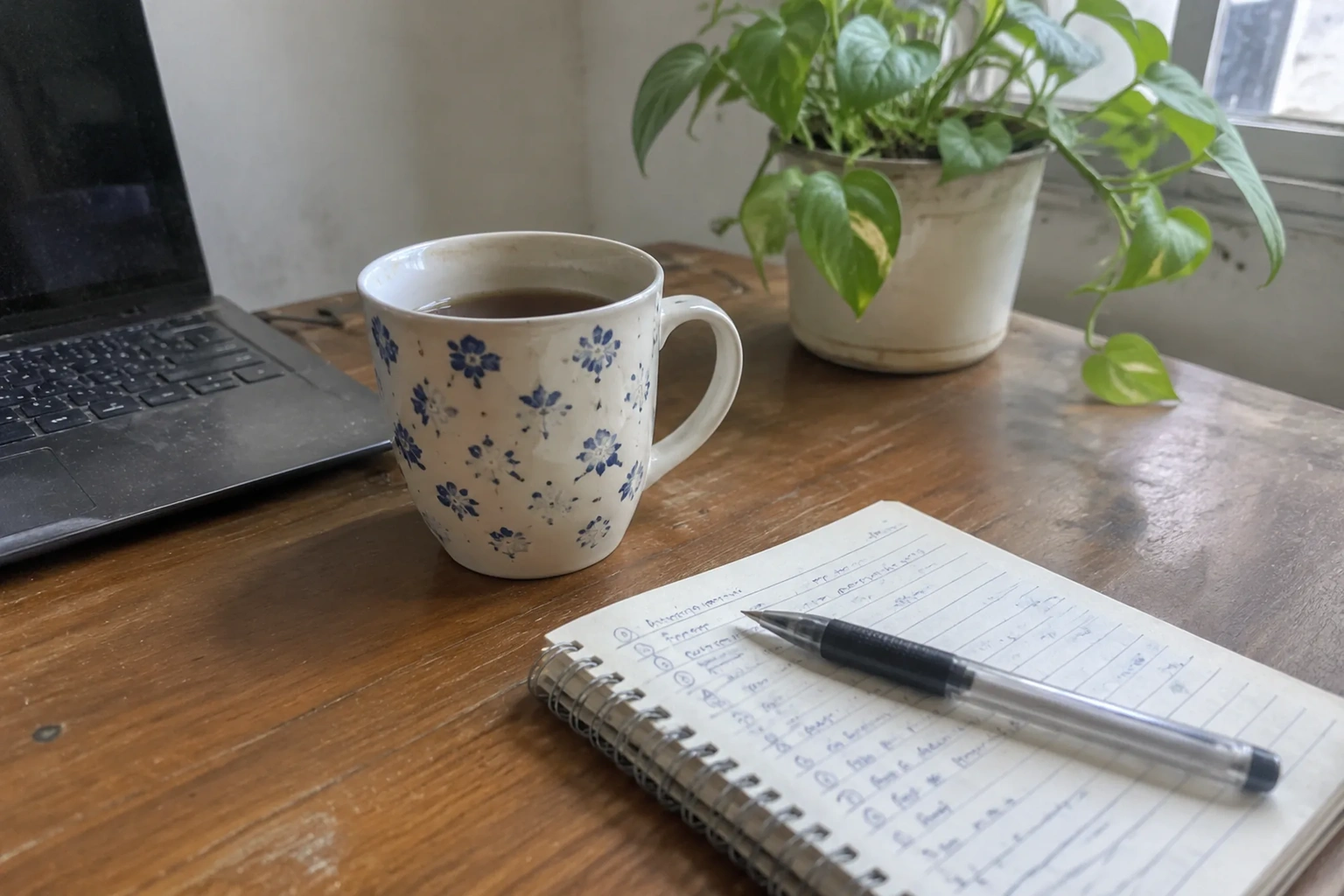
Caffeine is a routine disguised as a beverage. The interesting part is not the drug. The interesting part is that the kettle, the mug, the particular spot by the window, and the first sip form a chain that signals the start of focused work. People who switch mugs constantly, or who drink coffee while answering messages, lose the signal. The chain breaks before it can do its job.
The same logic applies to the end of the day. A specific cup, rinsed and set upside down on the same saucer, is a small ritual of completion. It tells the body that the working portion of the afternoon is over, even if a few loose ends remain. The mug does not need to be nice. It needs to be the same.
The desk-clearing that takes four minutes and earns back twenty
There is a version of tidying that is procrastination in a cardigan, and there is a version that is genuine maintenance. The second version has rules. It happens at a fixed time, it lasts four minutes, and it touches only three things: the surface of the desk, the browser tabs, and whatever is sitting on the chair.
Four minutes is short enough that it never becomes a project and long enough to clear the visible mess. The browser tabs matter most. A dozen open tabs is a dozen unfinished thoughts pressing on the attention, and closing them at a fixed point in the day, say just before lunch, gives the afternoon a cleaner floor to work on. The trick is the timer. Without a timer, the four minutes becomes forty. With a timer, it stays a routine.
A walk that is not exercise
Walking for health and walking for reset are two different activities that happen to use the same legs. The health walk wants distance, pace, and a heart rate. The reset walk wants none of those. It wants ten minutes, no phone, no destination, and the deliberate choice to notice three things on the route: a tree, a doorway, a parked car with a dented fender.
This is the routine most likely to be skipped, because it feels like it does not count. It does not burn calories worth mentioning. It does not clear the inbox. What it does is change the visual field, and a changed visual field interrupts the loop of rumination that builds up over a long morning. Ten minutes around the block at the same time each day is more restorative than a longer walk squeezed in at random, because the regularity is doing half the work.
The no-phone rule is the hard part. A walk with a podcast is entertainment. A walk with a phone in hand is just standing outside while being interrupted. The reset only happens when the ears and eyes are free.
Closing the last tab at a fixed hour
Busy days have a way of bleeding into evenings. The laptop stays open on the kitchen counter, and the mind never fully leaves work because the screen is still glowing. A small routine fixes this better than willpower: at a set hour, the laptop lid closes, the charger goes into a drawer, and the work phone goes face down in a different room.
The hour can be anything. What matters is that it is the same hour, and that the closing is a physical sequence rather than a mental decision. The lid, the charger, the phone. Three moves, under a minute. A person who does this for a week will notice that the evening feels longer, not shorter, because the boundary is real.
There is a useful exception. On genuinely heavy weeks, the boundary can move by an hour, but it should still be a boundary. The routine bends. It does not vanish.
The five-minute note that empties the head
Unfinished tasks have a way of circling. The mind keeps them aloft because it does not trust that they will be remembered. A short written dump at the end of the workday, five minutes at most, on paper or in a plain text file, gives the mind permission to put them down. The note does not need to be organized. It needs to be complete enough that nothing important is left floating.
The ritual has a second half: the note is read the next morning, first thing, before anything else. That read is what makes the writing trustworthy. Without it, the brain learns that the notes are a graveyard and refuses to release the tasks. With it, the notes become a genuine second memory, and the evening gets quieter.
Small routines fail when they are too ambitious
The most common failure mode is not laziness. It is scale. A person decides to meditate for twenty minutes, journal for a page, stretch for ten, and walk two miles, all as part of a new reset protocol. By Thursday the whole thing has collapsed, and the collapse takes the small useful pieces down with it.
Routines that survive busy days are the ones that fit inside the gaps of busy days. Ninety seconds. Four minutes. Ten minutes. A single mug. A single chair pushed in. The ambition should be aimed at consistency, not at depth. Depth arrives later, on its own, once the sequence is automatic.
There is also a case for keeping the list short. Two routines are enough to start. The chair push and the walk. The mug and the closed lid. Adding a fifth before the first two are automatic is how the whole structure gets abandoned.
The one routine worth protecting above the rest
If only one survives, it should be the transition routine, the twenty seconds between contexts. It is the cheapest, the most portable, and the one that touches the most hours of the day. A person with a clean transition between tasks can afford a messier desk. A person with no transition, and a spotless desk, will still end the afternoon feeling wrung out.
The chair gets pushed in. The breath happens. The next thing begins. Somewhere around the tenth repetition, the body starts to expect the pause, and the pause starts to arrive on its own, even on the days when nobody remembered to plan for it.





















