







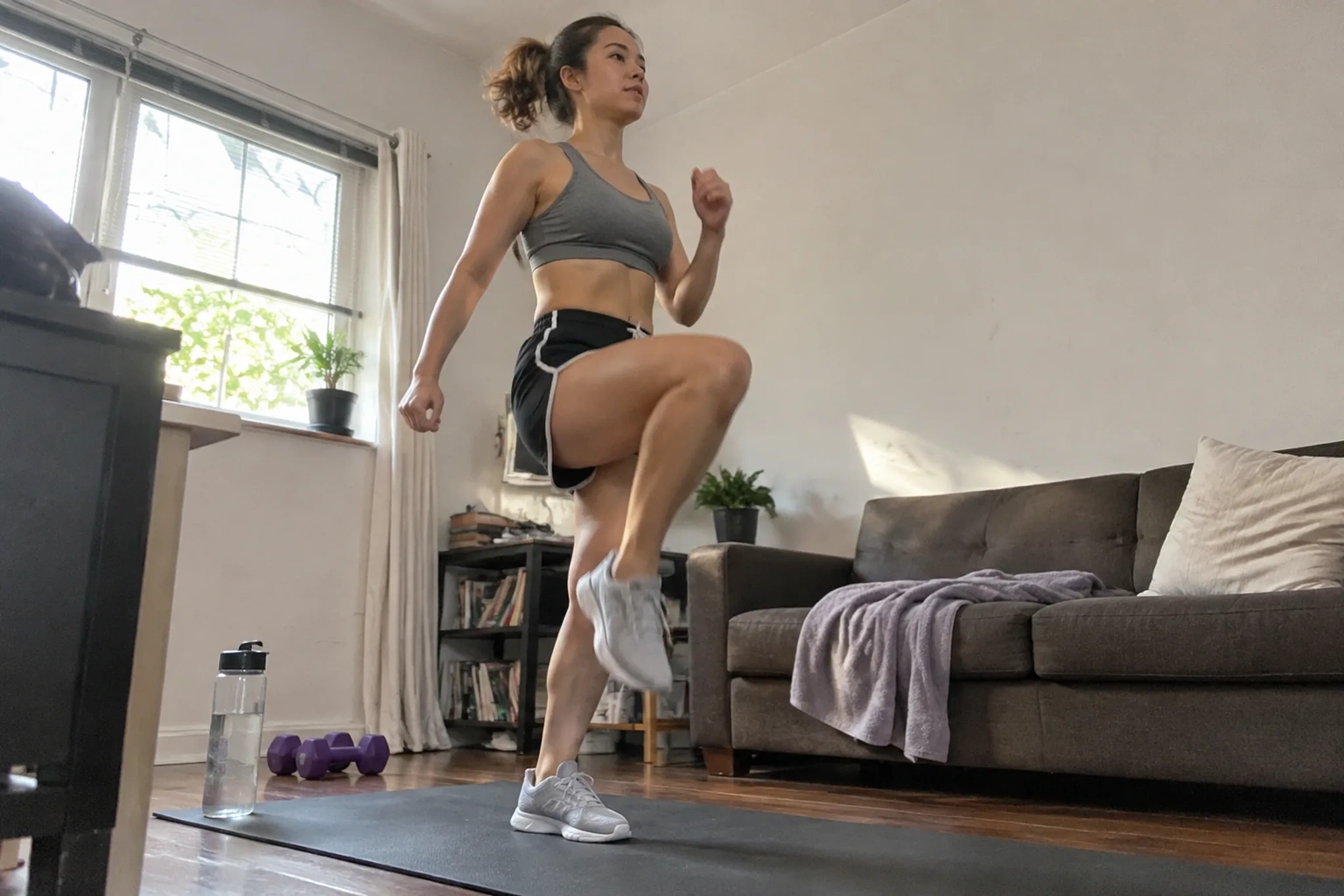
At 6:40 on a weekday morning, the floor of a second-floor apartment carries sound in ways that are not obvious until a neighbor mentions it. A jump rope lands like a hammer. A set of burpees sends a thud through the joists that a person two units over can feel in the sole of a foot. The bodyweight squat, performed slowly and in socks, produces almost nothing at all. That gap, between the exercises that broadcast and the exercises that do not, is the entire practical problem of apartment cardio, and it has a real solution set.
The solution starts with a distinction worth making plainly: quiet cardio is not low-intensity cardio. A person can raise a heart rate to a hard working level with a routine that a downstairs neighbor would struggle to hear. The trick is choosing movements that keep force inside the body, or transfer it into a soft surface, rather than slamming it into a shared floor. Once that principle is clear, the menu of options opens up considerably.
Why the Floor Is the Real Audience
Sound in an apartment travels through two paths. Airborne noise, like a television or a voice, is the obvious one. Impact noise is the one that causes actual complaints, and it moves through the structure itself: through the floor, into the joists, down into the ceiling of the unit below. A 150-pound person landing from a jump generates a force spike many times their body weight in a fraction of a second. That spike is what the neighbor hears, and no amount of carpet fully absorbs it.
This is why the standard advice to "just put down a mat" only partly works. A thin yoga mat does very little for impact. A dense interlocking foam tile, half an inch to an inch thick, does more. The serious version is a square of high-density rubber or a folding gymnastics-style mat, which spreads the load and kills the sharp transient. Anyone serious about jumping indoors should budget for the mat before the jump rope.
The Step-Touch That Replaces the Jumping Jack
The jumping jack is the first casualty. It combines a jump with an arm swing, and the landing is what carries. The step-touch version keeps the arms and the rhythm and removes the airborne phase entirely: step out to one side, bring the other foot to meet it, swing the arms overhead, step back. Done at speed, with the arms driving hard, the heart rate climbs into the same zone within a couple of minutes. The feet never leave the floor.
For a slightly harder version, a person can add a small hop on the step-out, keeping the landing soft and the knees bent, on the mat. That reintroduces a little impact, so it belongs on the mat and not on bare floor. The plain step-touch, though, is silent enough to do in a room above a light sleeper.
Shadowboxing, Which Is Almost Perfectly Silent
Boxing drills are the best-kept secret of apartment cardio. A person can throw jabs, crosses, hooks, and uppercuts in a small square of floor with no equipment and no noise beyond breathing. The feet pivot and shuffle but do not stomp. Ten minutes of continuous combination work, moving around the space, produces a genuine sweat and a genuinely elevated heart rate.
The catch is technique. Throwing punches with a locked elbow or a hyperextended shoulder is a way to get hurt, so the arms should stay slightly bent and the punches should stop short of full extension. Keep the fists loose, the shoulders relaxed, and the movement coming from the hips and the rotation of the torso. Done that way, shadowboxing is also a decent core workout, because every punch begins in the legs and the midsection.
The Low-Impact Cardio Machines That Fit a Living Room
A stationary bike and a rowing machine are the two pieces of equipment that belong in this conversation. Both are quiet by design. A magnetic-resistance bike makes a faint whir and nothing else. A rowing machine, particularly an air-resistance model, is louder, but the noise is a steady whoosh rather than an impact, and it rarely carries through a floor the way a jump does. The water-resistance rowers are quieter still.
The real constraint with both is footprint. A folding bike or a compact rower can tuck against a wall when not in use, which matters in a one-bedroom. A person who commits to either machine will get more consistent cardio than someone relying on a jump rope they are afraid to use. The machine that gets used is the one that does not annoy the neighbors.
Fast Feet and the Art of Staying Grounded
Running in place is loud because of the landing. A quieter substitute is fast feet: a rapid, low shuffle where the balls of the feet skim the floor and the heels barely lift. It looks a little ridiculous, and it works. The legs move quickly, the arms pump, and the body stays low. The sound is a soft patter, closer to a cat walking than a person running.
A person can build a full interval session from this: forty seconds of fast feet, twenty seconds of rest, repeated ten times. Add a set of high knees done with the same soft landing, and a set of butt kicks kept low, and the whole thing stays under fifteen minutes with the heart rate staying high throughout. The key is to keep the contact light and the knees bent, absorbing the force in the legs rather than passing it into the floor.
Stair Work Inside the Apartment
For anyone with an internal staircase, or access to a building stairwell, stair climbing is the quietest hard cardio available. Walking up and down a flight of stairs repeatedly raises the heart rate sharply and builds leg endurance, and the sound is footsteps on stairs, which is a normal apartment sound that few people object to. The stairwell itself, if it is a concrete building stair, is essentially soundproof to the units around it.
The obvious caveat is that stairwells are shared space. A person doing intervals up and down the same flight for twenty minutes will cross paths with neighbors, and the social cost of that is real. Early mornings and late evenings are the wrong times. Midday, or a stairwell that sees little traffic, is the right context. The internal staircase in a townhouse or duplex, of course, has no such problem.
Dance Cardio and the Volume of the Music
Dance-based cardio is quiet in the body and loud in the air. The movement itself, a continuous flow of steps, turns, and arm work, generates almost no impact noise. The music is the issue. A person dancing hard to a playlist at a volume that motivates will send bass through the walls, and bass is the noise that travels most easily between units.
The fix is headphones. Wireless earbuds or over-ear headphones let a person dance at full effort with the music loud in their own ears and silent in the room. The one downside is that hearing the music through headphones can make a person less aware of their own footfalls, so it pays to check the landing every few minutes and keep the steps soft.
Building a Week That Nobody Hears
A practical weekly structure might look like this: two sessions of shadowboxing intervals, two sessions on the bike or rower, one session of fast feet and low-impact bodyweight work on the mat, and one longer walk outside. That is six days of cardio, none of which generates a noise complaint, and all of which can be done in a space the size of a small living room.
The sessions do not need to be long. Twenty to thirty minutes is enough for a real cardiovascular stimulus, and shorter intervals at higher effort can do the job in fifteen. The point is consistency, and consistency is far easier when the workout does not require leaving the apartment, waiting for a gym, or worrying about the neighbor below.
The Mat, the Socks, and the Landing
Two small pieces of gear make the whole approach work better. The first is a proper mat, as discussed, for any movement that involves even a small hop. The second is a pair of grip socks or bare feet, which give better feedback on landing than cushioned sneakers. Shoes with thick soles deaden the sensation of the floor and make it harder to feel how hard the foot is striking. Bare feet on a mat teach a person to land softly because the feedback is immediate.
The landing itself deserves attention. A quiet landing is a soft landing: knees bent, weight through the midfoot, the heel touching down last. Practicing that on the mat for a few minutes before adding speed trains the body to absorb force rather than transmit it. It is also, conveniently, better for the knees and the lower back than a stiff, heel-first landing.
What the Neighbor Actually Hears
Most apartment leases include a clause about noise, and most neighbors are more tolerant than a person expects. The sound of footsteps, a chair moving, a door closing: these are normal. What triggers complaints is repetition and impact, the rhythmic thud of a jump rope or a set of burpees at seven in the morning. A routine built on step-touches, shadowboxing, fast feet, and a quiet machine produces none of that.
The honest test is simple. A person can stand in the room, do the movement, and listen. If the sound is a soft shuffle or a quiet patter, it is fine. If it is a thud that can be felt through the soles of the feet, it will be heard below. The body knows the difference, and the floor transmits it faithfully.
The morning routine that works in a second-floor apartment is the one that keeps the feet close to the ground, the landings soft, and the music in headphones. It is not a compromise on fitness. It is a different set of movements, chosen for a shared building, that happens to leave the heart rate exactly where a harder, louder routine would have put it.





















