





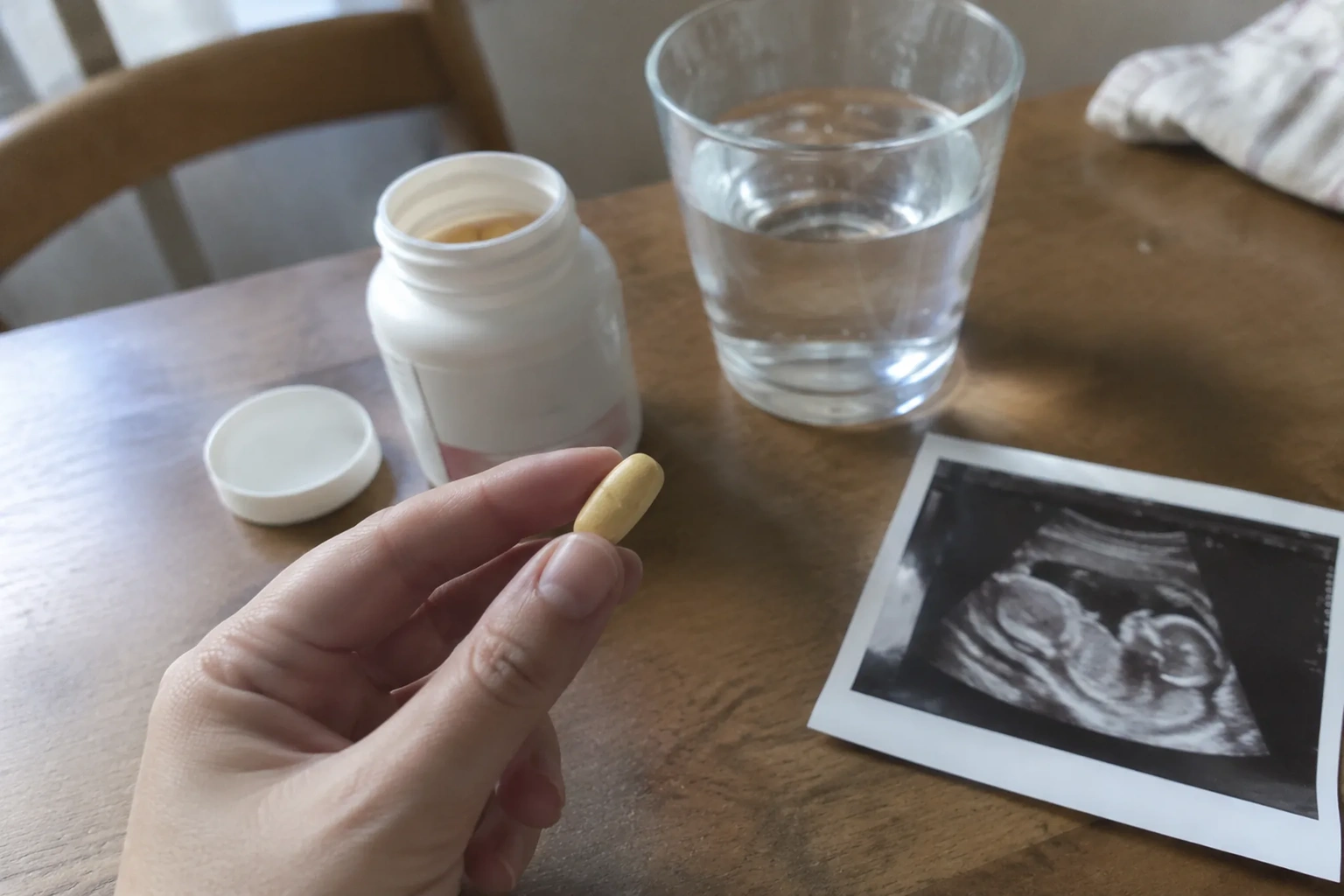
A prenatal vitamin is the only supplement most people will ever take on the direct instruction of a doctor, a midwife, or a nurse, and yet the buying decision still lands almost entirely on the person standing in the pharmacy aisle. The shelf holds forty bottles, the labels throw around "methylated," "whole food," "gentle," and "complete," and the price ranges from a few dollars to well past a dollar a pill. The questions worth asking before choosing one are mostly not on the label at all.
The stakes are narrow but real. The clearest, least controversial point in prenatal nutrition concerns folate taken early, ideally before conception and through the first weeks of pregnancy, to lower the risk of certain neural tube defects. That single fact explains why so many prenatal bottles exist and why the cheap ones are not automatically bad. Everything else on the label sits somewhere between well-supported and marketing.
Why the folate question outranks everything else
Most prenatal vitamins include folic acid, the synthetic form of folate, at 400 to 800 micrograms. Some use methylfolate, a form the body can use without converting it. The argument for methylfolate is that a slice of the population carries a gene variant that makes the conversion of folic acid less efficient. That variant is common. The claim that a person with the variant needs methylfolate to protect a pregnancy is a much bigger leap than the supplement industry admits.
Here is the practical split. A woman who has had a pregnancy affected by a neural tube defect is usually advised to take a much higher dose of folic acid, and that is a conversation with a clinician, not a shopping decision. Everyone else is choosing between forms that are, for the most part, treated as interchangeable by the people who study this. The methylated version costs more. It may matter for some. It is not the difference between a good prenatal and a bad one.
The folate number itself deserves a second look. A bottle that lists 400 micrograms of folate as "folate" rather than "folic acid" may be using a form measured differently, and the percentage of daily value can mislead. The label convention is to show folic acid in micrograms and methylfolate in micrograms of the active compound, and the two do not convert cleanly. A reader who just compares the big number on the front of two bottles is often comparing two different units.
The iron dose and the nausea problem
Iron is the ingredient most likely to make a prenatal vitamin a miserable daily ritual. A typical prenatal carries 27 milligrams, which is well above what most people get from food and enough to cause constipation, nausea, and a metallic aftertaste in a sizable share of users. The conventional advice is to take it with food and a little vitamin C, and to avoid taking it alongside calcium or a cup of coffee. That advice is sound. It also does not solve the problem for everyone.
A lower-iron prenatal exists, usually around 15 to 18 milligrams, and it is a reasonable choice for someone who cannot tolerate the standard dose and is not anemic. The catch is that iron needs rise steeply in the second and third trimesters, so a low-iron pill may need to be paired with a separate iron supplement later. Buying the low-iron bottle on day one without knowing the bloodwork is a bet that may not hold.
The form matters here too. Ferrous sulfate is the cheap, common form and the one most likely to cause stomach upset. Ferrous bisglycinate, often sold as "gentle iron," tends to be better tolerated and costs more. A prenatal that uses the gentler form at a slightly lower dose is, for many people, a more realistic daily habit than a cheaper pill that gets abandoned by week three.
What the "complete" claim actually covers
The word "complete" on a prenatal label usually means the product contains a broad spread of vitamins and minerals, not that it meets every need of pregnancy. Vitamin D is a good example. Many prenatals carry 400 international units, which is a fraction of what some clinicians now recommend, and the amount needed depends on sun exposure, skin tone, and where a person lives. A prenatal that claims completeness at 400 IU is technically complete and practically thin.
Choline is the ingredient most often missing or underdosed. It matters for fetal brain development, and the typical prenatal provides well under the recommended amount, sometimes none. A bottle with 50 milligrams of choline is not meaningfully covering the need. Two eggs a day do more. This is the kind of gap that a label can hide behind a long ingredient list.
Iodine is another quiet one. Pregnancy raises iodine needs, and a prenatal without iodine leaves the gap to table salt and dairy, which is fine for some diets and not for others. The label rarely makes this obvious, because iodine is buried near the bottom in small type and often absent entirely.
Gummies, tablets, and the absorption trade-off
Gummy prenatals are popular for a reason: they are pleasant, they do not upset the stomach the way a large tablet can, and people actually take them. The trade-off is real. Most gummies contain no iron at all, because iron tastes bad and ruins the chew. A gummy prenatal is a folate-and-vitamin-D delivery system with a pleasant texture, and it needs a separate iron source if iron is part of the plan.
Tablets and capsules are harder to swallow and easier to abandon. A pill that sits in the cabinet half full is worse than a gummy that gets taken every morning. The best prenatal is the one that survives the routine, and the routine is brutal in the first trimester, when nausea peaks and the smell of a vitamin bottle can be enough to end the experiment.
There is a middle path: a smaller capsule taken with a meal, or a prenatal split into two doses morning and night. Splitting the dose reduces the stomach load and improves absorption of some minerals, at the cost of remembering twice. For someone who has already failed one bottle, the split dose is often what makes the habit stick.
Third-party testing and the heavy-metal question
Supplements are regulated loosely compared with drugs, and the burden of checking purity falls on the buyer. A third-party seal, from an organization that tests for contaminants and verifies label accuracy, is one of the few signals worth trusting on a shelf full of claims. The seal does not guarantee the formula is ideal for pregnancy. It does mean the bottle contains roughly what it says and not a meaningful dose of lead or arsenic.
This matters more for prenatals than for most supplements, because the person taking them is often pregnant and the exposure window is long. Fish oil based prenatals, which add DHA, are a particular case: the oil can carry contaminants if it is not purified, and the label rarely says how. A tested brand is worth the extra dollars here.
The heavy-metal concern also runs the other way. Some "whole food" prenatals built from powdered greens and plant concentrates have been found to carry trace heavy metals from the soil. The label sounds cleaner. The testing tells a more complicated story. A seal is a more reliable guide than the word "natural."
The cost per day, not the cost per bottle
Prenatal vitamin pricing is designed to confuse. A bottle that costs thirty dollars may hold a month's supply or two weeks'. The number that matters is the daily cost, and it ranges from a few cents to well over a dollar. The cheap end is often a store-brand folic acid and iron tablet that covers the core needs and nothing else. The expensive end buys methylated folate, gentle iron, choline, DHA, and a testing seal.
The honest calculation is that the premium is real but not enormous over nine months, and the cheap option leaves gaps that have to be filled with separate purchases. A person who buys the budget pill, then adds iron, DHA, and choline separately, often spends more than the all-in-one bottle and takes four pills instead of one. The all-in-one is not a scam. It is convenience priced honestly.
The question to bring to the appointment
The most useful move before buying anything is to bring the shortlist to a clinician and ask two specific questions: does this dose of folate match the plan, and does the iron dose fit the bloodwork. Those two answers narrow the shelf to a handful of bottles. The rest, the methylated claims, the whole-food language, the gummy versus tablet debate, is a matter of what the person will actually take every morning for nine months.
A prenatal vitamin is a small daily commitment with a narrow set of well-established benefits and a wide field of marketing around them. The bottle that gets taken, tested, and matched to a real conversation with a clinician beats the bottle with the longest ingredient list. That is the whole decision, and it is smaller and more concrete than the shelf suggests.