







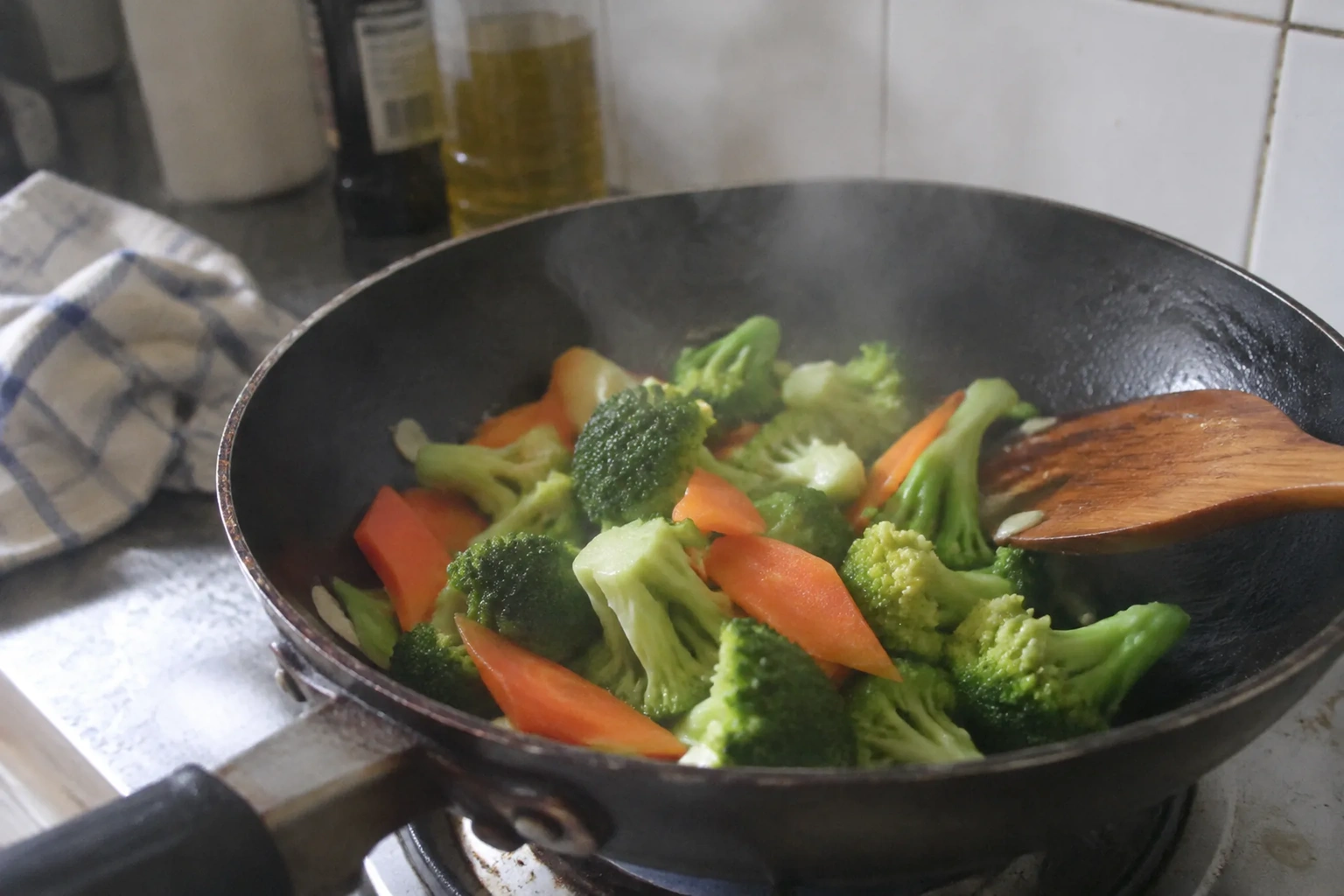
Raw broccoli and a sensitive gut are a bad combination, and the reason is mostly mechanical. The cell walls of a vegetable are built from cellulose and pectin, stiff structures that human enzymes cannot break apart. Whatever softens those walls before the food reaches the lower intestine decides how much gas, bloating, and cramping follows. Heat does the softening most reliably. A fork, a knife, and a hot pan can do a great deal of the work that a stomach was never designed to finish on its own.
That is the whole case for cooking vegetables longer and more thoughtfully than most recipes suggest. The rest is technique, and the technique divides neatly by what is actually troubling the digestion: tough fiber, fermentable sugars, or sheer volume of raw plant material arriving at once.
Fiber Is the Point and Also the Problem
Dietary fiber does not get digested in the small intestine. It travels to the colon, where bacteria ferment it and produce gas as a byproduct. For most people this is a quiet background process. For a gut that is inflamed, slow, or simply unaccustomed to a heavy vegetable load, the same fermentation becomes audible and uncomfortable.
Cooking does not remove fiber, and it should not. What it changes is fiber's physical form. Heat dissolves the pectin that glues plant cells together, so the walls separate and the vegetable turns soft. Soft tissue moves through the gut faster and presents less surface resistance to the colon's bacteria. The total fiber load is roughly the same; the assault on the system is gentler.
The difference between a raw carrot and a carrot braised for forty minutes is not a difference in nutrition labels. It is the difference between a mouthful of rigid scaffolding and something closer to porridge.
The Vegetables That Respond Best to Long Heat
Some vegetables reward patience far more than others. Cabbage, kale, collards, and Brussels sprouts are the classic candidates. They belong to a family that carries complex sugars called raffinose, which human enzymes cannot cleave and which gut bacteria ferment enthusiastically. Long cooking breaks down some of those sugars and softens the fibrous matrix around them.
Onions and garlic deserve separate mention. They store fructans, chains of fructose that ferment readily in the colon. Slow cooking in fat draws sweetness out and reduces some of the sharpness, though it does not eliminate fructans entirely. A person who reacts badly to raw onion often tolerates a long-caramelized one in modest amounts.
Beans and lentils are a different category. They are legumes rather than vegetables, but they sit in the same conversation because their oligosaccharides cause the same trouble. Soaking, discarding the soaking water, and cooking until genuinely tender makes a measurable difference. Canned beans, rinsed well, are already partly there.
What Overcooking Actually Costs
Water-soluble vitamins take a hit when vegetables are boiled hard. Vitamin C and several B vitamins leach into cooking water and degrade with heat. That is real. But the trade is often worth making for someone who otherwise avoids vegetables altogether because of what they do to the gut.
The better move is to cook gently rather than brutally. Braising, roasting, steaming, and stewing all soften tissue without the violent leaching of a rolling boil. A pot of greens simmered in broth for an hour keeps more of its substance than the same greens plunged into a large volume of water and drained.
Texture matters too. A vegetable cooked to the point of collapse is easier on the gut than one cooked to the point of tenderness but still firm in the center. The difference between al dente and soft is exactly the difference between resistant and compliant.
Mechanical Prep Before the Pan
Cutting does more than make vegetables cook evenly. Smaller pieces expose more surface area to heat and to the mouth, which means less work for the stomach. A cabbage shredded fine and cooked down will always be gentler than a wedge.
Peeling matters for some vegetables. The skins of cucumbers, zucchini, and tomatoes carry concentrated fiber and, in the case of tomatoes, seeds that pass through largely intact. Removing skins and seeds is not a culinary crime; it is a reasonable accommodation.
Puréeing goes further. A soup blended smooth has already done much of the mechanical breakdown that digestion would otherwise have to perform. The same vegetables eaten whole and the same vegetables eaten as a purée arrive at the colon in very different condition.
The Case for Cooking Vegetables to Death
There is a strain of cooking advice that treats mush as failure. Green beans should snap, broccoli should squeak, and anything soft is a crime against texture. This advice is written for people whose guts are not the limiting factor in their diet.
For someone with a sensitive system, the hierarchy inverts. A pot of green beans cooked for an hour with a ham hock until they slump against the spoon is not a lesser dish. It is a dish that a person can actually eat without paying for it later. The Southern tradition of long-cooked vegetables, dismissed in some quarters as a relic, was built partly on this practical wisdom.
The same logic applies to roasted vegetables taken past the point of caramelization into genuine softness. A carrot roasted until it yields completely to a fork carries a sweetness that a crisp one never develops. The gut and the palate often agree here.
Temperature, Fat, and the Question of Raw
Not every vegetable needs to be cooked to be tolerable. Lettuce, cucumber, and radish sit low on the fermentable scale for most people, and a raw salad causes no trouble. The trouble tends to come from the brassicas, the alliums, and the legumes.
Fat helps in its own way. A vegetable cooked in olive oil or butter goes down more smoothly than the same vegetable steamed plain, partly because fat slows the whole digestive process and partly because fat carries flavor into tissue that might otherwise taste like nothing. The gut does not object to fat in this context; it objects to bulk and to fermentable sugars.
Temperature is a smaller lever. A cooked vegetable served warm is easier than the same vegetable served cold, simply because cold food can slow gastric emptying. It is a minor effect, but a real one on a bad day.
Building Tolerance Instead of Avoiding Everything
The instinct when a vegetable causes discomfort is to remove it from the diet. That instinct is understandable and usually counterproductive. The gut is adaptable, and a diet that steadily excludes plant foods tends to produce a gut less able to handle them.
A more useful approach is to change the form of the vegetable rather than eliminate it. Start with small portions of well-cooked vegetables alongside other food. Increase slowly over weeks. Keep a rough mental note of which vegetables and which preparations cause trouble and which do not, because the pattern is often specific rather than general. Cabbage might be a problem while kale is fine; onions raw might be a problem while onions cooked into a stew are not.
The cooking method itself is part of the experiment. A person who cannot handle roasted Brussels sprouts might do fine with the same sprouts braised with a little bacon until they fall apart. The vegetable is the same; the preparation is not.
A Pot of Greens and What It Teaches
Consider a bunch of collard greens, stripped of their thick stems, rolled and sliced thin, then cooked in a covered pot with a little oil, a lot of chopped onion, and enough stock to keep them wet for forty-five minutes. The leaves go from stiff and slightly bitter to silky and deep. The onion melts into the liquid. What comes out of the pot is a vegetable that a person with a fragile gut can eat in a bowl with a spoon.
The same greens raw, shredded into a salad, would be a different experience entirely. Same plant, same fiber, same nutrients on paper. The difference is what the heat did to the walls of the cells and what that means for everything downstream.
That is the practical case for cooking vegetables longer than a modern recipe tends to suggest. The pan is the first stage of digestion, and it can be a generous one.





















