







Somewhere in the back of a refrigerator, behind the yogurt, a zucchini is turning soft. It has been there for eleven days. It was bought with a plan, a recipe maybe, some version of the week that never quite happened. By the time it is discovered, the skin has gone slack and the ends are weeping. It goes in the bin. The bin is where roughly a third of the food supply in wealthy countries ends up, and the domestic kitchen is a major contributor to that figure.
The usual advice about food waste is about planning: make a list, stick to it, shop once a week with a menu in hand. That advice treats cooking as a logistics problem, and it treats the cook as a failure of discipline when the plan collapses. The alternative is more interesting. It is learning to cook with what is actually there, on the day it is there, without a recipe written by someone who has never seen the inside of this particular kitchen.
This is a skill, not a virtue. It can be taught to anyone who can hold a knife.
The Refrigerator Audit as a Weekly Ritual
Before any of the cooking technique matters, there is a habit worth building: a short, unsentimental inventory taken once a week, ideally the day before the shopping trip. Open the door. Open the drawers. Pull things forward. The point is not to feel guilty about the half-bunch of parsley. The point is to see the actual contents of the kitchen as they are right now, not as they were intended to be on Sunday.
Most households have a reliable pattern in what they throw away. It is usually the same three or four items, week after week. A bag of greens bought with enthusiasm. Half a loaf of bread. The last third of a jar of something. A couple of lemons. Once a person knows their own pattern, they can stop fighting it and start cooking around it. If bread always goes stale, the answer is not to buy less bread. The answer is to have a plan for stale bread that is genuinely enjoyable: croutons, panzanella, breadcrumbs fried in olive oil with garlic, a savory bread pudding with whatever cheese is around.
The audit also does something subtle to the mental state of the cook. It replaces the vague anxiety of the uncooked with a concrete list. The zucchini is soft. The bread is going. The herbs are limp. All three are still food. None of them are emergencies.
Reading the Age of an Ingredient by Touch and Smell
Packaged food carries a date stamp. Fresh food carries information in its surface, its smell, its weight. Learning to read that information takes practice and a certain willingness to trust the senses. A carrot that has gone flexible is not spoiled. It has lost water. It will still cook, though it may need a longer braise or a finer grate. A tomato that has gone slightly soft at the shoulders is better than a firm one for sauce. A mushroom that is a little dry at the edge of the cap is fine, as long as the gills are clean and the smell is earthy rather than sour.
The distinction that matters is between food that is aging and food that is spoiled. Aging is a condition to be cooked around. Spoiled is a condition to be discarded without ceremony. The nose is the reliable test for the second. Anything that smells sour, or yeasty in a way that is not bread, or that has visible fuzz in a color not expected, is done. But most of what gets thrown out in a typical kitchen has not reached that point. It has simply reached the point where the cook no longer wants to think about it.
The soft zucchini, sliced thin and cooked hard in a hot pan, develops a sweetness the firm one never has. The limp herbs, chopped fine and stirred into a vinaigrette, are indistinguishable from fresh. The stale bread, torn and toasted, is better than the fresh loaf was on the day it was bought.
Building a Flexible Pantry That Accepts Leftovers
A pantry that supports this kind of cooking is built around a handful of items that will accept almost anything the refrigerator produces. Olive oil, garlic, dried pasta, rice, canned tomatoes, a vinegar, a jar of mustard, some kind of salty cured meat, a wedge of hard cheese, eggs. None of these are expensive. None are fashionable. Together they form a base that can absorb a soft zucchini, a half-bunch of parsley, a heel of bread, and a lonely lemon and turn them into a meal that feels deliberate.
The trick is to buy these things in quantities that make them genuinely available, not in the tiny jars that run out after two uses. A kilo of pasta, a large tin of tomatoes, a proper wedge of parmesan, a whole head of garlic. The point is to remove the friction of not having enough of something. Food waste thrives on friction. The cook who has to go to the shop for one missing ingredient will simply order takeaway instead, and the zucchini will wait another day.
There is a second pantry worth building, in the freezer. Bread ends, vegetable trimmings, the last spoonful of tomato paste, the rind of a hard cheese, a cup of cooked beans. These accumulate in small containers and become the base of a soup or a sauce later. The freezer is not a place to hide food from oneself. It is a place to store building blocks. The distinction is real: a container of labeled stock is a resource. A frozen lump of unidentified something is just waste with a delay.
The Scramble, the Frittata, and the Fridge-Cleaner Soup
Three dishes absorb almost anything. They are worth learning well enough to make without thinking, because the whole point of this kind of cooking is to reduce the decision to almost nothing when the ingredients are already in hand.
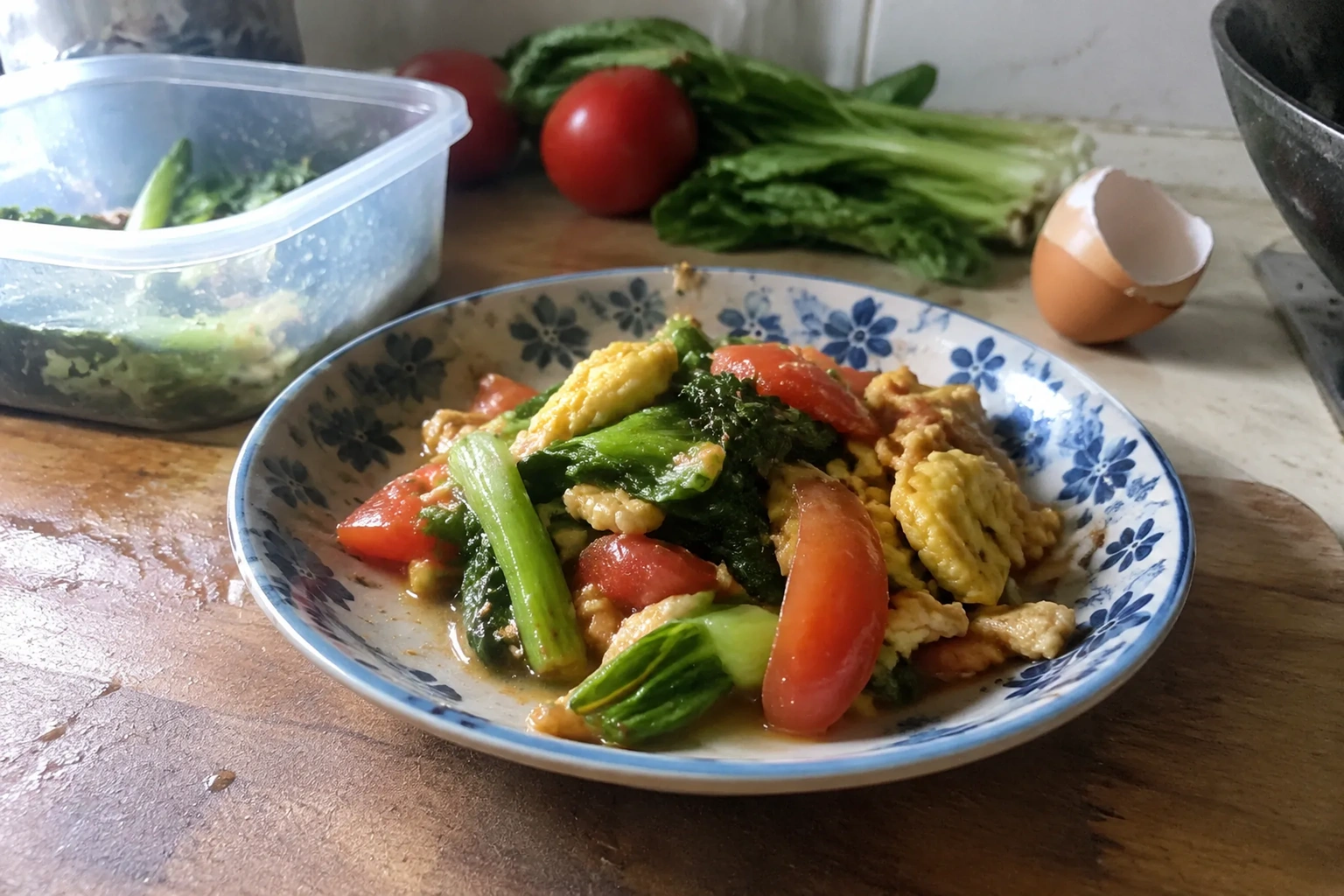
The scramble is the fastest. Eggs, hot pan, butter or oil, whatever vegetables are on hand cooked first until they are soft and a little browned, then the eggs beaten in. The key is to cook the vegetables properly before the eggs arrive, so nothing is raw and crunchy in the middle of the soft egg. A handful of chopped herbs at the end. A grating of cheese. A piece of toast made from yesterday's bread. This is a fifteen-minute meal that can absorb a soft pepper, a leftover potato, a couple of mushrooms, a spoonful of last night's greens.
The frittata is the same idea, scaled up and made slower. More eggs, a larger pan, a finish under the broiler or a low flame with a lid. It is the most forgiving dish in the kitchen. It can be eaten hot, warm, or cold. It can be sliced and taken to work. It improves in the refrigerator over a day or two, which is unusual and useful.
The soup is the slowest and the most capacious. Any vegetable, cooked in oil with an onion and some garlic, covered with stock or water, simmered until soft, blended or not, finished with something acidic and something rich. A squeeze of lemon. A spoonful of yogurt or cream. A drizzle of good olive oil. The soup is where the freezer trimmings go, where the soft carrot and the wilting celery and the last of the cabbage all find a use. It is also the most forgiving of mistakes. A soup that is too thin can be reduced. A soup that is too thick can be loosened. A soup that is bland needs salt, acid, or a hit of something cured and salty.
Why Ugly Vegetables Cook Better Than Perfect Ones
There is a practical argument for cooking with aging produce that goes beyond waste. The soft tomato has more sugar and more glutamate than the firm one. The wrinkled pepper is sweeter. The slightly dry mushroom has concentrated its flavor. The vegetable that has been sitting in the refrigerator is, in many cases, a better ingredient for cooking than the one that has just arrived from the shop.
This is the reason restaurant kitchens often buy produce specifically for aging. A tomato that is destined for sauce is not bought at its peak of firmness. It is bought and held until it is soft, then cooked down. The home cook who throws away the soft tomato is throwing away the better sauce ingredient and using the worse one instead. The logic is invisible because the supermarket has trained the eye to prefer the firm and the bright, but the kitchen has different priorities than the shelf.
The same is true of bread. Day-old bread is a better ingredient for panzanella, for croutons, for bread pudding, for a tomato sandwich where the bread should not fight back. The fresh loaf is for eating fresh. The aging loaf is for cooking, and it is the one that does the work.
A Week of Dinners From One Shopping Trip and Its Leftovers
Consider a week built around a single moderate shop. A chicken, a bag of rice, a few onions, a head of garlic, a bunch of parsley, a lemon, a bag of carrots, a couple of zucchini, a loaf of bread, a dozen eggs, a wedge of cheese, a tin of tomatoes. Nothing exotic. Nothing requiring a special trip.
Monday: roast chicken with carrots and onions. The carcass goes into a pot with water and the vegetable trimmings from the prep, simmered for an hour, strained, and put in the refrigerator for later. Tuesday: chicken and rice, made with the leftover meat and a quick broth from the carcass. Wednesday: a frittata with the last of the chicken, some cheese, and the parsley. Thursday: a tomato and bread soup, using the tin of tomatoes, the aging bread, and the broth. Friday: a scramble with whatever vegetables remain and a piece of toast. Saturday: a pot of beans, cooked from dry, with the last of the onion and garlic. Sunday: a soup made from the beans, the last of the carrots, and the frozen trimmings from the week.
None of these meals is fancy. All of them use the same ingredients in different configurations. The chicken is used three times. The bread is used three times. The broth is used twice. The parsley appears in three dishes. The lemon appears in two. Nothing is thrown out except the onion skins and the chicken bones, and the bones went into the broth first.
This is the rhythm that food waste resets are actually made of. Not a single dramatic change in shopping habits, but a shift in what counts as an ingredient. The soft zucchini is an ingredient. The stale bread is an ingredient. The half-bunch of parsley is an ingredient. The cook who sees them that way will cook with them, and the bin will stay emptier for it.
The Compost Bin as a Last Resort, Not a First
Composting has become the socially acceptable way to throw food away. It feels responsible. It is better than the landfill, where food scraps produce methane in the absence of oxygen. But it is still waste, and the energy, water, labor, and money that went into growing, transporting, and buying that food are still gone. The compost bin is a good backstop. It is a poor first choice.
The order of operations is simple. Cook it if it can be cooked. Freeze it if it cannot be cooked in time. Compost it only when neither of those is possible. Most of what ends up in the compost bin in a typical household could have been eaten, and the cook who learns to see the soft zucchini as the beginning of a meal rather than the end of one will find the bin filling more slowly each week.
The zucchini in the back of the refrigerator is not a moral failure. It is dinner, waiting to be noticed.





















