







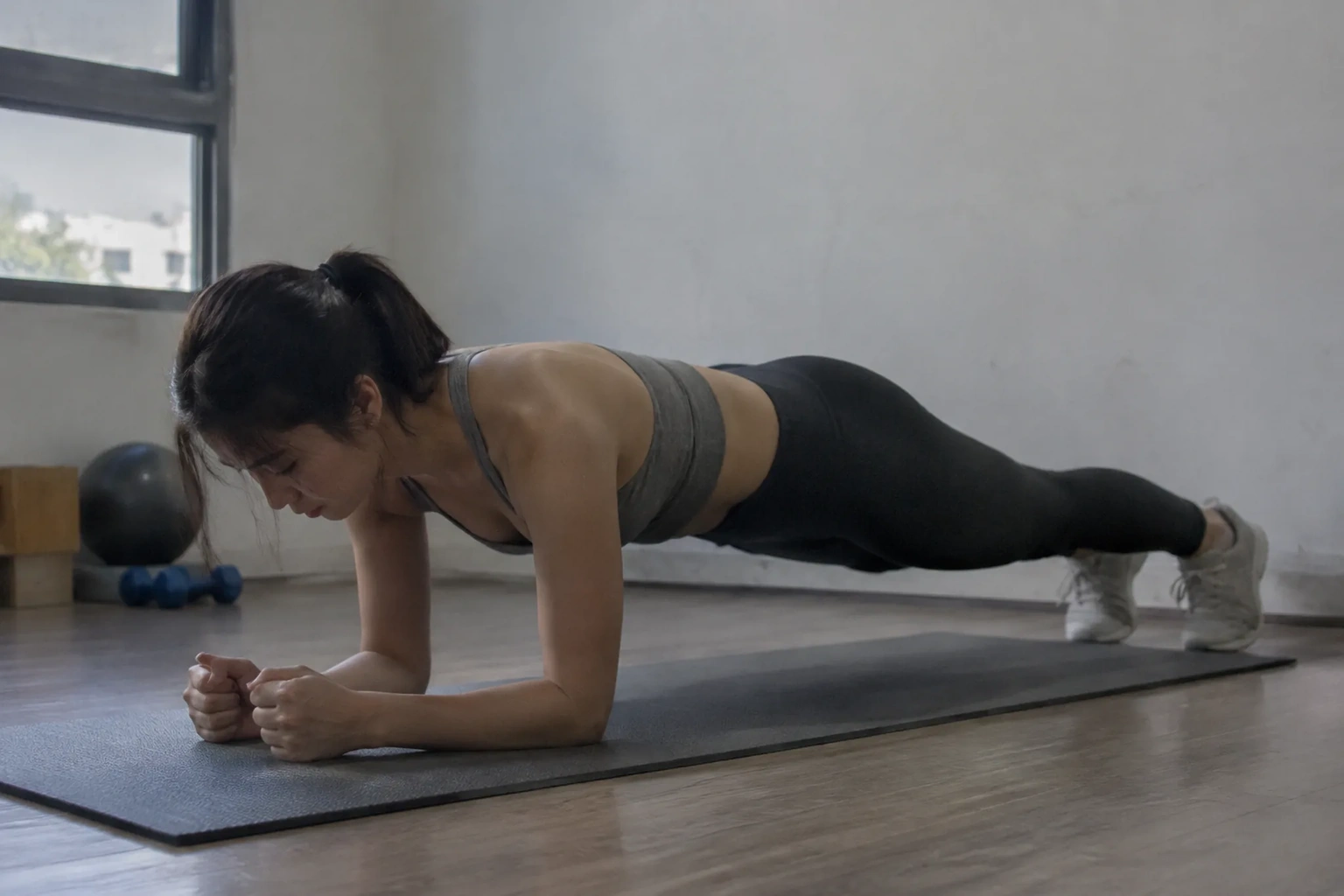
Planking looks like the easiest thing in the gym and is routinely the hardest. A body held still above the floor for a minute, no movement, no equipment, no excuse. Yet most people who drop to the floor in a living room and try it will feel their lower back sag within twenty seconds and call the exercise boring. The boredom is the point. Core strength built at home is mostly a negotiation with gravity and with patience, and the movements that matter are unglamorous, slow, and performed on a patch of carpet roughly the size of a bath towel.
The word "core" has been stretched to mean almost anything. In practice it refers to the cylinder of muscle wrapped around the spine and pelvis: the abdominals in front, the obliques at the sides, the deep muscles that stabilize the spine, and the muscles of the back and hips that work with them. A strong core keeps the trunk from folding under load, which is why it shows up in lifting a suitcase, carrying a child up stairs, and sitting through a long meeting without slumping. Home training does not need to build a magazine cover. It needs to build a trunk that holds its shape when something heavy arrives.
Why the floor is a better trainer than the machine
Gym core work often means a padded seat and a stack of weights. The home version has the floor, a wall, and body weight, which turns out to be enough. Body-weight work demands control rather than load, and control is where beginners make the fastest progress. A person who can hold a proper plank for forty seconds has learned to brace the trunk without holding the breath, which transfers directly to picking up a heavy box.
There is also a practical argument. A routine that fits in a living room between the coffee table and the sofa gets done. A routine that requires a drive, a locker, and a schedule gets skipped. The best home core work is short, repeatable, and slightly uncomfortable, and it lives on the same floor where the person already walks barefoot every morning.
The dead bug and the art of not moving
Lie on the back, arms pointed at the ceiling, knees bent at ninety degrees above the hips. Slowly lower one arm overhead and extend the opposite leg toward the floor, then return and switch sides. The lower back stays pressed to the ground the entire time. That contact is the whole exercise. The moment the back arches, the movement has become a hip exercise wearing a core costume.
Most people rush this one and get nothing from it. Slow it down until a set of eight takes a full minute. The dead bug teaches the trunk to stay locked while the limbs move independently, which is what happens when a person reaches for a high shelf while carrying weight in the other hand. It is also the safest starting point for anyone with a sensitive lower back, because nothing is loaded and nothing is twisted.
A plank held correctly is a full conversation with the floor
The standard forearm plank gets mocked because it looks static. Held with attention, it is anything but. Elbows under shoulders, feet hip-width, hips level, ribs pulled down toward the pelvis, and a hard squeeze through the glutes. The whole body should feel like one stiff board, and the first sign of failure is usually the hips dropping or the lower back dipping toward the floor.
Twenty seconds of a truly braced plank beats two minutes of a sagging one. Beginners should start at fifteen to twenty seconds and add five seconds per week, stopping the moment form breaks. The temptation to grind out a long, sloppy hold is strong, and it teaches the body to compensate rather than stabilize. A short, honest plank three times in a row is the better habit.
Side planks and the muscles nobody trains
The obliques, the muscles along the sides of the waist, are the most neglected part of the core in home training. A side plank, propped on one forearm with the feet stacked and the hips lifted, hits them directly. Most people discover a weakness here fast: the hips sag, the top shoulder rolls forward, and the whole position feels fragile for the first few sessions.
A modified version on the knees is a legitimate starting point, not a lesser one. Twenty seconds per side is a good target. The value shows up in daily life as the ability to carry a heavy bag on one side without the torso collapsing toward it, and in the way a person turns to reach something behind the seat of a car without wrenching the lower back.
Glute bridges belong in core work, whatever the purists say
The hips and glutes anchor the core at the bottom. A glute bridge, lying on the back with knees bent and lifting the hips until the body forms a straight line from shoulders to knees, trains the back of the trunk to work with the front. Squeeze at the top for a full second, lower with control, and keep the ribs from flaring open as the hips rise.
This is the exercise that quietly fixes the posture of anyone who sits at a desk all day, because it wakes up muscles that long sitting has put to sleep. Two sets of ten, done slowly, is plenty. The bridge also serves as a diagnostic: if the lower back arches before the hips lift, the glutes are not doing their share, and the core work should stay gentle until they are.
The bird dog and the spine that stays quiet
From hands and knees, extend one arm forward and the opposite leg back until both are level with the torso, hold for two seconds, return, and switch. The hips stay square to the floor and the lower back does not move. It sounds simple and exposes coordination problems immediately: the raised hip tilts, the supporting arm shakes, and the whole body wants to rotate.
That wobble is useful information. The bird dog trains the deep spinal stabilizers to hold the trunk steady while the limbs do their own work, which is the exact demand of walking down stairs with a laundry basket. Five slow reps per side, with a pause at full extension, is a solid set. Rushing through ten fast reps defeats the purpose entirely.
How often, and how hard, without wrecking the back
Core work at home does not need to happen daily. Three sessions a week, fifteen to twenty minutes each, is enough for most people to see real change in six to eight weeks. The muscles respond to frequency and consistency more than to intensity, and a short session done on a Tuesday evening beats an ambitious one planned for a Saturday that never arrives.
A simple circuit works well: dead bug, plank, side plank each side, glute bridge, bird dog. Two rounds, with rest as needed. The rule that matters is form over duration. The moment a position collapses, the set is over, and that is not failure. It is the signal that the muscles have done their work for the day.
Sharp pain in the lower back during any of these is a stop sign. Dull effort in the muscles is expected; a joint that complains is not. Anyone with an existing back injury should get a clinician's clearance before starting, and nobody should push through pain to prove toughness to an empty living room.
Breathing, because a braced trunk still needs air
The most common mistake in home core training is holding the breath through every hold. A trunk that is braced but not breathing is a trunk that will fail under real load, because real load happens while a person is talking, walking, and exhaling. The cue is simple: keep the brace, keep breathing, and let the ribs expand against the resistance of the abdominal wall.
Practice this during the plank. Take slow breaths and feel the ribs move while the hips stay level. It makes the hold harder and more useful at the same time, and it is the difference between a core that looks trained and one that works when a person bends to pick up a squirming toddler.
The living room floor teaches patience
Progress in core strength is slow and almost invisible. There is no mirror moment, no dramatic before and after, just a gradual shift in how the body handles the ordinary: a heavier grocery bag carried without a lean, a longer stretch of sitting without the lower back ache, a stumble on the stairs that gets caught instead of ending on the floor. Those small corrections are the actual payoff, and they arrive quietly, over weeks, on a patch of carpet in the corner of a room.





















