







By nine in the evening, most households have already made the decisive choice about how the night will go, and almost nobody notices making it. The overhead light in the kitchen gets flipped on for dinner and stays on. A laptop stays open on the sofa. The phone sits face-up on the arm of the chair, lit by a notification, then another. None of these is a crisis. Together they set a physiological posture that the body will carry into the bedroom two hours later.
A calm evening routine is not a spa ritual and does not require candles, a diffuser, or a hard stop on all fun after sunset. It is a sequence of small environmental and behavioral choices, repeated roughly the same way most nights, that give the nervous system a runway long enough to land. The runway matters more than any single item on it.
The body reads the hour before it reads the clock
Human sleep timing is governed in large part by light exposure and by the gradual slackening of alertness that comes from doing less. The body does not have a switch labeled bedtime. It has a slope, and that slope gets built or destroyed in the two to three hours before bed.
This is why a late evening spent under bright overhead lighting feels different from the same hours spent under a single lamp, even when the activity is identical. The intensity and color of light reaching the eyes in the evening sends a signal about whether the day is still going. Cool white light at full brightness at 10 p.m. tells the system it is midafternoon. A warm, dimmer pool of light tells it something else.
The same logic applies to stimulation. A tense phone call at 9:45 does not evaporate at 10. A work email read in bed keeps a low hum of vigilance running. The routine is not about avoiding all of this perfectly. It is about building enough buffer that one late message does not land directly on the pillow.
Two hours out: lowering the light ceiling
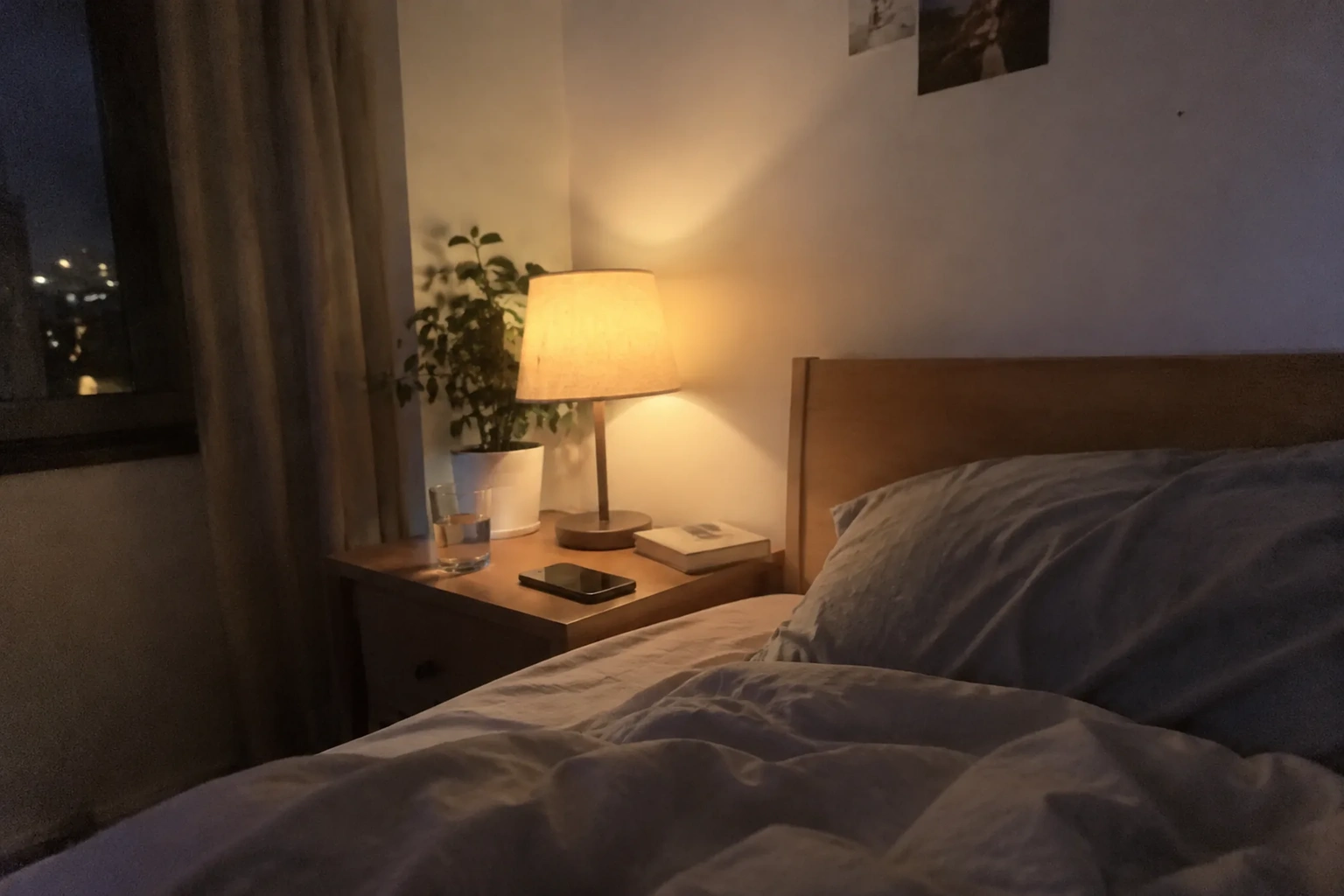
The first move in a calm evening is usually the cheapest and the most effective: after dinner, stop lighting the room like a workplace. Kill the overheads. Turn on lamps with warm bulbs, ideally ones placed lower than eye level, so the light pools on surfaces rather than pouring down from above. A floor lamp beside a chair changes the character of a room more than most people expect.
There is a practical reason to make this change early rather than at the moment of getting into bed. The eyes adapt to dim light over roughly twenty minutes, and the shift itself is part of the signal. A person who steps from a bright kitchen into a dim living room at 8:30 has already begun the descent. A person who stays under the same fluorescents until 10:45 and then flips them off has compressed the whole transition into minutes.
Screen brightness belongs in this same conversation, though the popular framing has gotten a bit overheated. The blue light from a phone is not a poison, and a single episode of something on a tablet will not derail a night. What matters more is the total luminance hitting the face and the way a bright screen becomes the brightest object in an otherwise dim room. Turning the display down, enabling a warmer night setting, and keeping the screen a comfortable distance from the face handles most of it.
The kitchen closes at a set time
Late heavy meals sit in the stomach for hours and tend to make the first part of the night restless, especially for people prone to reflux. A general guideline that holds up: finish the main meal two to three hours before lying down, and treat anything after that as a small snack rather than a second dinner.
Alcohol deserves its own line because it is so often miscast as a sleep aid. A drink in the evening can make falling asleep feel easier, and then the second half of the night tends to get choppier, with more waking and a lighter, less restoring quality overall. A routine that quietly includes a nightcap is not really a calm routine; it is a routine with a sedative in it. Keeping alcohol to earlier in the evening, and modest, is a reasonable compromise for people who are not going to give it up entirely.
Caffeine is the other kitchen item with a long tail. Its effects can persist for many hours, and an afternoon coffee at 3 p.m. is still measurably in the system at 9. Anyone who has tried moving the last coffee to before noon and noticed a difference has already run the experiment.
A shutdown ritual for whatever is still unfinished
The single most underrated element of an evening routine is a short, deliberate period of writing things down. Not journaling in any reflective sense. A plain list: what got done, what did not, what comes first tomorrow. Ten minutes at the kitchen table with a pen.
The purpose is to give the mind a place to put the open loops. Most evening mental churn is not deep anxiety; it is the low-grade hum of unfinished tasks and unsent messages circling for lack of an outlet. Putting them on paper converts them from something the brain has to keep holding into something external and scheduled. People who do this often report that the list is rarely looked at the next day. That is fine. The list did its job the night before.
This ritual also functions as a boundary marker. Work ends here. Email ends here. The remaining hours belong to something else. Without a marker, the workday tends to bleed into the whole evening, and the body never quite gets the signal that the shift has happened.
The last hour belongs to low-stakes activity
What actually happens in the final hour matters less than its emotional temperature. Reading, folding laundry, a slow stretch, a shower, a quiet conversation, a familiar show: all of these work. The common thread is that none of them demand performance, and none of them spike arousal right before bed.
The shower is worth a specific mention. A warm shower roughly an hour before bed causes a small drop in core body temperature afterward as the body sheds heat, and that drop is one of the more reliable physiological cues for sleep onset. The timing is what makes it work. A shower five minutes before climbing into bed misses the window.
What to avoid in this hour is more predictable: intense exercise, heated arguments, gripping news, anything that raises the heart rate or the stakes. A person who finishes a tense phone call at 10:50 and then lies down at 11 has essentially skipped the runway.
The bedroom as a room with one job
Bedrooms drift. A desk appears. A television gets mounted. Laundry piles on the chair. Over months, the room becomes a second living room, and the association between the bed and sleep weakens. Rebuilding that association is one of the more durable changes a person can make.
The practical version: keep the bed for sleep and intimacy, move the screens and the paperwork elsewhere if possible, and keep the room cool. A bedroom around 65 to 68 degrees Fahrenheit suits most adults, with room to adjust for personal preference. Darkness matters too, and blackout curtains do more for early summer mornings than most alarm clocks.
For anyone who cannot fall asleep within roughly twenty minutes, the standard advice is to get up, leave the room, and do something dull in low light until sleepy. Lying in bed frustrated teaches the brain that the bed is a place for frustration. Breaking that loop is more useful than any pillow upgrade.
The same sequence most nights, with room for a bad one
A routine works through repetition, and repetition requires that the routine be survivable on a Tuesday when a child is sick or a deadline ran long. The version that gets abandoned after two weeks is the version that was too elaborate.
The realistic build is a short list of anchors: overhead lights off after dinner, screens dimmed, food finished early, a ten-minute list, a shower, a book. On a good night, all of it happens. On a bad night, maybe two of those things happen, and the body still gets a partial signal.
Consistency across nights does more than perfection on any one night. A person who dims the lights and writes a list five nights a week will, over a month, feel a different quality of evening than someone who attempts a full ritual once and gives up when it does not stick. The point of the routine is that it becomes the default, the thing that happens without a decision.
What a calm evening is actually buying
The end result of all of this is not a perfect night of sleep. It is a shorter distance between the end of the day and the moment of lying down, and a body that arrives at that moment already partway down the slope. The overheads are off. The list is on the table. The phone is charging in another room. The room is cool and dark and does one thing.
That is the whole architecture. Small, repeatable, unglamorous, and far more effective than the collection of gadgets marketed for the same purpose. The routine works because it is boring, and it survives because it is short enough to keep.





















