







The vending machine at the end of the corridor is a small, humming casino. It glows. It has buttons that light up. It takes a dollar and thirty-five cents and returns a bag of something that tastes like salted cardboard and regret. The pleasure lasts about ninety seconds, and then comes the particular hollow feeling of having paid for disappointment in exact change.
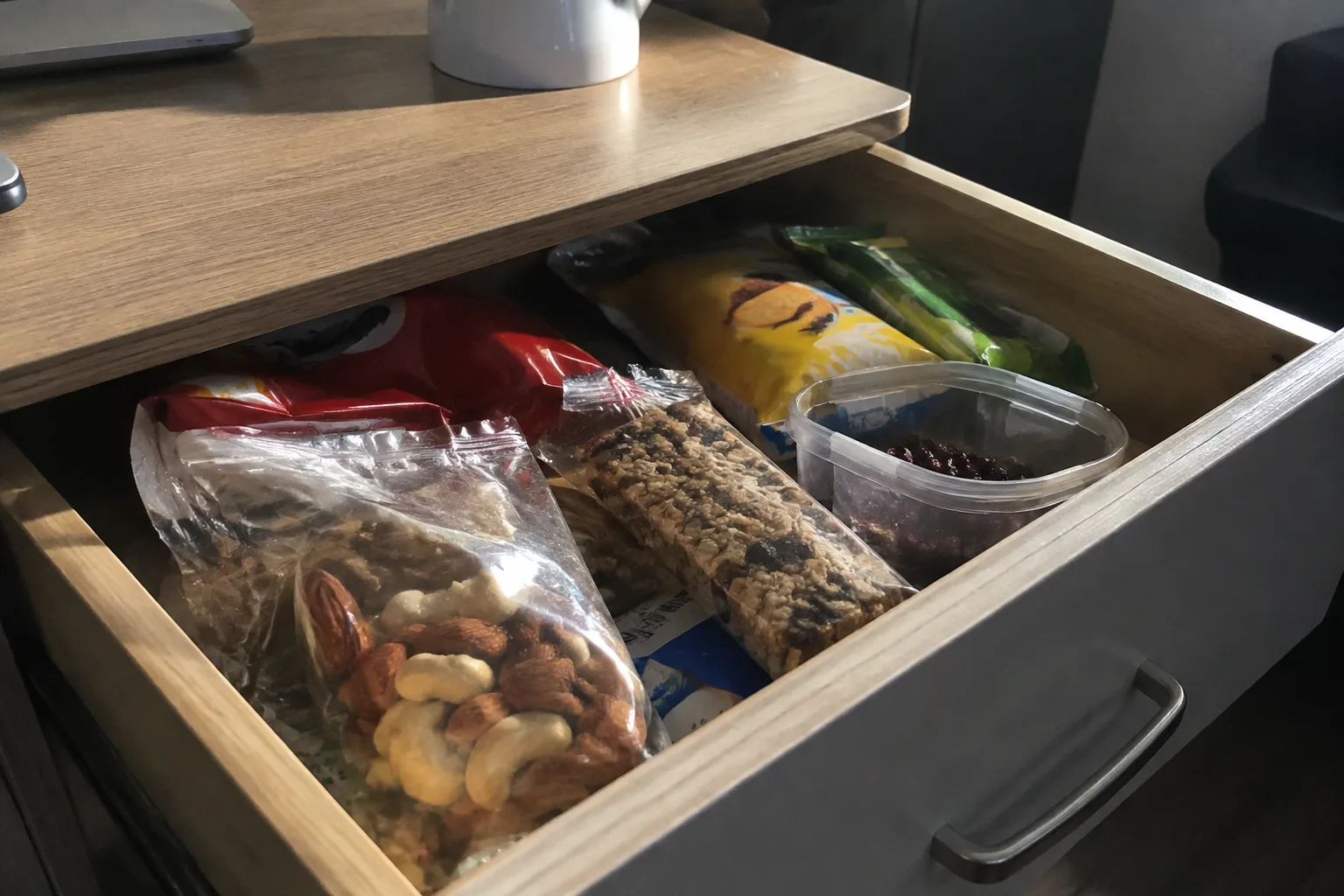
There is another way, and it lives in the top right drawer of the desk. The drawer where the pens go to die and the charger cables tangle into a nest. That drawer can be a better snack operation than the machine down the hall, and it costs less per week, and it does not make that grinding noise when it gets stuck.
The case for the desk drawer rests on three things the vending machine cannot offer: portion control, ingredient control, and the simple dignity of not standing in a hallway at three in the afternoon deciding between two brands of corn chip that are the same brand of corn chip.
What the Machine Actually Sells
Walk the aisle of a typical vending machine and the inventory sorts itself into a few families. There are the puffed and the fried: chips, cheese curls, pretzel sticks, the onion-ring-shaped things. There are the baked sweets: honey buns, little pies, cookies in cellophane. There are the sugar drinks and the energy drinks. And there is the sad shelf at the bottom where the granola bars go, the ones that taste like compressed sawdust held together with caramel.
The nutritional shape of that inventory is consistent: heavy on refined starch, heavy on sodium, heavy on added sugar, and light on protein and fiber. A person eats a bag of chips and is hungry again inside the hour, because the bag delivered calories without much satiety. That is the machine's real trick. It sells hunger back to itself.
The desk drawer can do better, and it does not require a nutrition degree to set up. It requires a short shopping trip and a willingness to repackage things into smaller containers.
The Nut Problem and How to Solve It
Nuts are the obvious desk snack, and the obvious desk snack has an obvious failure mode: the big bag. A pound of almonds at the bottom of a drawer is a portion-control problem disguised as a healthy choice. The hand goes in, the hand comes out, and nobody counts. By Friday the bag is a crinkled shell and the week's snack budget has vanished into a low-grade almond haze.
The fix is mechanical. Buy the big bag, then immediately divide it into small containers or paper snack bags, roughly a handful each. Twenty-five to thirty grams is a reasonable single portion, which is a small ramekin or a couple of tablespoons, not a cereal bowl. Do the division on Sunday evening and the drawer holds five days of snacks, each one already measured, each one a decision already made.
Almonds and walnuts hold up well in a drawer for a couple of weeks. Cashews go soft faster and are best eaten within a week or so of opening. Pistachios in the shell are a special case: the shelling slows a person down, which is either a feature or a nuisance depending on the mood. On a stressful afternoon it is a feature.
Roasted Chickpeas and the Crunch Category
The hardest thing to replace in the vending machine is crunch. The chip delivers a specific texture that a carrot stick does not, and a desk drawer that offers only soft and chewy things will lose to the machine every time.
Roasted chickpeas are the workhorse here. A can of chickpeas, drained and dried, tossed with a little oil and salt and paprika, spread on a sheet pan and roasted at around 400 degrees until they rattle, produces a snack that crunches like a chip and carries protein and fiber that a chip does not. They keep in a loosely covered container for several days, though they lose their snap if sealed while still warm. Let them cool fully on the pan before they go anywhere near a lid.
The same treatment works on edamame, on fava beans, on split peas. The technique is the same and the result is a shelf-stable crunch that does not come from a fryer. A small container of these in the drawer covers the afternoon chip craving with something that actually holds a person until dinner.
The Case for the Plain Rice Cake
Rice cakes have a bad reputation, largely earned by the flavored ones that taste like a chemistry experiment. The plain, unsalted, brown-rice version is a different object. It is a delivery system: dry, crisp, neutral, and sturdy enough to hold a topping without disintegrating.
Kept in the drawer with a small jar of peanut butter or a wedge of hard cheese, the rice cake becomes a two-minute snack that has actual protein and actual crunch. The drawer version is not glamorous. It is functional, and it beats a honey bun on every axis except the sugar rush, which is the axis a person is trying to avoid anyway.
The rice cake also solves the smell problem. A drawer full of snacks can turn into a drawer full of smells, and the neutral rice cake does not contribute. It waits, quietly, for its topping.
Dark Chocolate and the Afternoon Slump
The three o'clock slump is real and the machine knows it. The slump wants sugar, and the machine sells sugar in a dozen forms. The drawer can meet the same craving with a smaller, better dose.
A bar of dark chocolate, broken into squares and kept in a small tin, delivers the same mouthfeel and the same small pleasure as a candy bar, with less sugar and more intensity. Two squares is a snack. Half a bar is a mood. The tin matters: it slows the hand down and it keeps the chocolate from melting into the drawer's other contents on a warm day.
Dark chocolate also pairs with the nuts and the rice cakes, which means the drawer can produce a small, composed snack from three separate containers without any of them being a full meal. That is the whole point of the drawer: it is a pantry in miniature, and a pantry in miniature can compose.
The Fresh Problem
Anything fresh has a short clock, and a desk drawer is not a refrigerator. An apple in a drawer for a week gets soft. A banana in a drawer for three days perfumes everything around it. Fresh fruit belongs in a lunch bag or on the kitchen counter, not in the drawer as a permanent resident.
The drawer-friendly exceptions are the sturdy ones: a bag of baby carrots, a box of cherry tomatoes, a cucumber that can be sliced at the desk if the office has a knife and a cutting board. These are not shelf-stable, and they need to be eaten within a few days. Treat them as visitors, not residents.
Dried fruit is the resident version. Raisins, dried apricots, dried mango, dried cranberries. These keep for weeks and deliver sweetness with a little fiber. The caveat is the same as the nuts: a handful is a portion, and a bag is a binge. Repackage on Sunday with the nuts and the drawer holds a week of sweet and salty in measured doses.
The Container and the Rotation
A drawer full of open bags is a drawer full of stale snacks. The container is not decoration. It is the mechanism that makes the whole operation work.
Small glass jars with clamped lids, or the plastic deli containers that stack, or heavy paper snack bags folded and clipped. Each one holds a single portion or a single category. Each one is labeled with a marker if the office has a marker and a person who cares. The label is not for aesthetics. It is for the moment when the drawer is opened at four in the afternoon and the contents need to be legible at a glance.
Rotation matters too. The snacks that go stale fastest go at the front. The shelf-stable ones go at the back. On Friday the drawer gets a quick audit: what is soft, what is empty, what needs replacing on the next grocery run. Five minutes on a Friday saves the whole operation from turning into a drawer of forgotten crumbs by the following Thursday.
The Cost of the Whole Operation
A person who uses the machine twice a day at a dollar and a half a purchase is spending about fifteen dollars a week, or roughly seven hundred and fifty dollars a year, on snacks that make them hungrier than they started. That is a real number and it is worth sitting with.
The drawer version costs less per week, and the food is better, and the portions are already measured. A bag of almonds, a can of chickpeas, a bar of dark chocolate, a box of rice cakes, and a bag of dried apricots runs maybe twenty-five dollars and lasts a couple of weeks with the nuts stretched by repackaging. The math is not close. The machine is a convenience tax on people who are too busy to plan, and the planning takes one Sunday evening and a stack of small containers.
The drawer also has a secondary benefit that the machine cannot match: it is quiet. No humming, no grinding, no button that lights up and then does nothing. It just sits there, holding a week of small decisions already made, waiting for the afternoon to get hard.
By the following Monday the drawer is restocked, the containers are labeled, and the machine down the hall glows in the corridor for someone else. The person at the desk opens the top right drawer, takes out a small jar of roasted chickpeas, and gets back to work without standing in a hallway deciding between two brands of corn chip that are the same brand of corn chip.





















