







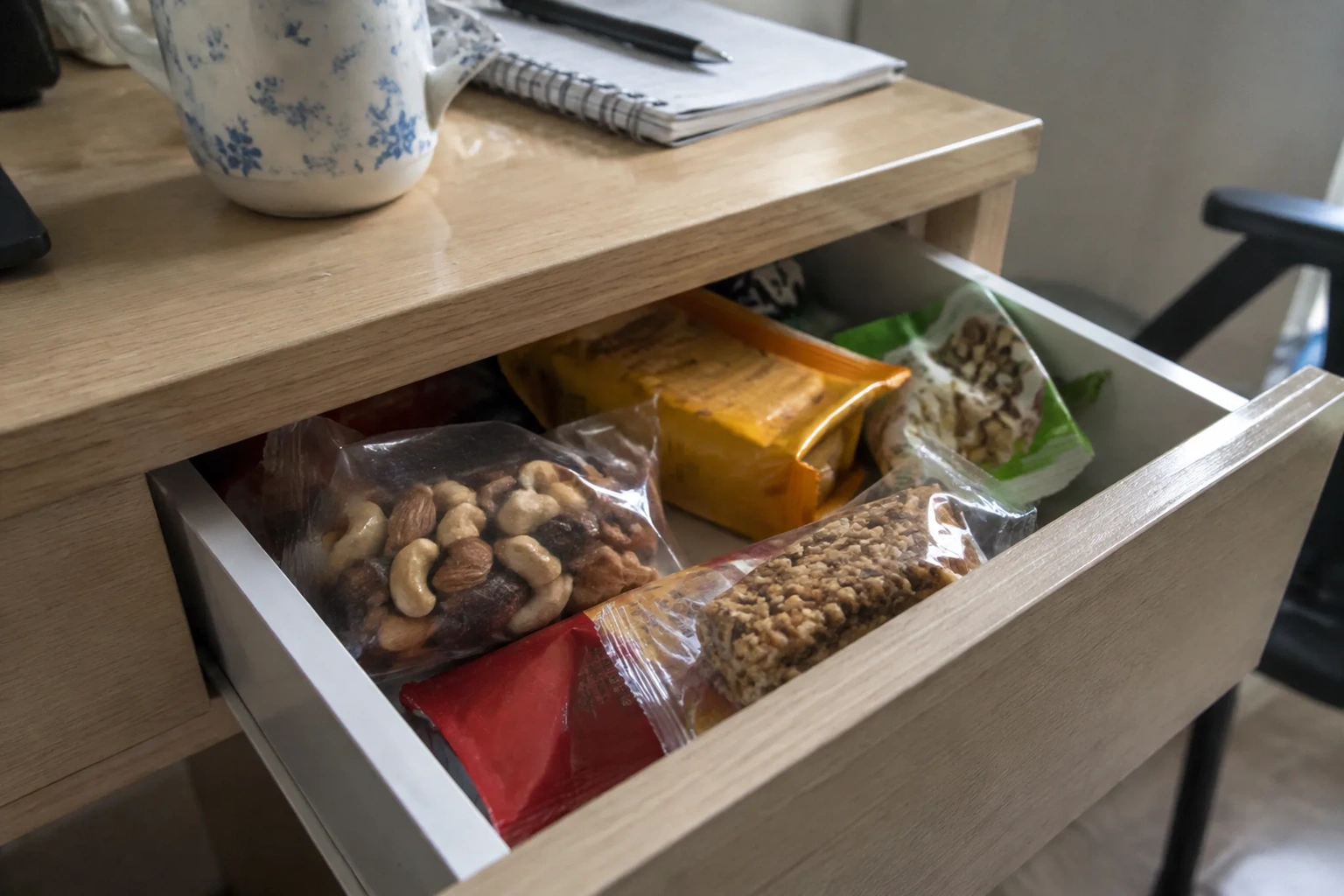
The bottom right drawer of a typical office desk holds a predictable museum of good intentions: a protein bar from eighteen months ago, a bag of trail mix with the almonds picked out, three sad crackers in a sleeve. The impulse behind that stash is sound. A working day runs long, lunch gets pushed, and the vending machine down the hall sells nothing that treats a digestive system kindly. The problem is that most desk-drawer snacks are chosen for shelf life and convenience, two qualities that rarely overlap with easy digestion.
What a person actually wants from a drawer snack is modest. Something that quiets a stomach between meetings, does not demand refrigeration, survives a warm office in July, and does not leave a body feeling heavy or gassy an hour later. That is a narrower brief than the snack aisle suggests, and it rules out a surprising number of the obvious candidates.
Why the Drawer Itself Works Against Digestion
Desk drawers are dark, room-temperature, and often forgotten for weeks. They are also the place where snacks go to be eaten in a hurry, at a keyboard, between tasks. That combination matters. A snack eaten fast, standing still or hunched over a monitor, tends to be chewed poorly, and poorly chewed food puts more work on the stomach and the gut below it. The drawer snack that supports digestion has to be something a person will actually slow down to eat, which means it needs texture that resists mindless inhaling.
There is a second, quieter issue: most drawer snacks are engineered for a long shelf life, which usually means low moisture, refined flour, added sugars, and a texture that stays the same for a year. Those qualities are not inherently hostile to digestion, but a diet that leans on them for weeks tends to lack the fiber and moisture that keep the digestive system moving comfortably.
The Fiber Problem With the Classic Granola Bar
The granola bar is the default desk snack, and most of them are worse than they look. A typical mass-market bar lists honey or brown rice syrup as the second or third ingredient, with a modest amount of oats and a lot of puffed rice. The result is a bar that delivers quick sugar, some fat, and a small amount of fiber, wrapped in a package that promises more than it gives.
Digestively, the trouble is the sugar load without the fiber to slow it down. A snack that spikes blood sugar and then drops leaves a person hungry again within the hour, which invites a second bar, and the cycle repeats. Better choices in the same category exist: bars built around whole nuts, seeds, and a base of dates rather than syrup, or the plain oat-and-nut bars with a short ingredient list. The test is simple. If the first three ingredients include a syrup, the bar is candy in a health-food costume.
Roasted Chickpeas and the Crunch That Satisfies
A small bag of roasted chickpeas sits in a desk drawer well for months, needs no refrigeration, and delivers a genuinely useful combination: plant protein, fiber, and a firm crunch that forces a person to eat them one at a time rather than by the handful. That last point is not trivial. The physical effort of crunching slows the eating, and slower eating gives the gut a better chance to signal fullness before the bag is empty.
The caution with chickpeas, and with any legume, is portion size. A whole bag eaten in one sitting can leave a stomach feeling distended and gassy, especially for someone whose diet does not regularly include beans. A quarter-cup serving is plenty for a between-meetings snack. The drawer version should be a small bag, not the family-size one, for exactly this reason.
Dried Fruit, With the Water Caveat
Dried apricots, prunes, and figs are among the most shelf-stable snacks that actually do something for digestion. Prunes in particular have a long folk reputation and a reasonable fiber content, and a few of them in the afternoon can head off the constipation that comes from sitting at a desk all day and drinking too little water.
The caveat is hydration. Dried fruit pulls water into the gut, and eaten in quantity without enough fluid, it can have the opposite of the intended effect, leaving a person bloated and uncomfortable. A desk drawer should therefore hold dried fruit next to a water bottle, and the snack should come with a glass of water, not a coffee. Four or five apricots, or two or three prunes, is a sensible serving.
Plain Nuts and the Serving-Size Trap
Almonds, walnuts, and pistachios are the workhorses of the desk drawer. They keep for months, need no refrigeration, and supply fat, protein, and fiber in a package that does not spike blood sugar. Walnuts bring a useful amount of omega-3 fat, and almonds a decent dose of fiber, though the amounts are modest per handful and should not be overstated.
The trap is the handful that becomes three. Nuts are calorie-dense and easy to eat without thinking, and a large bag in a drawer invites exactly that. The practical fix is portioning at home: small bags or small containers holding roughly a quarter cup, so the drawer holds a snack rather than an open-ended supply. Pistachios in the shell have an added advantage, since shelling them slows the pace considerably.
The Case for Plain Crackers and a Jar of Peanut Butter
Whole-grain crackers with a spoonful of natural peanut butter make a drawer snack that is more satisfying than either part alone. The crackers supply a little fiber and a lot of crunch, and the peanut butter adds protein and fat that slow the whole thing down. A small jar of peanut butter, the kind that needs stirring, keeps for weeks in a drawer and turns a bland cracker into a real snack.
The plainness matters. Crackers loaded with seasoning and cheese powder are salty and easy to overeat, and the seasoning does nothing for digestion. A simple whole-grain cracker, a small jar of peanut butter, and a spoon is a complete desk kit, and it costs less than a week of vending machine visits.
What to Leave Out of the Drawer Entirely
Some snacks deserve to stay out of the drawer, not because they are poison but because they are the wrong tool for a between-meetings hunger. Candy bars, sugary granola bars, and flavored chips deliver quick energy and little else, and their sugar and salt load tends to leave a person hungrier and thirstier than before. Greasy snack mixes and cheese puffs sit heavily and are easy to eat by the handful.
The other category to leave out is anything that requires refrigeration or spoils quickly. Yogurt cups and cut fruit sound wholesome, but a drawer that reaches 80 degrees in summer is not a refrigerator, and a forgotten yogurt is a smell that ends careers. The drawer snack has to survive neglect, because neglect is what desk drawers do.
The Water Bottle Belongs in the Same Drawer
Digestion depends on fluid, and the single most common desk habit that works against it is drinking too little water and too much coffee. A drawer stocked with fiber-rich snacks but no water is a drawer that sets a person up for bloating and constipation. The practical move is to keep a refillable bottle in the same drawer as the snacks, or on the desk beside them, and to pair every dry snack with a few swallows.
This is unglamorous and easy to skip, which is exactly why it belongs in the plan. The snack choices get all the attention, and the water gets none, and yet the water is the part that makes the fiber work.
A Working Drawer, Stocked in Ten Minutes
A drawer that supports digestion does not need to be elaborate. It needs a small bag of roasted chickpeas, a container of plain almonds or pistachios in the shell, a handful of dried apricots or prunes, a sleeve of whole-grain crackers, a small jar of natural peanut butter, and a water bottle. That is six items, most of them cheap, all of them shelf-stable, and none of them requiring a refrigerator.
The rest is habit. Eat the snack slowly, at a desk or away from it, with water rather than coffee. Keep portions small and the bags small, so the drawer holds a snack and not a supply. And clear out the eighteen-month-old protein bar, because a drawer that still holds the old mistakes will keep getting opened for them.





















