







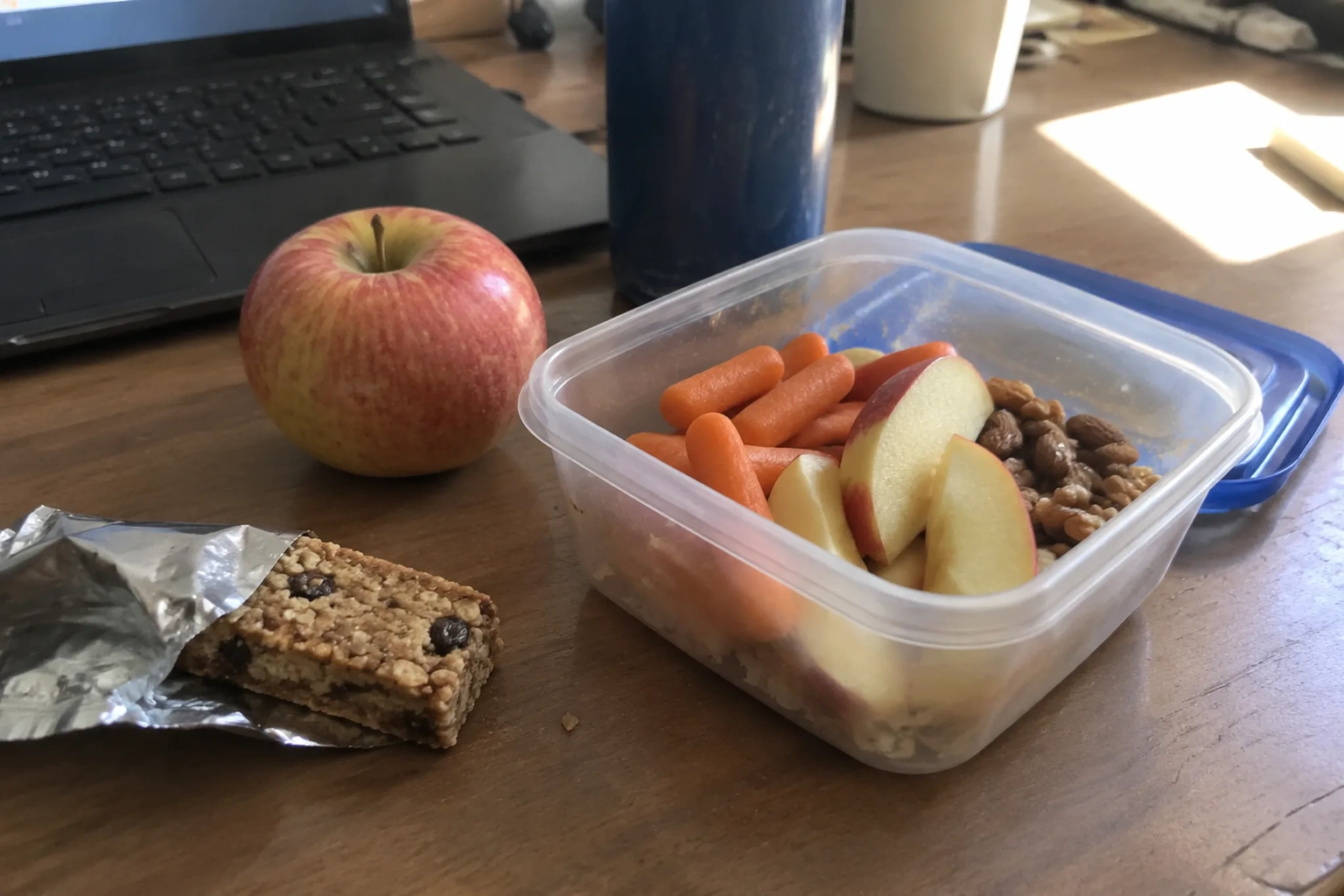
The desk drawer is a small museum of good intentions. A protein bar bought on a Tuesday in January sits under a tangle of charging cables, its wrapper slightly greasy. A bag of trail mix has gone soft. A packet of instant oatmeal, torn open and abandoned, has begun to smell faintly of the drawer itself. The lunchbox, meanwhile, has a different problem: everything in it was chosen that morning, under time pressure, and by the afternoon it has either been eaten or is being avoided.
The distance between those two containers is where most snack planning quietly fails. A snack that keeps a person steady through the long stretch between lunch and dinner has to survive two different environments and two different moods: the drawer, where it waits for weeks, and the lunchbox, where it waits for hours next to a cold pack and a bruised apple. The requirements are not the same, and the mistake is treating them as if they were.
The Mid-Afternoon Problem Is Not Hunger
By three in the afternoon, the body is not usually asking for a meal. It is asking for something that will not make the next two hours worse. The wrong snack produces a sharp rise and a matching fall, and the fall arrives exactly when the work gets tedious. The right one produces a slow, unremarkable steadiness that nobody notices, which is the point.
This is why the snack question is really a question about composition. A snack built mostly on refined starch and sugar will be digested quickly, and the crash that follows is reliable enough to schedule meetings around. A snack with protein, fat, and fiber moves through the system more slowly. The difference is not dramatic in any single afternoon. It compounds across a week of afternoons.
The practical target is a snack that pairs a carbohydrate with something that slows it down. An apple alone is fine. An apple with a spoon of peanut butter is better. A handful of almonds next to a few dried apricots beats either one eaten alone. None of this is exotic. The failure is almost never ignorance. It is the gap between knowing and having the right thing within arm's reach at the moment the energy dips.
Why the Desk Drawer Rewards a Different Kind of Snack
Anything stored in a drawer for a month has to tolerate neglect. No refrigerator, no cold pack, no one checking on it. That rules out fresh fruit, most dairy, and anything that turns rancid quietly. What survives is a narrow and slightly unglamorous category: nuts, roasted chickpeas, whole-grain crackers, shelf-stable cheese crisps, dried fruit, and the better class of packaged bar.
The trap in the drawer is the bar aisle. Most bars are candy in a matte wrapper, and the label confirms it: a long list of syrups and a protein number that comes from a isolate nobody would eat on its own. A decent bar has a short ingredient list and enough fat and fiber to slow the sugar down. The test is simple. If the first three ingredients are some form of sugar, it belongs in the candy drawer, not the work drawer.
Nuts deserve their own shelf. A small jar of almonds or walnuts, decanted into a container at the start of the week, solves the drawer problem almost completely. They keep for months, they need no refrigeration, and a modest handful with a piece of fruit is a genuinely steady snack. The only real risk is volume: a whole jar next to a keyboard disappears faster than anyone intends.
The Lunchbox Has the Opposite Constraint
A lunchbox snack has hours, not months. It will sit from morning until mid-afternoon in a bag that may or may not be cold. That short window opens up options the drawer cannot hold: a small cup of Greek yogurt, a boiled egg, a wedge of firm cheese, cut vegetables with a tub of hummus. These are the snacks that actually carry a person from lunch to dinner without a detour to the vending machine.
The lunchbox also has a texture problem the drawer does not. A snack eaten at a desk in front of other people should be quiet and tidy. Loud crunching, strong smells, and anything requiring two hands and a plate are out. A peeled hard-boiled egg is a fine snack and a poor office one. This is an unglamorous consideration that decides more snack choices than nutrition labels do.
Cold packs matter more than people expect. A lunchbox with a single small ice pack and a yogurt cup will be warm by early afternoon on a mild day. Two packs, or a frozen water bottle pressed against the dairy, buys the extra hours. The point is not food safety theater. It is that a snack which has gone warm and unappetizing gets skipped, and a skipped snack is the same as no snack at all.
What Actually Belongs in the Drawer
A workable drawer stock, chosen for shelf life and steadiness, looks roughly like this: a sealed container of mixed nuts, a bag of roasted chickpeas, a few whole-grain crackers, a bar or two of the short-ingredient kind, and a small stash of dried fruit. That is a drawer that can feed a person on a bad day without requiring a decision.
The container matters as much as the contents. Snacks left in their original bags get crushed, spill, and go stale. Decanting into small lidded containers at the start of the week turns a drawer into a pantry and makes the portion visible. A person reaching for a handful from a container takes a handful. A person reaching into an open bag takes whatever the bag allows.
There is also a rotation rule worth adopting. Anything that has lived in the drawer for more than a season should be eaten or thrown out. Drawers accumulate sad, forgotten food, and a drawer full of stale snacks is a drawer nobody trusts. A quarterly clear-out keeps the stock honest.
What Belongs in the Lunchbox
The lunchbox stock is fresher and more perishable by design. A small yogurt cup, a boiled egg, cut carrots or cucumber with a small tub of hummus, a portion of cheese, and a piece of fruit form a rotation that covers most of the week. The aim is one protein-forward item and one produce item per day, packed the night before so the morning does not decide.
Packing the night before is the single highest-leverage habit in this whole business. A snack chosen at 7 a.m. by a person already running late tends toward whatever is fastest, which is usually whatever is sweetest. A snack chosen at 9 p.m. by a person who has already eaten dinner tends toward something actually reasonable. The same person, two different decisions, one clear winner.
There is a case for a small dedicated lunchbox compartment for the snack, separate from the lunch itself. When the snack shares space with the sandwich, it gets eaten at lunch and then is gone by three. A separate compartment, packed as its own thing, survives until it is needed.
The Snacks That Fail Both Tests
Some snacks are wrong for both containers. Sugary granola bars, fruit snacks, and most flavored yogurt cups fail on steadiness. They spike and drop. Soft baked goods fail on storage. Chips fail on tidiness and on steadiness both. And the humble candy dish, refilled weekly by someone well-meaning, is a drawer snack that actively works against the goal.
The pattern behind all of these failures is the same: they are chosen for the moment of purchase, not the moment of consumption. A snack bought because it looked appealing on a shelf is not the same as a snack chosen because it will be eaten at 3 p.m. on a Wednesday by a person who is tired and slightly bored. The drawer and the lunchbox both reward the second kind of thinking.
Building the Two-Container Habit in One Sunday Hour
The whole system fits into an hour on a Sunday. Nuts and chickpeas go into containers for the drawer. A batch of hard-boiled eggs goes into the fridge. Vegetables get cut and stored in water. A stack of small hummus tubs gets bought. The lunchbox is packed the night before from that stock, and the drawer is restocked once a month from the same grocery run.
The reason this works is that it removes the decision from the tired moment. The person reaching into the drawer at three in the afternoon is not making a nutritional choice. They are making a reach. The Sunday hour decides what that reach finds, and the reach is where the whole thing succeeds or fails.
A drawer full of almonds and a lunchbox with a boiled egg in it will not transform anyone's life. What it will do is make the long afternoon slightly less of a slide, and slightly more of a steady walk. That is a modest outcome, honestly earned, and it is more than most snack advice delivers.





















