







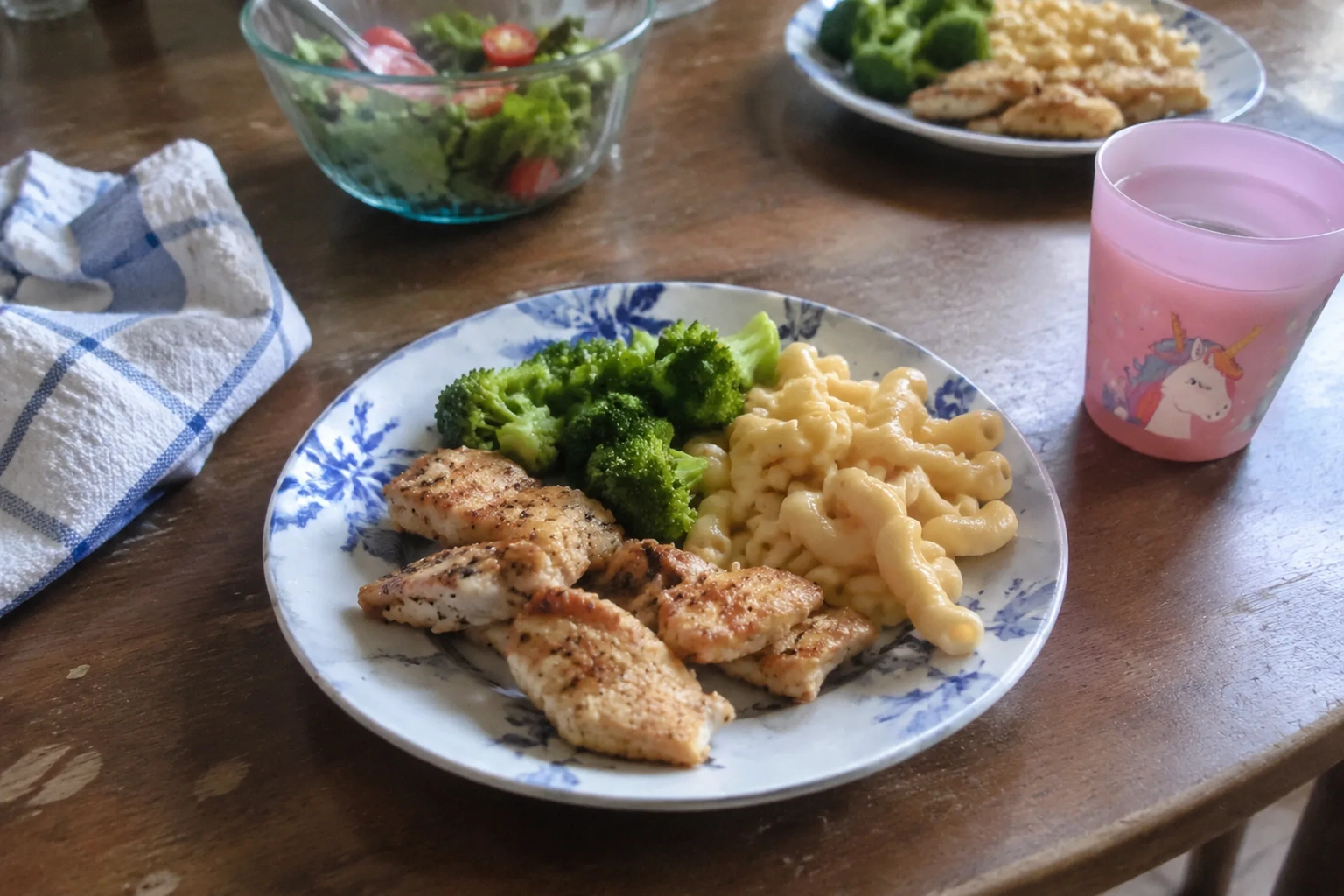
Chicken nuggets, buttered pasta, a bowl of white rice with nothing on it. These are the meals that make parents quietly despair, and they are also, by and large, the meals children ask for by name. The standoff between what a picky eater will accept and what a household wants to serve has a reputation as unwinnable. It isn't. The trick is to stop treating the child's plate and the adult's plate as two separate negotiations and start treating them as one dinner that gets divided at the last moment.
That single idea, divide late rather than cook twice, is the spine of everything below. A cook who keeps it in mind can serve roast chicken with a bright herb sauce one night and a plate of plain stripped-back chicken the same night, from the same pan, without a single extra pot. The rest is technique and a handful of reliable dishes.
The one-pan, two-plate method
Most vegetables and proteins can be cooked in a way that leaves them neutral, then dressed or sauced at the table. A tray of roasted carrots pulled from the oven is sweet and soft and unthreatening. The adult portion gets a spoon of cumin yogurt and a scatter of herbs. The child's portion gets nothing, or a slick of butter. Same carrots, same tray, two entirely different experiences on the plate.
The mistake many households make is seasoning the whole dish in the kitchen and then discovering the child won't touch it. Sauce on the side is not a compromise, it is the entire architecture. Adults who like big flavors still get them, because they can heap the sauce on. A picky eater gets the plain version and never feels like the odd one out.
There is a real advantage to this beyond peace at the table. A child who sees the same roasted vegetable served plain and also sees a parent spoon something bright over their own portion learns that food is a thing you adjust, not a fixed verdict delivered from the kitchen. The dish isn't "kid food" or "adult food." It's dinner, and people take it how they like it.
Pasta with a sauce that goes on at the table
Pasta is the great neutral canvas, and the reason it fails so often is that the sauce gets married to the noodles in the pan. Keep them apart. Boil the pasta, drain it, and toss a portion with butter or a little olive oil and grated cheese for the plain plate. The rest gets whatever the adults want: a garlicky tomato sauce, a punchy puttanesca, a lemony ricotta. The plain plate and the dressed plate come from the same pot of water.
This works with almost any shape. Rigatoni, penne, fusilli, plain old spaghetti. The pasta itself is a texture many picky eaters accept readily, and the neutrality of it is the point. Nothing is hidden. Nothing is sneaked. The child can see exactly what is on the plate and the adult can eat something with actual flavor.
One practical note: cook the pasta a minute past the adult ideal if a picky eater is at the table. Slightly softer noodles go down easier for a hesitant eater, and the adult portion can be pulled early if the cook wants it firm. Two strainers, one pot, a minute apart.
The sheet-pan dinner that splits cleanly
A sheet pan loaded with chicken thighs, cubed potatoes, and chunks of broccoli can feed a whole family from one oven and one wash-up. The trick is placement. Group the plainest items on one end and the seasoned, sauced, or spiced items on the other. The chicken thighs on the plain side get salt and a little oil. The ones on the seasoned side get paprika, garlic, and a squeeze of lemon. Everyone eats from the same pan.
There is a timing wrinkle worth knowing. Potatoes take longer than broccoli, so they go in first, then the broccoli joins for the last stretch. Chicken thighs are forgiving and can sit in a hot oven while the vegetables finish. A cook who plans the pan in layers ends up with everything hot at once, which is more than can be said for the cook who boils pasta, makes a separate sauce, and reheats a nugget tray.
The sheet pan also solves the presentation problem. Food that arrives on a shared platter invites a child to take what looks familiar. A platter of plain roasted potatoes next to a platter of lemony roasted potatoes lets a picky eater choose without a fight. The adults take from both. Nobody has been served a special meal, and nobody has been handed a lecture about trying new things.
Building a table of small, separate dishes
Some nights the easiest dinner is a spread of components rather than a composed plate. A bowl of plain rice, a bowl of beans, a dish of sliced cucumber, a plate of shredded chicken, a small pitcher of sauce. Everyone builds their own plate. The picky eater takes rice and cucumber and maybe a little chicken. The adults take everything and drown it in sauce. It is the same shopping list and the same kitchen work.
This style of eating has a long history in plenty of cuisines, and it happens to be enormously forgiving of a limited palate. A child who will eat plain rice and plain chicken is not being difficult at a table like this, because those things are on offer. No one has to cook a separate meal. The components are the meal.
The spread approach does require a small shift in mindset. A cook used to plating a finished dish has to get comfortable letting the table do the assembling. It is less precise and more generous, and it tends to produce calmer dinners, because there is nothing to reject. A plate is a series of choices, and a picky eater gets to make choices like everyone else.
The texture problem, which matters more than flavor
Many adults assume picky eating is about taste. More often it is about texture. A child who refuses a tomato will happily eat tomato sauce. A child who rejects a mushroom will eat mushroom soup if it's smooth. The mouthfeel of a food, its wetness, its sliminess, its resistance to the teeth, drives more refusals than any flavor does.
This is useful because texture can be engineered without changing the underlying ingredient. A vegetable can be roasted until crisp instead of steamed until soft. A sauce can be blended smooth instead of left chunky. A protein can be shredded instead of sliced. A cook who watches which textures a picky eater accepts can adjust the same ingredient into a form that gets eaten.
The flip side is that a food accepted one week can be refused the next, and this is normal. Texture tolerance shifts, sometimes with the seasons, sometimes with a growth spurt, sometimes for no visible reason. The household that keeps serving the plain version alongside the dressed one rides out these shifts without a crisis. The food is there. The child can take it or leave it. Dinner continues.
Sauce on the side is not a defeat
There is a persistent idea that serving plain food to a child is a kind of surrender, that the family table should be a place of adventure and the plain plate is a failure of nerve. This gets the incentives backward. A cook who insists on one dressed dish and watches a child eat nothing has not won anything. A cook who serves a bright, flavorful dish and a plain version alongside it has fed everyone and kept the table calm.
The plain version is also, quietly, a form of exposure. A child sees the same ingredient week after week in its neutral state, and the familiarity builds. The carrot is no longer a strange orange thing on the plate. It's the carrot that shows up on Tuesdays. Somewhere in that repetition, a bite gets taken. It rarely happens on a schedule, and it rarely happens because an adult argued for it.
What an adult plate can look like next to a child's
It helps to have a few concrete pairings in mind, because the divide-late method only works if the adult half is genuinely worth eating. A plain roasted chicken thigh next to the same thigh with a spoon of salsa verde and a squeeze of lime. Plain rice next to rice with a spoon of chili crisp and a fried egg. Plain pasta next to pasta tossed with garlic, anchovy, and breadcrumbs. The gap between the two plates is where the flavor lives, and the adult gets all of it.
The adult plate should not be a sadder version of the child's. That is the failure mode. If the plain plate is buttered pasta and the adult plate is also buttered pasta with a little pepper, nobody is eating well. The adult half needs its own bold gesture: acid, heat, herbs, a sauce with some backbone. The child gets the calm version. The adult gets the one worth looking forward to.
The leftovers that make the next night easier
One of the quieter benefits of cooking this way is that the plain components keep well. A pot of plain rice, a tray of roasted plain chicken, a bowl of plain steamed vegetables: all of these reheat into the next night's dinner with almost no work. The adult can dress a portion differently each time, so the same base produces a stir-fry one night and a grain bowl the next. The picky eater gets the familiar plain version and is perfectly content.
This is where the economics of the whole approach show up. Cooking two full meals a night is expensive in time and ingredients. Cooking one base and dressing it two ways costs almost nothing extra. The sauce is a spoonful. The herbs are a handful. The extra pan is not needed. A household can eat well on a picky eater's menu if the menu is designed to split at the end.
By the end of a week, a cook who has leaned on this method has a fridge holding several neutral components and a small collection of sauces and condiments. Wednesday's dinner is a matter of reheating and choosing. The picky eater is not standing in the way of a good meal. The good meal was built to accommodate the picky eater from the start.





















