







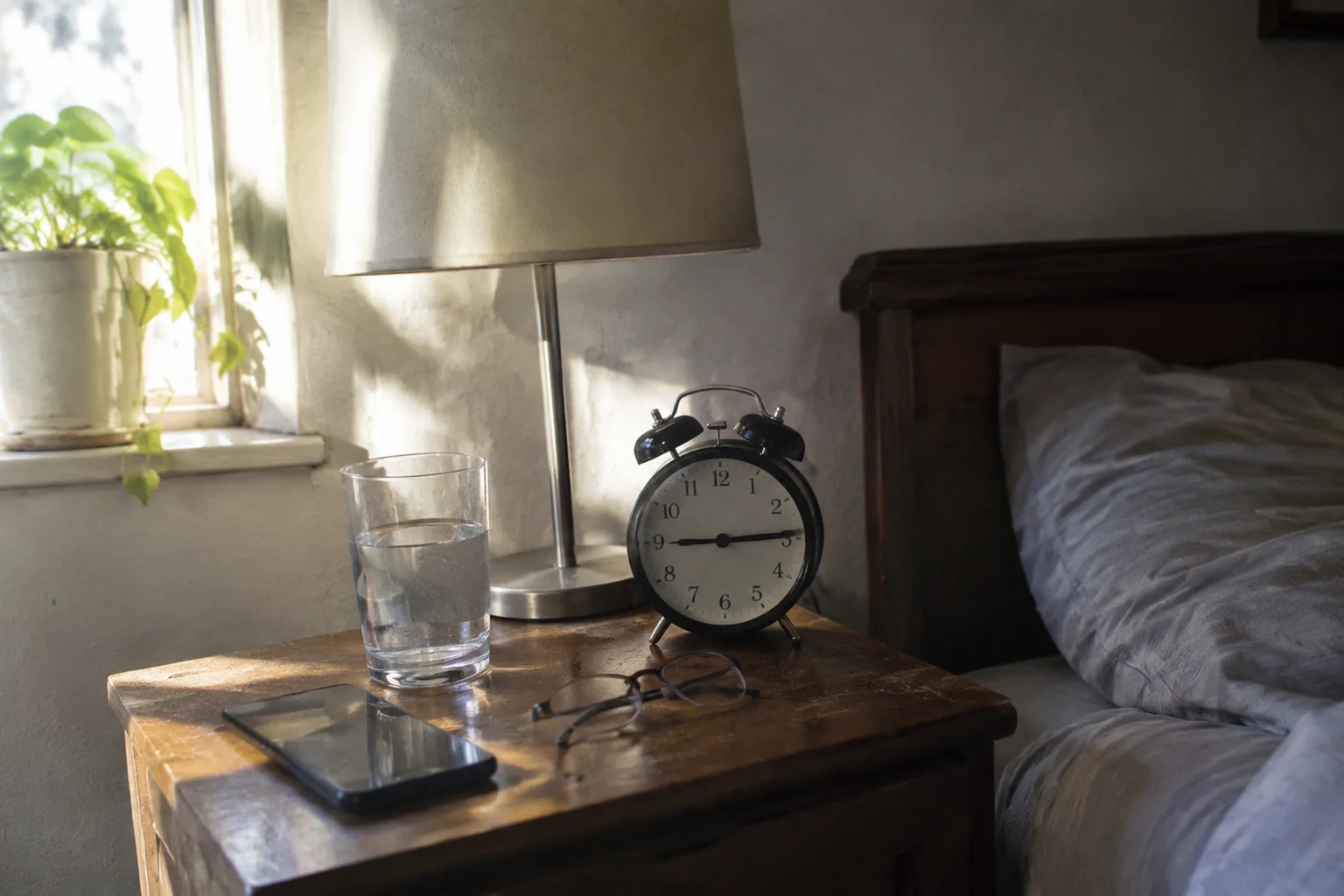
The hour before bed is the most overworked and least examined stretch of the day. It carries the weight of everything the daylight hours failed to finish: the dishes, the inbox, the half-read article, the vague dread about tomorrow's calendar. By the time most people climb under the covers, that hour has been spent on maintenance and distraction, and sleep arrives as an interruption rather than a landing.
Evening habits get talked about in two registers, both unhelpful. One is the clinical checklist: no screens, no caffeine, dim the lights, sleep eight hours. The other is the wellness aisle: lavender spray, weighted blankets, a supplement with a name that sounds like a software product. The stuff that actually shapes a night sits between those poles, in small decisions made between dinner and bed.
The argument here is simple enough to state outright: the quality of a night is decided long before the lights go out, and the deciding happens mostly in the body's temperature, the mind's unfinished business, and the texture of the last ninety minutes.
The case for treating the evening as a descent
Sleep does not switch on. It arrives after a gradual cooling, a slow dimming, a loosening of the body's grip. Core temperature drops by roughly a degree over the evening, and that drop is part of what signals the brain that the day is closing. Fighting it, by staying in a hot room or under a hot shower right before bed, or by moving briskly through chores at 10:30 at night, delays the whole process.
This is why the most useful evening habit is not a single act but a slope. A descent can start as early as dinner, with lighter food and a slower table. It can continue through a warm shower taken an hour or two before bed, so the body's post-shower cooling has time to work. It can end with the room a few degrees cooler than the rest of the house, and a person under a blanket, not a duvet kicked to the floor.
None of this is exotic. It is also not the same as the standard advice to "wind down," which is vague enough to mean anything. A descent has a shape: warm, then cool; bright, then dim; busy, then still. The shape is the habit.
Dinner as the first decision
The last real meal of the day sets the tone for everything after it. A heavy, late, spicy dinner leaves the body working through digestion at the hour it should be settling. A very light one leaves a person hungry at 11 p.m., rummaging in the kitchen and resetting the whole evening.
The practical middle ground is a meal finished at least two hours before bed, with enough protein and fiber to hold off hunger but not so much fat and heat that digestion drags on. A bowl of beans and greens, a piece of fish with rice, a plate of roasted vegetables with a spoon of yogurt: none of these are special. They are simply the kind of dinner that does not ask the body to do two jobs at once.
Alcohol deserves its own sentence. A drink with dinner feels like it helps a person relax, and it does, briefly. But alcohol fragments sleep in the second half of the night, when the body metabolizes it, and the result is a night that looks long on the clock and feels short in the morning. A glass of wine at 6 p.m. is a different proposition from a glass at 9:30.
The fifteen-minute kitchen reset
There is a specific kind of dread that comes from walking into a kitchen at midnight and seeing the day's debris on the counter. It is small and it is real, and it has a way of following a person into the bedroom.
A short reset after dinner, fifteen minutes at most, does more for sleep than most people expect. The dishes go in the rack or the machine. The counter is wiped. The coffee maker is set for morning, or deliberately left empty. The point is not cleanliness for its own sake. The point is that the mind, which has a habit of scanning the environment for unfinished tasks, finds fewer of them when it does its last sweep of the day.
This is also where tomorrow gets quietly handled. A lunch assembled, a bag by the door, a note about the one thing that must not be forgotten. The effect is not dramatic. It is closer to the feeling of a held door, a small courtesy extended to the version of oneself who will wake up at 6:30 with no memory of having made the plan.
Light as a signal, not a setting
Overhead lights at full brightness at 10 p.m. tell the brain something false: that it is still afternoon. The body's clock responds to light, particularly the blue-heavy light of ceiling fixtures and screens, and a bright room can push the whole rhythm later by an hour or more without anyone noticing.
The fix is unglamorous. Lamps instead of overheads. A lower bulb in the one room used most in the evening. Curtains drawn against the streetlight. A screen set to its warmest setting, or better, put face-down on a shelf while something else occupies the hands.
Screens are not the villain they are made out to be, but they are a poor last activity. The problem is rarely the light alone; it is the content, which is engineered to be interesting, and interesting is the opposite of sleepy. A person who reads a novel on a phone at 10:45 is in a different situation from a person who reads a novel on paper, mostly because the phone has a hundred other doors in it.
The unfinished-business problem
Most nights that go badly are not ruined by the body. They are ruined by the mind, which chooses the dark and quiet of the bedroom to bring up the email that was not sent, the conversation that went sideways, the bill that is due Friday.
The habit that helps here is almost embarrassingly plain: a piece of paper and a pen, ten minutes before bed, and a list of what is still open. Not a plan, not a schedule, just a written record of the loose ends. The act of writing them down tells the mind, in a language it seems to accept, that the items are stored somewhere and do not need to be held overnight.
The second half of the habit is harder. Some of those loose ends are not tasks but feelings, and a list does not hold them. A short walk, a conversation with whoever shares the house, a few minutes of something absorbing and low-stakes (a crossword, a chapter, a stretch on the floor) can do what a list cannot.
Why the shower belongs earlier than most people take it
A hot shower right before bed feels like a good idea and often is not. The heat raises core temperature just when the body is trying to lower it, and the result can be a long, warm, wakeful stretch under the covers.
A shower taken an hour or ninety minutes before bed works the other way. The body cools afterward, and that cooling coincides with the natural evening drop. The effect is small and reliable, and it costs nothing beyond moving the shower earlier in the evening.
The same logic applies to exercise. A hard workout at 9:30 p.m. can leave a person wired for an hour or two. A hard workout at 6 p.m. tends to help. The variable is not exercise itself but its distance from the moment of lying down.
The room the body actually sleeps in
Bedrooms tend to accumulate the day. Clothes on the chair, a laptop on the desk, a stack of mail on the nightstand, a phone charging within arm's reach. Each of these is a small prompt, and prompts are what the mind uses to stay awake.
The bedroom that supports sleep is boring by design: cool, dark, quiet, and free of the day's paperwork. The phone charges in another room, or at least across the room. The temperature sits a few degrees below what feels comfortable in the rest of the house. The curtains block the streetlight. The bed is for sleep and, ideally, not much else.
This is the part of the evening that people skip because it feels like chores. It is closer to stagecraft. The room is the set, and a set that is already dressed for sleep makes the performance of falling asleep easier to give.
A last hour that is not a performance
The final hour of the evening has become, for many people, the most productive hour of the day. The house is quiet. The messages have slowed. There is finally room to answer the email, pay the bill, fold the laundry, plan the week.
This is a trap dressed as efficiency. The last hour is the worst hour for work that requires alertness, because it borrows against the next morning. The bill paid at 11 p.m. is paid by a person who will be slower at 9 a.m. The email sent at 11:30 is sent by a person who will read it again at 7 and wince.
A better use of that hour is something that does not need to be finished. A few pages of a book. A show with a clear end. A conversation on the sofa. A walk around the block in the cool air, which does double duty: it lowers the body's temperature and gives the mind a horizon to look at instead of a screen.
The 4 a.m. wake-up and what it is telling
Many people who struggle with sleep do not struggle at bedtime. They fall asleep fine and then wake at 4 a.m., clear-headed and annoyed. The cause is usually one of two things: blood sugar that has dipped after a light or early dinner, or a nervous system that never fully downshifted because the evening was spent in a state of low-grade alertness.
The first is a food problem with a food solution: a small, protein-heavy snack in the hour before bed, a spoon of yogurt or a few nuts, can carry a person through the early hours. The second is a habit problem, and it is solved earlier, by the descent described above: the dimming, the cooling, the list, the boring room.
The 4 a.m. wake-up is worth taking seriously as information. It is the body reporting on how the evening went, often more honestly than the morning does.
What the evening is actually for
There is a version of the perfect evening, sold in articles and advertisements, that involves a bath, a book, a cup of herbal tea, and a person who has somehow finished everything and is now serene. Almost no one lives there.
The workable version is smaller and more forgiving. Dinner that is not too late or too heavy. Fifteen minutes at the counter. Lamps instead of overheads. A shower at 8:30 rather than 10. A list of what is still open. A room that is cool and dark and free of the day. None of these are impressive on their own. Together they make a slope, and the slope is what carries a person down into sleep.
The last thing to notice is that the evening habits worth keeping are the ones a person would not mind repeating for years. A supplement can be stopped. A routine that is built on a small, pleasant sequence (the shower, the list, the lamp, the book) tends to survive, because it is not a regimen. It is a way of ending the day that the day itself can tolerate.
By the time the light goes off, the room is cool, the phone is elsewhere, and the mind has been given its small written record of what is still open. The night has been set up, not performed. Falling asleep becomes the least dramatic part of the evening, which is exactly the point.





















