







The gut does not announce itself much until it does. A person can go years without giving the lower abdomen a second thought, then spend a week noticing every gurgle, every afternoon slump, every meal that sits wrong. The habits that keep that system quiet tend to be unglamorous, cheap, and repeated so often they stop registering as choices at all.
What follows is not a protocol. It is a collection of small behaviors, most of them unremarkable, that happen to line up with how the digestive tract prefers to be treated. Some are about food. Some are about timing. A few are about posture, sleep, and the strange human tendency to eat lunch at a desk while answering email.
The common thread is that none of them require a supplement, a subscription, or a special refrigerator shelf.
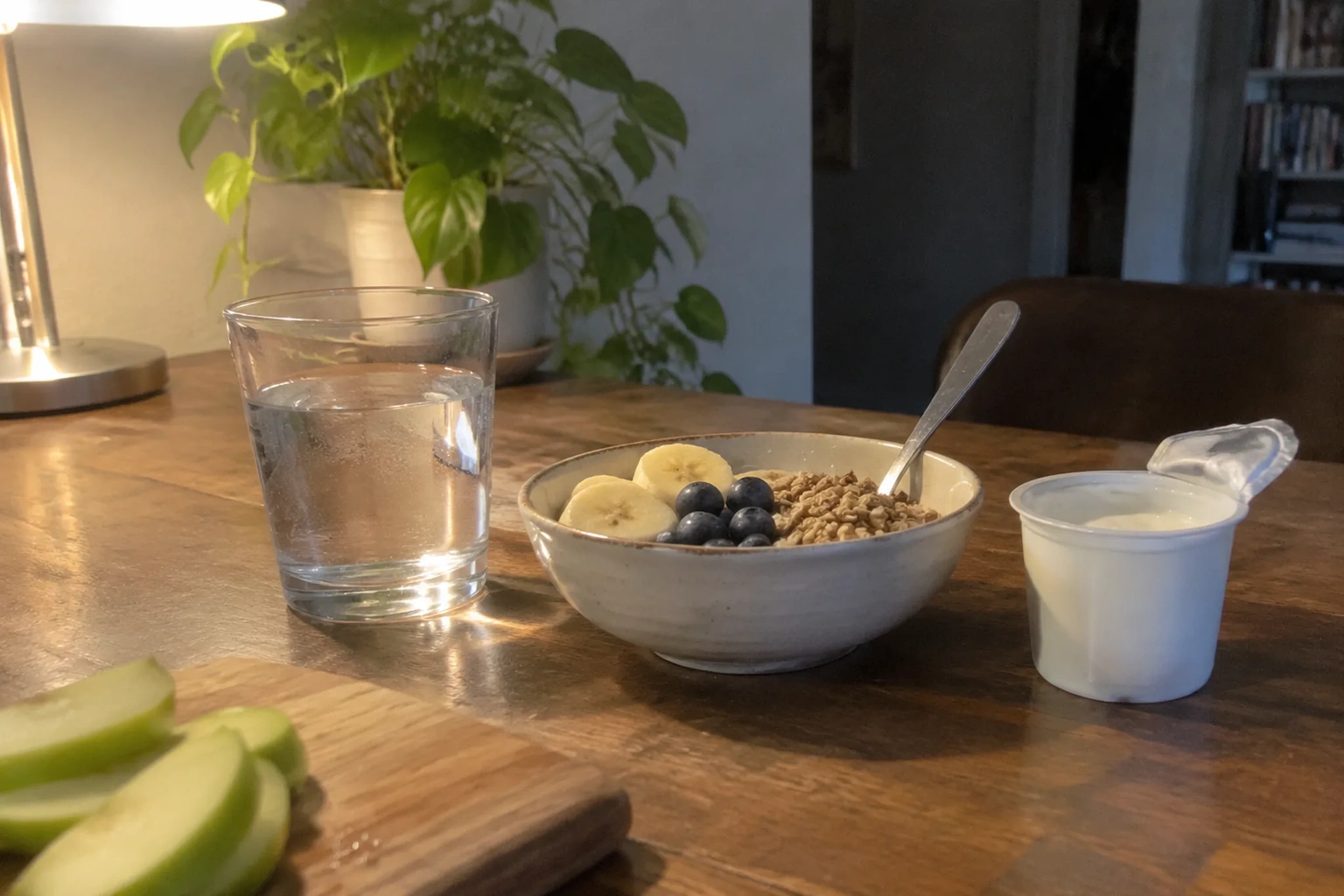
The morning glass of water before anything else
Before coffee, before the phone, before the toast: a glass of plain water. This is the cheapest habit on the list and the one most people skip. Overnight, the body loses fluid through breathing and sweating, and the digestive tract wakes up slightly dehydrated. A glass of water in the first twenty minutes of the day gives the system something to work with.
The effect is not dramatic. Nobody drinks a glass of water and feels their intestines reorganize themselves. But regularity in the morning bathroom trip tends to improve when the day starts with fluid rather than with a double espresso on an empty stomach. Coffee is fine. Coffee first, water never, is the pattern worth changing.
Eating at roughly the same times, even on weekends
The gut runs on a clock. The migrating motor complex, the wave of contractions that sweeps the small intestine between meals, operates on a cycle of roughly ninety minutes to a few hours. When meals arrive at scattered times, that rhythm gets muddled. When they arrive at consistent times, the body starts anticipating them, and digestion runs more smoothly.
This is why the weekend breakfast at eleven, followed by a late lunch at three, followed by dinner at nine, can leave a person feeling vaguely off by Sunday night. The body spent Friday and Saturday eating on schedule, then got a two-day disruption. Keeping meal times within an hour or so of the weekday pattern is one of the least restrictive changes available.
Chewing longer than feels necessary
Digestion starts in the mouth, with saliva containing enzymes that begin breaking down starches and fats. A person who chews each bite twenty or thirty times gives those enzymes more surface area to work on and takes pressure off everything downstream.
The practical version: put the fork down between bites. Not every bite, not forever, just enough to slow the pace. Meals taken in ten minutes tend to end with larger, less broken-down pieces arriving in the stomach, which then has to work harder and produce more gas. A meal that takes twenty minutes produces a noticeably quieter afternoon.
A short walk after the largest meal
Ten or fifteen minutes of easy walking after dinner does more for digestion than most people expect. The movement encourages the stomach to empty and the intestines to keep things moving, and it takes the edge off the post-meal heaviness that makes a person want to lie down.
The key word is easy. A gentle stroll around the block, not a run. Intense exercise right after eating can send blood away from the digestive tract and toward the muscles, which is the opposite of helpful. The walk is a nudge, not a workout.
Fiber from several sources, not just one
Fiber is not a single thing. Soluble fiber, found in oats, beans, apples, and carrots, forms a gel in the gut and feeds certain bacteria. Insoluble fiber, found in wheat bran, nuts, and leafy greens, adds bulk and speeds transit. Most people get one type and miss the other.
A bowl of oatmeal every morning checks the soluble box and leaves the insoluble one empty. A salad at lunch does the reverse. The goal is variety across the day: a piece of fruit, a handful of nuts, a serving of beans, some whole grain, some vegetable. The gut responds to that mix better than to any single high-fiber food eaten religiously.
Increasing fiber quickly, though, is a mistake. The bacteria that ferment fiber need time to adjust, and a sudden jump from ten grams a day to thirty produces bloating and gas for a week. Add one serving at a time, over weeks, not days.
Fermented foods in small, regular amounts
Yogurt with live cultures, kefir, sauerkraut, kimchi, miso: these carry live microorganisms that some people's guts seem to tolerate well and others do not. The evidence is mixed and the marketing is loud, but a modest serving of one fermented food a few times a week is a reasonable experiment for most people.
Small is the operative word. A tablespoon of sauerkraut alongside a meal, a half cup of plain yogurt, a spoon of miso stirred into broth. Large daily doses of multiple fermented foods tend to cause more trouble than they solve, especially in the first few weeks. Start with one, keep the amount small, and give it a month before judging.
Keeping the water intake steady through the afternoon
Most people drink water in the morning and then forget about it until evening. The hours between two and five are often dry, and that is when the after-lunch slump hits and the constipation that started the day before gets a little worse.
A water bottle on the desk, refilled once at lunch and once at three, solves most of this. Fiber without water is a recipe for a harder stool, not an easier one. The two habits work together or not at all.
The sitting posture that does not compress the abdomen
Slouching at a desk for eight hours folds the torso forward and compresses the abdominal cavity. The gut does not have a lot of room to begin with, and folding over it for most of the day slows transit and encourages the bloated feeling that shows up around four in the afternoon.
Standing up every hour, even for two minutes, undoes most of the damage. So does a chair that lets the hips sit slightly higher than the knees, with the feet flat on the floor and the lower back supported. These are small adjustments, and they matter more than most people give them credit for.
Sleeping on a consistent schedule
The gut has its own circadian rhythm, and it takes cues from the body's master clock. When sleep times drift, the gut clock drifts with them. Shift workers know this well: the digestive complaints that come with rotating schedules are not imaginary.
For people with ordinary schedules, going to bed and waking up within an hour of the same time each day, including weekends, keeps the gut clock stable. The connection is indirect but real. A body that sleeps on schedule tends to eat on schedule, and a body that eats on schedule tends to digest on schedule.
Limiting the late-night kitchen raid
Eating a full meal within two hours of lying down gives the stomach a job to do while the body is trying to rest. Reflux, in particular, gets worse when a person lies flat on a full stomach. The standard advice to finish dinner three hours before bed is not arbitrary.
For people who get hungry at night, the compromise is a small snack earlier in the evening, around eight or nine, and then nothing until morning. A handful of nuts, a piece of toast, a banana. The point is to avoid the large meal at ten-thirty that sends a person to bed with a stomach still working.
Noticing which foods reliably cause trouble, and then actually avoiding them
Most people already know which foods disagree with them. The information is there, in the pattern of the last few years. The problem is that the pattern gets ignored, and the food gets eaten anyway, and the discomfort gets blamed on something else.
A simple approach: keep a loose note for two weeks of what was eaten and how the gut felt a few hours later. No need for an app or a spreadsheet. A sentence in a notebook is enough. After two weeks, the repeat offenders tend to be obvious. They are often the same three or four items: a particular dairy product, a certain fried food, a specific sweetener, a large serving of raw onion.
Avoiding them is not the same as eliminating entire food groups. It is a matter of eating the offending item less often, or in smaller amounts, or cooked differently. Cooked onion is often fine where raw onion is not. A small amount of aged cheese sits better than a large amount of milk.
The habit of eating without a screen
Eating while scrolling or watching produces faster meals, larger portions, and less chewing. All three work against the gut. The screen also distracts from the body's own signals, so the meal ends when the plate is empty rather than when the person is satisfied.
The version of this habit that actually sticks is not a moral stance against screens. It is a single meal a day, usually lunch or dinner, eaten at a table with no device in reach. One meal. The rest can be as distracted as the day demands.
Over months, that one unhurried meal tends to become the anchor of the day's eating, and the other meals start to slow down around it. The gut notices. It usually says so quietly, by being less noticeable itself.





















