







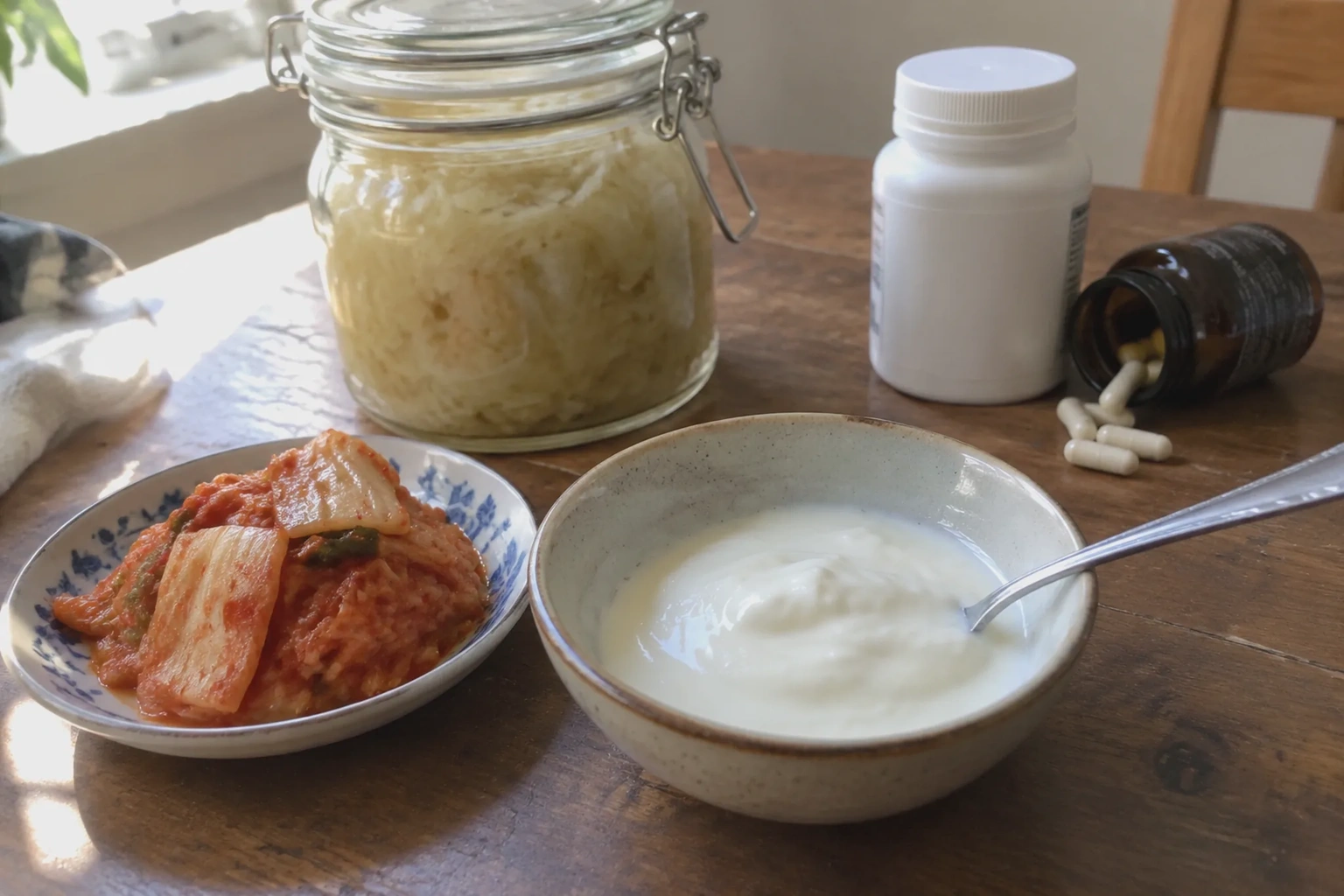
Fermentation has moved from the back of the fridge to the supplement aisle. The same organisms that turn cabbage into kraut and milk into yogurt now arrive freeze-dried in capsules, priced like a premium multivitamin and marketed with the language of gut health, immunity, and "microbiome support." The two products share a word and a biological premise. They are not interchangeable, and the gap between them is where most of the useful thinking lives.
A jar of live sauerkraut and a bottle of probiotic capsules both claim to deliver beneficial bacteria. One costs a few dollars and occupies shelf space next to the mustard. The other costs thirty or forty dollars a month and lives in a cabinet with the vitamins. The price difference has persuaded a lot of people that the capsule is the serious version of the food. In most cases it is the weaker one, and the reasons are worth spelling out slowly.
What fermentation actually does to food
Fermentation is a controlled microbial process. Bacteria or yeast consume sugars and produce acids, gases, or alcohol, which lower the pH and preserve the food while changing its flavor and texture. A cabbage packed with salt begins to release water, and lactic acid bacteria already living on the leaves start converting sugars into lactic acid. Within a week or two the cabbage is sour, crisp, and hostile to most spoilage organisms.
The result is a food with a living population of bacteria and a chemistry that the bacteria themselves created. That chemistry matters. Lactic acid, the tang in kimchi, is partly what makes the environment inhospitable to pathogens. The bacteria and the acid arrive together, and they arrive inside a matrix of fiber, vitamins, and plant compounds that the fermentation has already partially broken down.
A supplement capsule contains bacteria and almost nothing else. The freeze-dried powder has no fiber, no acid, no food matrix. It is a delivery vehicle for a defined number of organisms, and the number on the label is measured at the factory, not at the moment of swallowing.
The survival problem in a capsule
Bacteria in a capsule must survive the stomach. Gastric acid is designed to kill microbes, and it does a competent job. The coating on a capsule helps some organisms pass through, but the survival rate is a real variable and one that manufacturers do not always report. A label claiming ten billion CFU, colony forming units, describes what went into the bottle. What reaches the small intestine is a smaller and less certain number.
Fermented food faces the same acid, but the bacteria arrive with a buffer of food and acid that they produced themselves. Whether that meaningfully improves survival is a detail researchers still argue about. The broader point is simpler: the capsule's entire value depends on a delivery problem it cannot fully solve, while the food arrives with the problem partly handled by design.
This is why the strain list on a supplement bottle matters more than the CFU count. A specific strain of Lactobacillus may have evidence behind it for a specific purpose, and a different strain of the same species may have none. The species name on a jar of yogurt does not carry that burden because the yogurt is not making a targeted medical claim. It is just food that happens to be alive.
Shelf stability and the cold chain
Live fermented food is perishable by definition. Refrigerated sauerkraut, unpasteurized kimchi, and fresh kefir all need cold storage, and their bacterial populations decline over time even under good conditions. A jar forgotten in the back of the fridge for three months is not the same product it was on the day it was bought.
Supplements solve this problem by removing the water. Freeze-drying puts the bacteria into a dormant state, which extends shelf life to a year or more at room temperature. That is a genuine advantage for anyone who travels, keeps irregular hours, or cannot reliably refrigerate food. The trade-off is that dormancy is not the same as viability, and heat exposure during shipping can quietly reduce the count before the bottle reaches a kitchen cabinet.
The practical rule is unglamorous. A supplement is convenient and shelf-stable and often overpriced relative to what it delivers. A fermented food is cheap and perishable and delivers its bacteria along with everything else in the jar. Neither is the automatic winner, and the choice depends on what a person is actually trying to accomplish.
The label problem with probiotic capsules
Probiotic supplements occupy a strange regulatory space. In the United States they are sold as dietary supplements, which means they are not reviewed for efficacy before sale. The FDA does not verify that the strains listed on the label are the strains in the capsule, and independent testing has repeatedly found discrepancies between what a bottle claims and what it contains.
Fermented foods face a different kind of scrutiny. A jar of kimchi has to be what it says it is because it is food, and food has its own labeling rules. The bacterial content is not guaranteed in any specific amount, but the product is at least the thing on the label, and the fermentation is real rather than reconstructed from a powder.
This asymmetry explains a lot of the frustration people report after a few months on a probiotic regimen. They bought a product whose central claim could not be verified, at a price that implied verification had happened. The food aisle makes no such promise, which turns out to be a kind of honesty.
What fermented food brings that a capsule cannot
The case for food is not just about bacteria. A serving of live sauerkraut delivers fiber, vitamin C, and a range of plant compounds that fermentation has made more available. Kimchi brings garlic, chili, and fish sauce into the same bite. Kefir brings protein and calcium. The bacteria are one component of a complex food, and the food as a whole is what gets eaten.
There is also the matter of diversity. A typical probiotic capsule contains a handful of strains, often from a few well-studied genera. A spoonful of raw sauerkraut or a pour of kefir can contain dozens of species, many of which have never been cultured in a lab. The microbiome research community has spent years pointing out that diversity, not a single hero strain, is what tends to correlate with gut health in observational studies.
That does not mean fermented food is a cure for anything. The evidence for specific health outcomes is mixed and often modest, and the marketing around gut health has outrun the science by a wide margin. What can be said with confidence is that fermented food is a whole food with a long history of human consumption, and that a capsule is a narrow extract of one part of that food.
When a supplement is the right call
There are real situations where the capsule wins. A person with a restricted diet, a history of severe digestive issues, or a medical reason to avoid live cultures may need a targeted strain that a food cannot reliably provide. A traveler who cannot refrigerate anything for two weeks may find a shelf-stable supplement more practical than a jar of kimchi. A clinician recommending a specific strain for a specific condition is making a different kind of recommendation than a wellness influencer recommending "probiotics" in general.
The key is specificity. A supplement makes sense when a person knows which strain they want and why, and when the product has evidence behind that strain. A supplement makes little sense as a general "gut health" purchase, which is how most of them are sold.
The cost of a daily habit
Run the numbers over a year. A good probiotic capsule runs somewhere between thirty and sixty dollars a month, which is roughly four hundred to seven hundred dollars annually. A jar of refrigerated sauerkraut costs five to eight dollars and lasts a couple of weeks. A quart of kefir costs about the same as a gallon of milk. Even a person buying premium kimchi from a specialty shop spends a fraction of the supplement budget.
The cost difference is not the whole argument, but it is a useful filter. If a supplement is being taken as a general wellness habit rather than a targeted intervention, the money is buying convenience and a label, and the food is buying bacteria plus dinner. Most households would do better putting the supplement budget into the grocery cart and eating a spoonful of something sour with lunch.
A spoonful of sauerkraut with the sandwich
The most useful shift is not from one product to another but from a pill mindset to a food mindset. A forkful of kimchi on the plate, a splash of kefir in a smoothie, a spoonful of sauerkraut next to a sandwich: these are small, cheap, repeatable acts that deliver live bacteria along with flavor and fiber. They require a refrigerator and a willingness to eat sour things, and that is the entire barrier.
Supplements will keep selling because they promise a clean, measurable, convenient version of a messy biological process. Some of them are well made and serve a real purpose. But the jar in the fridge is the older technology, and it is still the one that comes with dinner attached.





















