







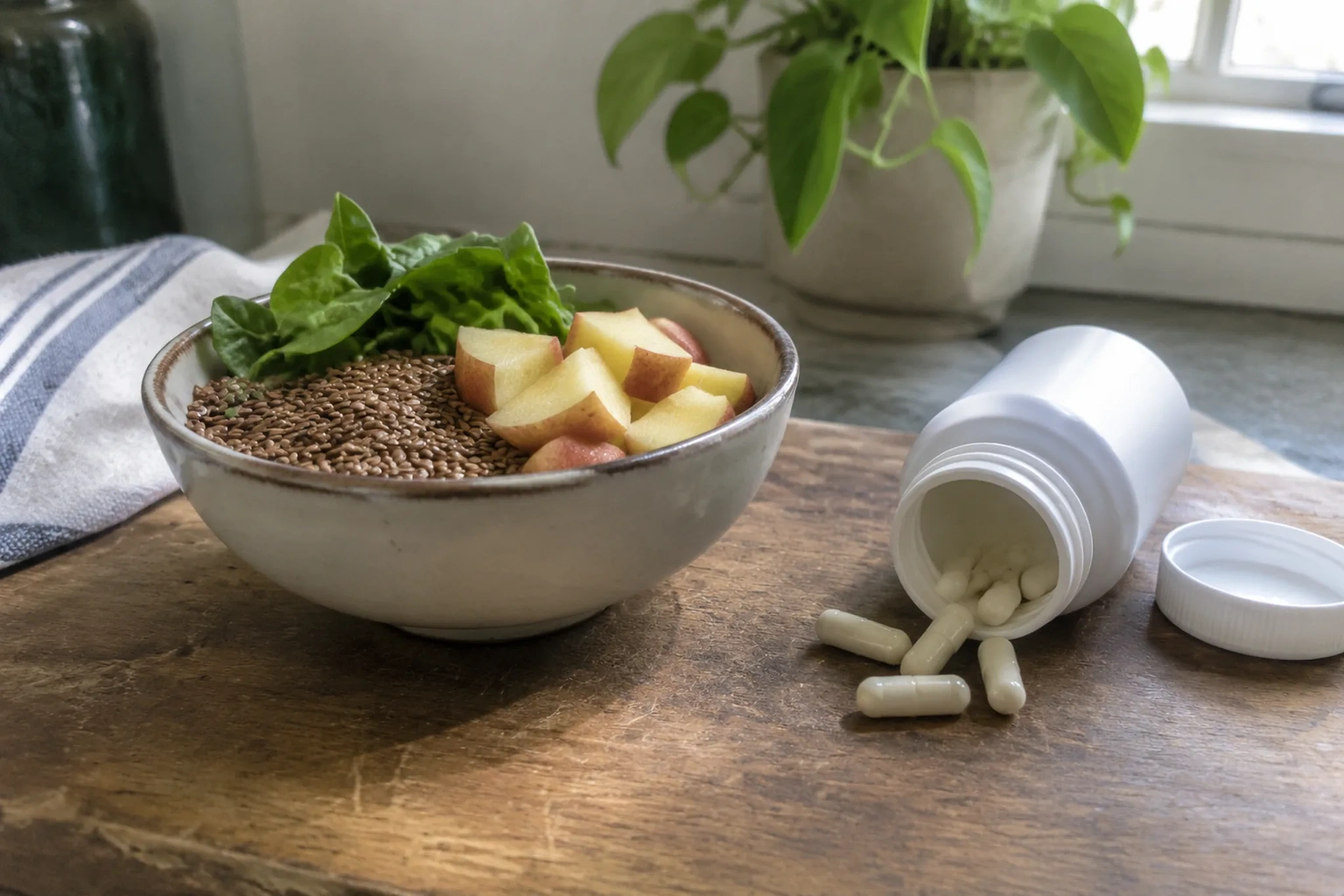
Gut advice has become a pile of bottles on a shelf: a fiber powder, a probiotic capsule, a fermented drink, a digestive enzyme, each sold as the missing piece. Most people end up buying the bottle that advertises hardest and skipping the one habit that would actually change their gut. The question worth asking before spending money is simpler than the supplement aisle suggests: which comes first, the fiber or the live cultures?
The short answer, for most healthy adults, is fiber. That is not because probiotics are useless. It is because fiber is the raw material that gut bacteria consume, and without raw material, added cultures have little to eat once they arrive. A probiotic taken on top of a low-fiber diet is a worker hired to a factory with no supplies.
The factory floor of the colon
The human colon hosts trillions of microbes, and their survival depends on what reaches them undigested. Fiber, the parts of plant food that human enzymes cannot break down, is that delivery system. Some fibers ferment quickly in the upper colon, feeding one group of bacteria. Others ferment slowly, traveling farther and feeding another. The diversity of plants eaten across a week shapes the diversity of the community doing the feeding.
A person on a low-fiber diet, heavy on white bread, chicken, and cheese, is running a thin supply line. Adding a probiotic capsule delivers a few billion live organisms into a habitat that may not support them. Some of those strains are well studied and do have effects, but the effect is usually modest and temporary if the underlying food supply stays the same.
What a probiotic can actually do
Probiotics are live microorganisms, usually specific strains of Lactobacillus or Bifidobacterium, that are shown in some studies to support digestion, reduce certain types of diarrhea, or help with specific conditions. The evidence is strain-specific and condition-specific, which is why a doctor recommending one for a particular problem names a product, not a category. The general-purpose capsule marketed to everyone is a different thing from the targeted use in a clinical setting.
The other issue is survival. Stomach acid, bile, and time on a shelf all take a toll on live cultures. A capsule that claims 30 billion colony-forming units at manufacture may deliver far fewer by the time it is swallowed, and fewer still that are viable after the acid bath. The bacteria that make it through often pass through the gut without settling in permanently. That does not make them worthless. It makes them a short-term intervention rather than a foundation.
Fiber does the unglamorous work
Fiber is cheap, shelf-stable, and acts on the whole community rather than adding one strain. Beans, lentils, oats, barley, apples, and vegetables feed the bacteria already present, the ones that have adapted to that person's body over years. When the fiber intake rises, the bacteria that digest fiber multiply, and they produce short-chain fatty acids, compounds that help maintain the lining of the gut and influence appetite and inflammation in ways researchers are still mapping.
The practical problem is that most people eat about half the fiber they need. The commonly cited target sits around 25 to 30 grams a day for adults, and a typical Western diet delivers maybe 15. A person does not need a powder to close that gap. A cup of cooked lentils carries roughly 15 grams. A bowl of oatmeal with a spoon of chia seeds adds another 10. Two pieces of fruit and a serving of broccoli fill the rest.
A real example: a breakfast of instant oatmeal and a banana, a lunch of lentil soup and a whole-grain roll, and a dinner of black beans, rice, and roasted vegetables clears 30 grams without a single supplement. That meal pattern is boring. It also works, and it costs less than a month of capsules.
Why the fiber ramp needs patience
Jumping from 12 grams to 35 grams in a week produces gas, bloating, and cramping, and most people who try it quit before the gut adapts. The bacteria that digest fiber multiply in response to it, and that shift takes a few weeks. A slower climb, adding one fiber-rich meal at a time and drinking enough water, lets the community adjust without a revolt.
Fiber also needs water to do its job. Soluble fiber forms a gel, and without enough fluid it can slow the gut rather than help it. The person who adds psyllium husk to a dry day of coffee and little else is setting up a different problem. Water and fiber travel together.
When probiotics earn their place
There are clear situations where a live-culture product makes sense. A course of antibiotics, which can wipe out large portions of the gut community, is one. Certain digestive conditions, guided by a clinician, are another. Traveler's diarrhea and some types of irritable bowel symptoms have evidence behind specific strains. Fermented foods, from yogurt with live cultures to kefir to kimchi, deliver live microbes alongside nutrients and are a gentler daily habit than a capsule.
The order matters. A person recovering from antibiotics who takes a probiotic while eating white rice and crackers is giving the new arrivals an empty pantry. The same person who takes the probiotic alongside a fiber-rich diet gives the cultures a chance to interact with a functioning community. The fiber sets the table; the cultures are guests who may or may not stay.
The capsule's real competitor is the grocery list
Walk the supplement aisle and the packaging promises convenience. One capsule, once a day, no cooking. That pitch lands because fiber requires decisions at the store and time at the stove. But the comparison is unfair. A probiotic capsule costs roughly a dollar a day. A bag of dried lentils costs a few dollars and makes six or seven meals. The fiber option is cheaper, more thoroughly studied for long-term gut health, and feeds the entire ecosystem rather than adding one borrowed strain.
The exception is the person who genuinely cannot or will not eat enough plant food, whether from a restricted diet, a medical condition, or a schedule that leaves no room for cooking. For that person, a fiber supplement is a reasonable bridge, and a probiotic may be a useful add-on. Supplements exist for the gaps. They work badly as the whole plan.
A reasonable order of operations
For someone starting from scratch, the sequence looks like this. First, add one fiber-rich food to each meal for a month: beans at lunch, oats at breakfast, vegetables at dinner. Second, add fermented food a few times a week, a plain yogurt with live cultures or a spoon of sauerkraut. Third, consider a probiotic only for a specific reason, such as after antibiotics or under a clinician's guidance for a particular symptom.
That order is not a rule handed down from a lab. It is a reflection of what the evidence supports: the food supply shapes the community, and the community shapes the gut. Adding cultures to a well-fed system is a small nudge. Adding them to a starved one is a gesture.
The shelf life question nobody asks
Probiotic capsules sit on shelves for months. The label guarantees a count at the time of manufacture, and the count at the time of purchase is a different number nobody prints. Refrigeration helps, and some products require it, but most drugstore bottles sit at room temperature through shipping and storage. Fiber powder has its own issues, mostly clumping and a gritty texture, but it does not die in transit.
This is why the fiber-first approach holds up beyond the first month. A bag of oats does not lose its value on a warm shelf. A can of beans does not need a refrigerator. The grocery-list approach survives the ordinary neglect of a busy life, and the capsule does not.
What the gut asks for by dinnertime
By the end of a day, a person's gut has processed whatever arrived. If that was a capsule and a sandwich on white bread, the community got a brief visitor and little else. If that was a bowl of black bean chili, a handful of almonds, and an apple, the community got a full day's work. The bacteria that thrive on that second day are the ones that produce the compounds linked to a calmer gut and steadier appetite.
A capsule can be part of a good plan. It cannot be the plan. The next time a bottle promises to fix digestion in one swallow, the better move is to check the pantry first. The lentils are already there, and they have been doing this work for a very long time.





















