







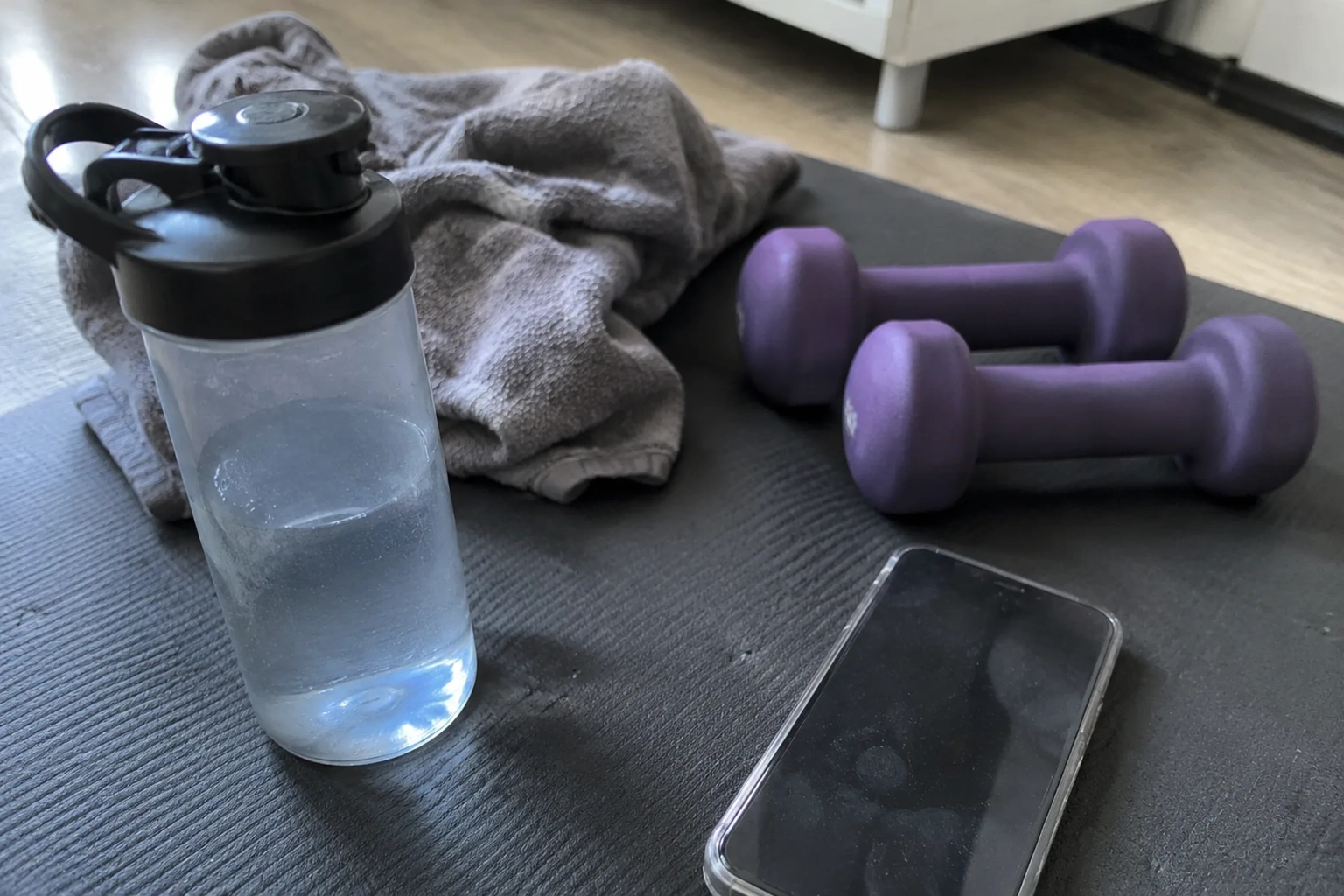
Gym schedules die in the same week every time: a Monday that starts with good intentions, a Tuesday meeting that runs to seven, a Wednesday where the commute wins. The people who come out the other side with their training intact are rarely the ones with the most disciplined temperaments. They are the ones who built habits with slack in them before the busy week arrived, so the habit could bend without breaking.
That distinction matters, because most fitness advice is written for the calm week. It assumes energy, time, and a kitchen that is not full of other people's half-eaten snacks. A schedule built for the calm week collapses the moment a real one shows up. What survives is sturdier and less impressive: shorter sessions, lower floors, and a willingness to be satisfied with less than the ideal version of a workout.
The ten-minute floor that keeps the identity intact
Ask a trainer what happens to clients during a crunch period and a pattern emerges. The session that gets cancelled outright is the ninety-minute one. The session that survives is the ten-minute one, because ten minutes is short enough that almost nothing can displace it. A person can do ten minutes of bodyweight work in a hotel room, on a garage floor, in the gap between two calls.
The value is not in the ten minutes of stimulus. It is in the fact that the person still trained, still counts as someone who trains, and does not have to spend a fortnight rebuilding momentum from a standing start. The identity is the thing that gets protected. Fitness habits survive busy weeks when the floor is low enough to be non-negotiable.
A useful test: could the shortest version of the session be done in ordinary clothes, without a shower afterward, in a room with no equipment? If the answer is no, the floor is too high for a bad week.
Why the all-or-nothing week is the enemy
The temptation during a busy stretch is to declare the week a write-off and start fresh next Monday. This feels clean. It is also the single most reliable way to lose six weeks instead of one, because the write-off tends to extend itself. One skipped week becomes three, and the return gets harder each time.
A person who trains twice in a chaotic week, badly, in a parking garage, has done something the write-off person has not: kept the habit warm. Two short sessions will not build much muscle. They will keep the neural patterns, the routine, and the self-image from going cold. The difference between two sessions and zero is enormous. The difference between two sessions and five is small.
Anchoring the session to a fixed trigger
Habits that depend on motivation fail in busy weeks, because busy weeks consume motivation. Habits anchored to a fixed cue do better. The cue does not have to be a time of day. It can be an event: after the school drop-off, before the first email, immediately after the last meeting of the afternoon.
The trick is choosing a trigger that is itself immovable. "After work" is a poor trigger because work hours move. "Before the first coffee" is a better one, because the coffee is happening regardless. A person who trains before the coffee has attached the habit to something the day cannot cancel.
Busy weeks are exactly when the calendar fills with things that have a fixed time, so a training slot with a fixed time has a fighting chance. A training slot described as "sometime in the afternoon" does not.
The two-exercise session that fits in a carry-on
When time collapses, the session should collapse with it, down to a single movement pattern and its opposite. A push and a pull. A squat and a hinge. Fifteen minutes of one set of push-ups alternated with one set of rows, resting as needed, is a complete session for the purposes of survival. It hits the major patterns, requires no equipment beyond a doorway or a sturdy table, and can be done in a hotel room at 6:40 in the morning.
The mistake is trying to preserve the full program in miniature. A compressed session that tries to include mobility, core, conditioning, and accessory work becomes a thirty-five-minute session with the worst parts of the original. A compressed session that does two things well takes ten minutes and actually happens.
Walking as the habit that never needs a locker
There is one fitness habit that survives almost every busy week without modification, and it is the least glamorous one. Walking requires no change of clothes, no equipment, and no recovery. It can be inserted into the day in fragments: a phone call taken on foot, a parking spot chosen at the far end of the lot, a train stop skipped on purpose.
People who train seriously often dismiss walking as insufficient. In a normal week, it is the base layer, not the whole program. In a chaotic week, it is the thing that keeps the weekly activity total from falling to zero. A person who walks during a terrible week and lifts during a good one has a habit that never fully switches off. The walking is the thread that keeps the whole thing connected.
Pre-deciding the cut list before the week arrives
The most useful preparation for a busy week happens on the calm Sunday before it. Not a new program, not a fresh set of goals: a short list of what gets cut first. The long run goes. The accessory work goes. The extra set goes. What stays is written down in advance, so the decision is already made when the week gets loud.
Decisions made in the middle of a busy week are made by a tired person with a full inbox. Decisions made beforehand are made by a rested person with perspective. That is why the cut list works. It removes the negotiation. When the Wednesday meeting runs long, there is no debate about whether to train; there is only the pre-decided short session, done or not done.
One practical version: write the full program on one side of a card and the survival version on the other. On a busy week, the card gets flipped and stays flipped. No guilt, no renegotiation, no scrolling through training apps looking for a better option.
Eating that does not depend on cooking from scratch
Nutrition habits tend to fail in busy weeks for a structural reason: they were built around cooking, and cooking is the first thing to go when the calendar fills. A person who has no fallback plan eats whatever is nearest, which is usually whatever is fastest, which is usually whatever is worst.
The habits that survive are the ones with a shelf-stable or freezer-based fallback. A bag of frozen vegetables, a rotisserie chicken, a container of pre-cooked rice, a jar of peanut butter, a loaf of bread in the freezer. None of these are impressive. All of them produce a meal in under ten minutes with no cognitive load.
The point is not to eat perfectly during a busy week. The point is to avoid the week where every meal is ordered in, because that week tends to produce a second week of the same, and the habit of cooking quietly disappears. A person who eats a mediocre but adequate dinner on Wednesday is in a much better position than one who eats nothing and orders a pizza at ten.
Sleep is the habit that holds up the others
Every fitness habit depends on a body that has recovered enough to do it. In a busy week, sleep is the first thing traded away for more hours, and the trade almost never pays. A person who sleeps five hours a night for a week will train worse, eat worse, and feel worse, and the habits that depended on energy will start to fall away.
The protective habit is a fixed wake time, even on the bad nights. A fixed wake time keeps the body clock from drifting, which keeps the sleep that does happen more effective. A person who goes to bed late but wakes at the same time every day recovers faster than one who sleeps in and shifts the whole rhythm.
This is not a glamorous habit. It is the one that makes the others possible.
Returning without a reckoning
The week after the busy week is where most habits actually die. The person returns to the gym, finds the weights heavier than before, and interprets this as evidence of decline. The interpretation is usually wrong. A week off costs very little in actual strength; what it costs is the feeling of competence, and that feeling is what drives the return.
The people who keep their habits for years have a boring recovery protocol: they come back at roughly seventy percent of the old effort, do a short session, and leave feeling like they could have done more. That feeling is the point. It makes the next session easy to start. A brutal return session, by contrast, produces soreness, dread, and a second week off.
Habits survive busy weeks because they were built to survive them, not because the person who owns them is unusually strong-willed. The willpower is a small part. The rest is design: a low floor, a fixed trigger, a cut list written in advance, a fallback meal, a fixed wake time, and a return that does not punish the person for having been away. None of these are impressive on their own. Together they mean the busy week ends and the habit is still there, waiting, slightly dusty, ready to be picked up again.





















