







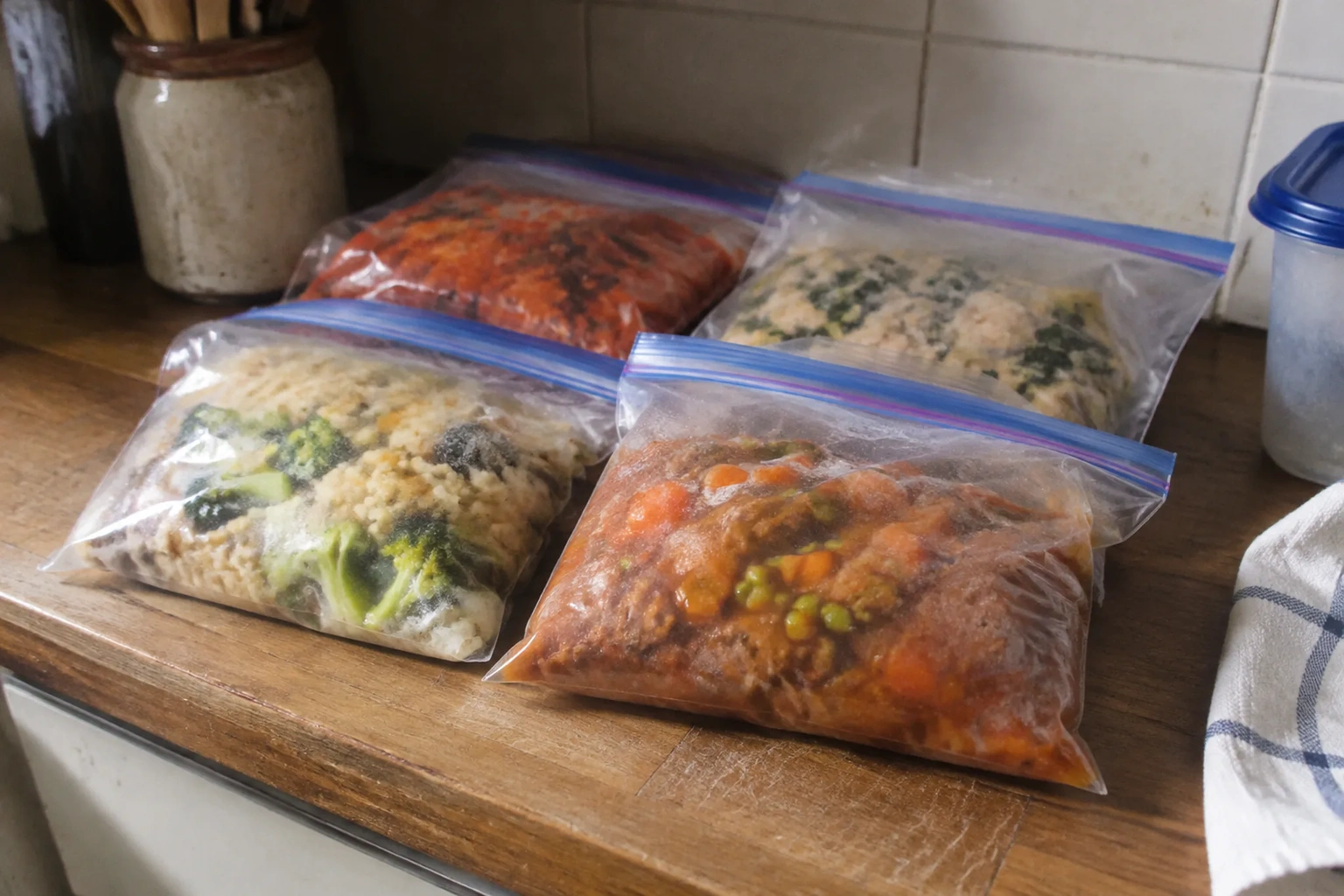
Freezer meals have a reputation problem. The phrase conjures images of gray casseroles in foil pans, of Sunday afternoons surrendered to an industrial-scale cooking session that leaves the kitchen wrecked and the cook resentful. Most people who try it once do not try it twice. The food is fine, technically. It fills a hole. But it does not make anyone glad to be eating it, and a freezer full of food nobody wants is just a slower way of throwing money away.
The case for a weekend prep session is real, though. A few hours on a Sunday can buy back the worst twenty minutes of a dozen weeknights, the ones spent standing in front of an open fridge at 6:30 with no plan and no patience. The trick is choosing the right dishes. Not everything freezes well, and not everything that freezes well is worth the effort of making in bulk. A short list, chosen carefully, beats a long list every time. What follows is that short list, along with the reasoning behind each pick and the specific handling that keeps it from turning to mush.
The dishes that survive a month at zero degrees
Freezing is hard on texture. Water expands, cell walls rupture, and sauces that were silky on Sunday can separate into a watery puddle and a grainy sludge by Thursday. Starches go one of two ways: rice turns to gravel, potatoes turn to mealy paste. Dairy curdles under slow thaw. The dishes that come through cleanly tend to be high in fat, high in acid, or built on a base that was never delicate to begin with. Braises, stews, bean dishes, and anything with a tomato or coconut backbone hold up. Anything that depends on a crisp edge or a raw vegetable's snap does not.
The shortlist below is built around that principle. Each dish was chosen because it freezes without shame, because it reheats into something a person would actually choose to eat, and because the prep work scales up without turning the kitchen into a disaster zone. None of them require a vacuum sealer, a chest freezer, or any equipment beyond a stack of containers and a working stove.
A tomato-braised chicken that improves on the second day
Chicken thighs, bone-in or boneless, braised in a simple tomato sauce with onion, garlic, and a pinch of dried oregano, is the workhorse of the freezer. The meat is forgiving, the sauce is cheap, and the whole thing reheats into something that tastes like it was made that afternoon. The key is to brown the thighs properly before they go into the liquid. That browning is the difference between a sauce with depth and a sauce that tastes like canned tomatoes and regret.
Bone-in thighs hold their texture better through freezing, but boneless are easier to portion and reheat faster. Either works. The sauce should be a little thinner than a sauce meant to be eaten fresh, because the chicken will release liquid as it thaws and a thick sauce turns soupy. A squeeze of lemon or a splash of vinegar stirred in at the end of cooking brightens the whole pot and survives the freeze better than fresh herbs, which go dark and limp.
Portion into containers with plenty of sauce, leaving a half-inch of headspace for expansion. A batch of eight thighs makes four generous portions. Reheated on the stove or in a low oven, it becomes dinner with a pot of rice or a loaf of bread. Shredded, it fills a taco or a sandwich. The sauce alone is worth keeping a jar of in the back of the freezer for a fast pasta night.
Black beans cooked from dry, frozen in their own liquid
A pot of dried black beans simmered with onion, garlic, cumin, and a bay leaf is one of the cheapest, most useful things a freezer can hold. Canned beans are fine, but the dried ones cooked at home have a creamier interior and a broth worth keeping. The whole pot freezes beautifully, liquid and all, and thaws into something that can go in a burrito, over rice, into a soup, or straight into a bowl with a spoonful of sour cream.
The one caution is salt. Beans cooked with salt from the start come out more evenly seasoned and hold their shape better, so salt the water generously. Freeze in two-cup portions, which is roughly the amount in a can, so the containers can substitute directly in any recipe. A pound of dried beans makes about six cups cooked, which is three cans' worth for a fraction of the price and a much better result.
The broth is the part most people throw away. It is deeply savory and freezes into ice cubes that can be dropped into a future pot of beans or a braise. A tray of bean broth cubes in a bag in the freezer door is the kind of small, specific thing that makes a kitchen feel well run.
A lentil and sausage stew that thickens as it sits
Brown lentils, a pound of Italian sausage, a carrot, a celery stalk, and a can of crushed tomatoes make a stew that freezes and reheats better than almost anything else on this list. Lentils hold their shape if they are not overcooked, and the sausage gives the whole pot a fatty, salty backbone that keeps it from tasting like health food. The stew thickens in the freezer and loosens on the stove, so a container that looks solid as a brick will turn back into a proper stew with a splash of water and ten minutes on low heat.
Undercook the lentils slightly before freezing. They will continue to soften as the stew reheats, and lentils that were perfect on Sunday will be mush by Wednesday if they start out tender. The same logic applies to the vegetables: a firm carrot holds up, a soft one dissolves. Cut everything a little larger than seems necessary.
This is the dish to make when the freezer is nearly empty and the week ahead looks grim. It is forgiving enough to absorb whatever is in the fridge, cheap enough to make in a double batch, and good enough that people ask for the recipe. Freeze it in single portions for lunches and larger ones for dinners. It does not need rice or bread to feel like a meal, though both are welcome.
The case against freezing rice, and what to do instead
Rice freezes badly. Not always, and not irredeemably, but badly enough that it is not worth the space. The grains turn dry and separate, and reheating tends to leave a texture that is somewhere between grainy and gummy. A freezer full of containers of rice is a freezer full of disappointment. The better move is to freeze the saucy things that go over rice and cook rice fresh, which takes twenty minutes and is the least interesting part of any meal anyway.
Potatoes are a similar story. Boiled or roasted potatoes freeze into a mealy, watery mess. Mashed potatoes freeze acceptably if they are loaded with butter and cream, but they are never quite as good as fresh. The dishes that freeze best are the ones that never depended on a starch to carry them. Stews, braises, bean dishes, and sauces all come back to life. Starches mostly do not.
There is an exception worth naming. Cooked pasta, slightly underdone, freezes surprisingly well when it is mixed into a sauce rather than frozen on its own. A baked pasta dish, a lasagna, or a pasta e fagioli thick enough to stand a spoon in will reheat into something close to what it was. The pasta absorbs the sauce as it thaws, so the dish should be a little looser going into the freezer than it would be on the table.
Containers, portions, and the headspace rule
The container matters more than most people expect. Glass is heavy and takes up space, but it does not stain, does not hold onto smells, and can go from freezer to oven if it is the tempered kind. Plastic is lighter and cheaper, but it cracks in the cold and absorbs the color of anything tomato-based. A mix works: glass for the dishes that will be reheated in the same container, plastic or silicone for the ones that will be turned out and heated on the stove.
Whatever the container, leave headspace. Liquid expands as it freezes, and a container filled to the brim will crack or push its lid off. An inch of space at the top of a quart container is enough. For bags, press flat and stack them like books, which saves space and thaws faster than a solid block.
Label everything with the dish and the date. A freezer full of unmarked containers is a freezer full of mystery, and mystery is the enemy of the weeknight cook. A strip of masking tape and a marker takes ten seconds and saves a future dinner. The general rule is three months for most cooked dishes, though a well-wrapped braise will hold for six. The date on the lid is the only reliable record.
Thawing in the fridge, not on the counter
The single most common mistake with freezer meals is the thaw. A container left on the counter for a few hours is a container that spends part of that time in the temperature range where bacteria multiply fastest. The safe move is to move the container to the fridge the night before, which means deciding what to eat a day ahead. That small act of planning is the whole point of the exercise.
For the days when the plan falls apart, there is the cold-water thaw: a sealed bag submerged in cool water, changed every half hour, will thaw a portion in an hour or two. A microwave works in a pinch, though it tends to heat the edges of a frozen block before the center has given up. The stove is the last resort for a solid block, and a low flame with a lid will get there eventually without scorching the bottom.
A weekend prep session is worth doing once a month, not once a season. A single Sunday spent making two of these dishes, portioned and labeled and stacked in the freezer, changes the character of the following three weeks. The point is not to fill the freezer to the ceiling. It is to have four or five containers of food that a person is genuinely glad to see at the end of a long day. The list above is short on purpose. It is the food that survives the freeze without turning into the gray casserole of memory, and that is the only shortlist worth making.





















