







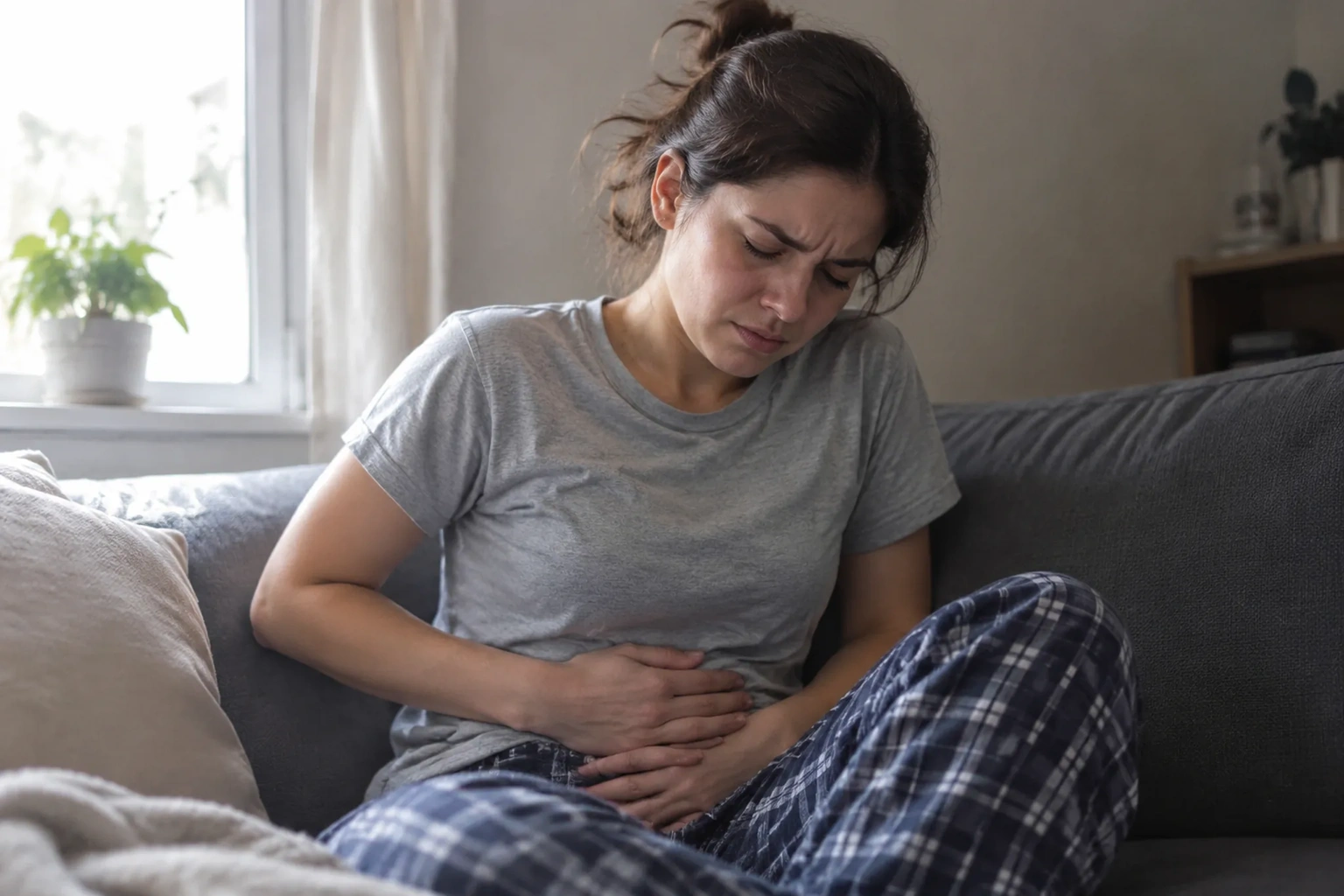
Almost every guide to period cramps falls into one of two camps: take a pill, or take a bath. The pill advice is fine as far as it goes. The bath advice is where things get lazy, because a bath is not movement, and the question of what a body in pain should actually do with itself, actively, for ten or fifteen minutes, tends to get skipped. There is a real answer to that question, and it is more specific than "gentle yoga" and more useful than "listen to your body," which is technically true and practically useless when the body is saying nothing except a low continuous no.
The honest starting point is that cramps come from a muscle doing exactly what it is supposed to do, only too hard. The uterus contracts to shed its lining, and prostaglandins, the chemical messengers behind inflammation and pain, push those contractions past the point of comfort. Some of that is unavoidable. What movement can do is work on the layers around it: the blood flow, the muscular guarding, the shallow breathing that pain tends to produce. It cannot switch the contractions off. It can make the body holding them less tight.
That distinction matters, because it sets expectations. A person who expects movement to erase cramp pain will conclude after ten minutes that it failed. A person who expects movement to take the edge off, or to shorten the worst hours, will usually find that it does something.
Why lying still often backfires
The fetal position is the default posture of period pain, and it is not wrong exactly. Curling around the ache feels protective. But hours of it have a cost: the hips stay flexed, the lower back rounds, the breath goes shallow and high in the chest, and blood pools in a pelvis that is already congested. The result is a second layer of discomfort stacked on the first, muscular and postural, which then makes the original cramp feel bigger than it is.
There is also the matter of circulation. Muscle in pain likes blood flow the way a stiff hinge likes oil. Lying motionless under a blanket does not deliver much of it. The contrast between a heating pad and a walk around the block is instructive here: both are pleasant, but only one moves fluid through the tissue.
The walk that does more than the stretch
Walking is the least glamorous recommendation in this entire category and probably the most reliable. A slow twenty-minute walk, at a pace that would allow conversation, does several things at once. It swings the hips through a full range of motion without asking the abdominal muscles to brace. It lifts the breath out of the shallow chest pattern. It moves blood through the legs and pelvis. And it gives the nervous system something to attend to besides the ache, which is not nothing.
The pace matters more than the distance. A brisk power walk with a clenched core is the wrong tool. The target is a stroll with a slightly loose belly and swinging arms, the kind of walk a person takes when they are early for something and in no hurry. Flat ground, no hills, no carrying a heavy bag on one shoulder.
Timing helps too. A walk taken in the first hours, before the pain peaks, tends to work better than one attempted at the height of it, when the body is least willing to cooperate. On the worst day, five minutes out the door and five minutes back counts. The point is the movement, not the mileage.
Cat-cow, and why the spine likes it now
Of all the yoga poses hauled out for period pain, cat-cow earns its reputation. On hands and knees, the spine rounds and arches slowly, and the pelvis tips with it. That rocking motion massages the lower back and the sacral area, which is where a lot of cramp pain radiates, and it does so without loading the abdominal wall.
The version that helps is slow and small. Eight to ten rounds, moving with the breath, arching on the inhale and rounding on the exhale. Not a fast pump. Not a deep backbend. The spine moves a few inches at most, and the neck stays long. If the wrists complain, the same motion can be done seated in a chair, hands on knees, rocking the pelvis forward and back.
There is a reason this pose suits the cramping body specifically: it keeps the low back mobile while the front of the body stays soft. Most cramps come with a guarded, tightened belly. Cat-cow never asks that belly to crunch.
A reclined twist with a pillow under the knees
Lying on the back with a pillow under the knees is already one of the more comfortable positions available during a cramp, because it takes the pull off the lower back. Adding a gentle twist to it turns a rest position into a movement.
The setup: lie down, knees bent, feet flat, pillow under the knees. Let both knees fall slowly to one side, keeping the shoulders on the floor, and stay there for five or six breaths. Return through center, then fall to the other side. The knees do not need to reach the floor. A stack of pillows or a folded blanket between the knees makes the twist smaller and easier, which is usually the right call on a bad day.
The appeal here is the combination of stretch and stillness. It opens the low back and the outer hip without any effortful holding, and the slow breathing that comes with staying in one place for half a minute does its own work on the nervous system. Ten minutes of this, done slowly, is a legitimate answer to an afternoon of cramps.
The pelvic tilt done small and often
A pelvic tilt is almost invisible from the outside, which makes it easy to dismiss. Lying on the back with knees bent, the lower back presses gently into the floor as the pelvis rocks, then releases. That is the whole movement. It is small, it is quiet, and it can be done in a bed, on a sofa, or on a office floor with the door closed.
What it offers is a way to move the pelvis without moving the whole body. For someone whose cramps come with low back ache, ten slow tilts, held for a breath each, can take the edge off the ache in a couple of minutes. It also teaches the belly to soften on the exhale, which is the opposite of the bracing pattern pain tends to produce.
This is the move to reach for when the day does not allow a walk or a mat. It fits into the gaps: waiting for a kettle, sitting through a meeting, lying in bed at midnight unable to settle.
What to skip on the heaviest day
Some movement is worth postponing. Anything that asks the core to brace hard, crunches, planks, heavy lifting, or fast sun salutations, tends to increase intra-abdominal pressure right where the cramping is happening. Inversions, headstands and shoulder stands, are not worth the effort on a cramp day for most people; they demand neck and core work that the body is in no mood for.
Deep backbends and strong forward folds also tend to disappoint. The first can compress the low back that is already aching; the second can feel like being folded over the very area that hurts. Neither is dangerous in any dramatic sense. Both are simply poor use of a limited amount of willing energy.
And there is the obvious one: if movement makes the pain sharper rather than duller, stop. Cramp pain that worsens with activity, or that comes with dizziness, heavy bleeding, or pain far out of proportion to a normal period, is a reason to see a clinician rather than to keep stretching. Gentle movement is a comfort tool, not a diagnostic one.
Breathing as the quietest form of movement
There is a version of this advice that treats the breath as an afterthought, a nice add-on to the real work of stretching. That ordering is backwards on a cramp day. Slow breathing, with the exhale longer than the inhale, is the fastest way to downshift the nervous system, and the nervous system is what decides how much a cramp is going to hurt.
The mechanics are simple. Inhale through the nose for a count of four, exhale for a count of six or eight, and let the belly rise and fall rather than the chest. Six or seven rounds. Done lying down with a hand on the lower belly, it doubles as a way to check whether the abdomen is braced or soft, which is information the body rarely volunteers during pain.
This is also the move that pairs with everything else. A walk with slow breathing, a cat-cow with slow breathing, a twist held for six slow breaths: the breath is what turns a stretch into a settling.
Ten minutes, in the order that suits the day
A practical sequence, for a day when the cramps are moderate and the energy is low: two minutes of pelvic tilts in bed, five minutes of cat-cow on the floor or in a chair, three minutes of a reclined twist with a pillow under the knees, then a slow walk to the kitchen and back. Ten minutes total, and it can be done in pajamas.
On a worse day, the sequence shrinks: pelvic tilts and breathing, five minutes, done lying down. On a better day, it stretches into a twenty-minute walk and a longer set of twists. The order is not sacred. What matters is that the movement stays gentle, that the belly stays soft, and that the breath stays slow.
The heating pad can stay. It just should not be the only thing in the room that gets used. A body in cramp pain is not asking to be left entirely alone; it is asking to be moved carefully, in small amounts, in ways that do not fight the contraction but do not surrender to it either. Ten minutes of swinging hips and slow exhales will not end a period. It will make the afternoon more bearable, and that is a real thing to offer.





















