







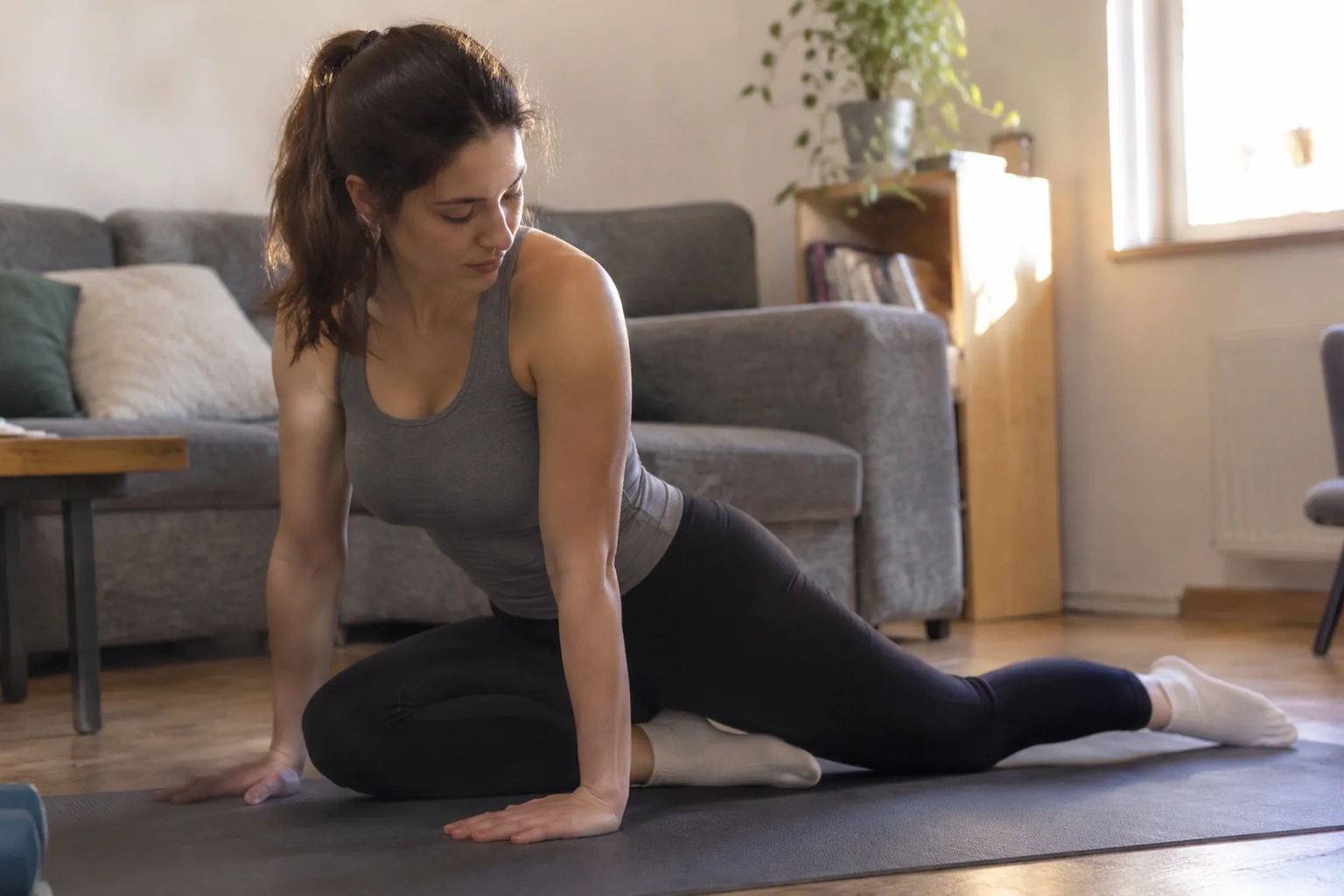
Hip tightness has a way of announcing itself at the most inconvenient moments. Tying a shoe, settling into a car seat, folding laundry on the floor: a small, sharp resistance in the front of the hip or a dull ache deep in the glute that says the joint has opinions about the position it has been asked to hold. The instinct is to push harder, to force the range, to stretch until something gives. That instinct is usually wrong, and it is the reason so many people spend months stretching a hip that never seems to loosen.
The gentler approach described here is not a concession to fragility. It is a recognition of how hips actually work: as a ball-and-socket joint wrapped in layers of muscle, fascia, and connective tissue, most of which respond to slow, patient movement far better than to force. What follows is a practical set of stretches and a way of thinking about them, aimed at the person who has tried the aggressive route and found it wanting.
Why "Tight" Is a Loaded Word
The sensation of tightness in a hip rarely means the muscle is physically short. It can mean the tissue is guarding after a long period in one position, that the joint is stiff from underuse, or that the nervous system has simply decided that a certain range of motion feels unsafe and has clamped down accordingly. Stretching with force treats all of these as the same problem, which is why the results are inconsistent.
A gentler approach works on the assumption that the hip needs coaxing, not conquering. The goal of each movement is to reach a point of mild tension and then stay there long enough for the tissue to accept it. That staying is the hard part. The body wants to fidget, to push, to make the stretch into an achievement. Patience is the actual skill being trained.
The Ninety-Ninety Position and Its Quiet Demands
Sit on the floor with the front leg bent about ninety degrees and the back leg also at ninety, both shins resting on the ground. The front thigh and back thigh should form roughly a right angle, like a figure-four drawn in the air. Sit tall. Most people will immediately feel a stretch in the back-side hip, which is the point.
The demand here is not to sink deeper. It is to stay upright and breathe. The pelvis wants to tilt backward and the spine wants to round, and resisting that with a tall, easy posture is the whole exercise. Hold for thirty to sixty seconds, then switch sides. If the position feels unbearable on the first attempt, lean back slightly onto the hands and reduce the angle of the front knee. There is no prize for the deepest figure-four.
A Knee-to-Chest That Respects the Lower Back
Lying on the back, draw one knee toward the chest and hold it there with both hands behind the thigh. The other leg stays long on the floor, or bends with the foot planted if the lower back protests. The stretch lands in the glute and the back of the hip.
What makes this gentle is the grip. The hands guide the knee rather than drag it. The lower back stays in contact with the floor, and if it lifts, the knee has gone too far. Breathe into the back of the ribcage and let the thigh settle a little closer on each exhale. Thirty seconds is plenty. The tendency to yank the knee in and hold the breath is the exact habit this stretch is designed to break.
The Hip Flexor Stretch Without the Arch
Kneel on one knee with the other foot planted in front, both knees at roughly right angles. The classic mistake is to push the hips forward and let the lower back arch, which produces a big sensation in the front of the hip that is mostly spinal extension, not hip opening. A gentler version tucks the pelvis slightly, as if tucking a tail, and then moves the hips forward by an inch or two.
The stretch should be modest, a low pull in the front of the back hip. Hold for thirty to forty-five seconds. If the back knee complains, fold a blanket or towel beneath it. This is the stretch most likely to be overdone, because the front of the hip is where people feel the most dramatic sensation and therefore assume the most progress. The tuck-and-inch version is less theatrical and more honest.
Figure-Four on the Floor, With a Wall for Company
Lie on the back with both knees bent and feet on the floor. Cross one ankle over the opposite thigh, just above the knee, and let the crossed leg's knee fall open. The foot of the supporting leg stays planted. From here, the stretch can be held as is, or the supporting leg can be lifted and the hands can hold behind the thigh for more.
The wall version is the gentler one: lie near a wall, place the legs up the wall, and cross the ankle over the thigh there. Gravity does the work, and the lower back gets a rest at the same time. Five minutes in this position, breathing slowly, does more for a stubborn hip than a minute of aggressive pulling. The ankle should rest lightly, never press down hard on the thigh.
Seated Butterfly, With the Spine Doing Its Share
Sit on the floor with the soles of the feet together and the knees falling out to the sides. Hands rest on the feet or the ankles. The gentle version keeps the spine tall and lets the knees drop only as far as they want to go. Pressing the knees down with the hands is where this stretch goes wrong for most people.
Instead, hinge forward from the hips, keeping the back long, and stop the moment the lower back starts to round. A small forward lean with a straight spine reaches the inner hip far more effectively than a deep fold with a curved back. Hold for forty-five seconds. If the knees sit high off the floor, sit on a folded blanket to tilt the pelvis forward, which lets the hip open without force.
The Standing Hip Circle as a Warm-Up, Not a Test
Stand with the feet hip-width apart and the hands on the hips. Draw slow circles with the pelvis, as if tracing a dinner plate with the tailbone. Ten circles in each direction, unhurried. The movement is small and the breath stays easy. This is not a stretch in the traditional sense, but it is the best way to prepare a hip for the positions above, and for many people it is the only thing the hip needs on a stiff morning.
The circle should be smooth enough that a hand resting on the low back would not feel a jerk or a catch. If it does, the circle is too big. Shrink it until the motion is continuous, then hold that size for a full set. This is a diagnostic as much as a warm-up: the direction where the circle snags is the direction where the hip is guarding.
How Long to Hold, and What to Feel
Thirty to sixty seconds per stretch is the working range. Shorter holds tend to bounce off the tissue; much longer holds are fine if the position is comfortable but unnecessary for most people. The sensation to aim for is a mild, spread-out pull, maybe a three on a scale of ten. Sharp, pinpoint pain, tingling, or numbness means the position is wrong, not that the stretch is working.
Breathing matters more than people expect. A slow exhale through the nose, longer than the inhale, nudges the nervous system toward letting go. Holding the breath does the opposite. The stretch is a conversation, and the breath is the tone of voice.
The Daily Ten Minutes That Beats the Weekly Hour
Hips respond to frequency. Ten minutes most days will do more than an hour once a week, because the tissue adapts to repeated, gentle input rather than to occasional intensity. A useful sequence: ninety-ninety for a minute per side, knee-to-chest for thirty seconds per side, hip flexor stretch for forty-five seconds per side, figure-four on the floor for a minute per side, and a slow hip circle to finish. That is under ten minutes and covers the major directions the hip moves.
The sequence can be done in the evening, after the body is warm from the day, or in the morning after a hot shower. Consistency beats duration, and a short session that actually happens is worth more than an ambitious one that gets skipped.
When Gentle Stretching Is Not Enough
Some hip tightness does not yield to stretching, and that is worth saying plainly. A hip that pinches in the front when the knee comes toward the chest, or that aches at night, or that has lost range after an injury, deserves a professional look. Stretching a joint that is irritated or structurally limited can make things worse. The gentle approach described here is for the common, garden-variety stiffness that comes from sitting and from ordinary life.
There is also a category of tightness that is really weakness in disguise. A hip that feels tight in extension may be a hip whose glutes have forgotten how to do their job, and no amount of stretching will fix that. Strength work, often with a physiotherapist or a good trainer, is the missing piece for those people. Stretching and strengthening are not rivals; they are two halves of the same conversation.
A Final Position Worth Trying Before Bed
Lie on the back with the knees bent and the feet on the floor, then let both knees fall to one side while the shoulders stay flat. The legs stack, the hips rotate, and the stretch lands in the outer hip and the low back. A pillow between the knees keeps the position comfortable. Stay for a minute, breathe slowly, then switch sides.
This is the stretch that tends to surprise people, because it opens a direction the hip rarely gets: rotation with the spine quiet. It is also the one most likely to be felt the next morning, in the good way, a faint reminder that the hip moved somewhere new. Done before bed, it asks almost nothing and gives back a little more each night.





















