







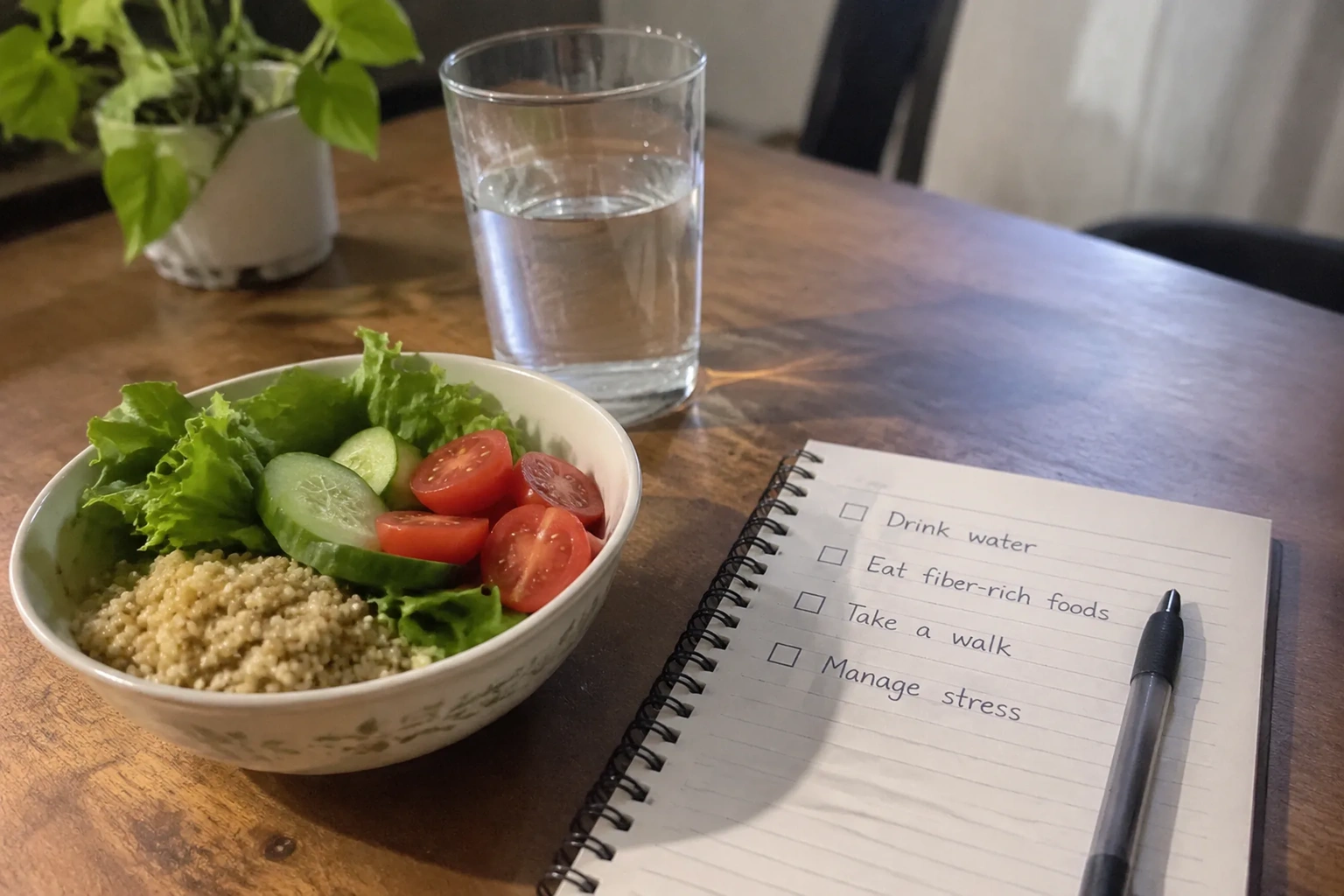
Shift work does something to the gut that no amount of yogurt can fix. A nurse finishing a twelve-hour night at seven in the morning, a long-haul driver eating dinner at a truck stop at 2 a.m., a new parent who has not slept more than three hours in a row since March: the gut does not care about willpower. It cares about timing. The digestive tract runs on a clock, and every meal, every bathroom trip, and every bowel movement is a small appointment the body keeps with itself. Move the schedule and the appointments start getting missed.
The conventional advice, eat more fiber, drink water, take a probiotic, is not wrong so much as it is incomplete. It was written for people who wake up and go to bed at roughly the same hour. For anyone living on rotating shifts, overnight work, or a schedule that changes week to week, the harder problem is sequencing: when to eat, when to stop eating, when to sit still, and when to let the body catch up. The routines below are built around that problem.
The Gut Runs on a Clock, and the Clock Can Be Moved
The digestive system has its own daily rhythm, roughly aligned with light and darkness. Stomach acid production, enzyme release, and the muscular waves that push food through the intestines all follow a cycle. The colon is especially punctual: in people on a regular schedule, the strongest wave of colonic activity tends to arrive in the morning, shortly after waking, which is why so many people have a reliable morning bathroom trip.
Irregular schedules scramble that cycle. The body receives conflicting signals: light at the wrong hour, food at the wrong hour, sleep in fragments. The result is familiar to anyone who has worked nights. Constipation for some, urgent loose stools for others, bloating that appears out of nowhere, appetite that vanishes or turns ravenous at odd times.
The useful insight is that the clock is not fixed. It can be nudged, and it responds to a few specific cues more than others. Light is one. Meals are another. Physical movement is a third. A person does not need a perfect schedule to give the gut a workable one; they need to pick a handful of anchors and hold them steady even when everything else shifts.
Anchor Meals Around the Shift, Not Around the Sun
On a rotating schedule, the worst thing a person can do is try to eat according to the clock on the wall. Breakfast at 7 a.m. means nothing to a body that started its day at 8 p.m. The better approach is to build meals around the sleep block instead of the daylight.
For a night shift that runs from 11 p.m. to 7 a.m., a practical pattern looks like this: a substantial meal before the shift starts, a lighter meal or snack in the middle of the night, and a small, easily digested meal after the shift ends, before sleep. The post-shift meal is where most people go wrong. A heavy breakfast at 8 a.m. after a night of work lands in the stomach right as the body is trying to wind down, and it often produces reflux, bloating, or a sluggish, uncomfortable sleep.
Keeping that last meal small and low in fat makes a measurable difference. So does eating it within an hour of getting home, rather than waiting until hunger builds into a full meal. A bowl of oatmeal, a banana with a spoon of peanut butter, a piece of toast with soft cheese. Something that sits easily and does not demand much digestion.
During the shift itself, the temptation is to graze continuously, especially on a long overnight. Grazing keeps the gut working constantly, which is the opposite of what it wants during a period when the body expects rest. A single mid-shift meal, eaten at a consistent hour, gives the digestive system a defined window of work and a defined window of rest. That rhythm matters more than the specific food.
The Twelve-Hour Eating Window That Survives a Rotating Roster
Time-restricted eating has become popular, and for shift workers the concept is genuinely useful, with one adjustment. The standard advice is to eat within an eight-hour window and fast for sixteen. On a rotating schedule, an eight-hour window is often impossible, because the shift itself spans more hours than that and the body needs fuel across it.
A twelve-hour eating window is more realistic and still gives the gut a meaningful overnight rest. The window opens with the first meal after waking and closes with the last meal before the next sleep block. Everything in between is fair game. Everything outside is water, plain tea, or nothing.
The point of the window is not weight loss, though that often follows. The point is to give the intestines a stretch of several hours when they are not processing food. That rest period is when much of the gut's housekeeping happens, including the muscular contractions that sweep residual material through the colon. People who eat around the clock, as many shift workers do out of boredom or stress, never give that housekeeping a chance to run.
Keeping the window consistent matters more than its exact start time. A person whose shift changes every week should still try to keep the window the same length and anchored to the same point in their sleep cycle, even if the clock time moves. The gut adapts to the pattern, not to the number on the dial.
Coffee Goes Before the Shift, Not During the Crash
Coffee is the shift worker's most reliable tool and also one of the easiest ways to wreck a gut routine. Caffeine stimulates the colon, which is why so many people need a bathroom within twenty minutes of their first cup. On a normal schedule, that is convenient. On a night shift, it can mean an urgent, poorly timed trip in the middle of a task that cannot be interrupted.
The practical fix is to drink coffee early in the shift, not in the middle of the night when the body is already under strain, and to stop caffeine several hours before the planned sleep block. A cup at the start of a night shift supports alertness and triggers a predictable bathroom trip before the work gets busy. A cup at 4 a.m., when fatigue is heaviest, often produces jitteriness, stomach acid, and a worse crash later.
For people prone to reflux, coffee on an empty stomach is a common trigger. Pairing it with food, even something small, reduces that risk. And for anyone who has noticed that coffee on a night shift produces loose stools or cramping, the culprit is often the timing rather than the coffee itself.
Movement as a Digestive Cue, Not a Workout
Physical movement is one of the strongest signals a person can send to the gut. A ten-minute walk after a meal speeds gastric emptying and encourages the colon to move. This is not about exercise in the fitness sense. It is about using motion as a cue, the same way light and meals are cues.
For shift workers, the easiest place to insert that cue is right after the largest meal of the day, whenever that happens to be. A walk around the parking lot before clocking in. A lap around the block after the post-shift meal, before getting into bed. Even five minutes of gentle movement helps, and it does not require a gym or a change of clothes.
The other end of this is stillness. Sitting for long stretches, which many shift jobs demand, slows the gut. Standing up once an hour, even for a minute, keeps things moving. A person who cannot leave a station can still shift weight, stretch the arms overhead, or walk to the far end of the room and back. The gut reads these small movements as activity, and it responds.
Fiber Timing Matters More Than Fiber Amount
Everyone knows fiber is good for digestion. Fewer people realize that when fiber is eaten matters as much as how much. A large bowl of beans or a big salad right before a sleep block is a recipe for gas, bloating, and a disrupted rest. The same food eaten earlier in the waking period, with hours of activity ahead, tends to sit far better.
For irregular schedules, the useful rule is to front-load fiber. Put the vegetables, the legumes, the whole grains into the first two meals of the waking period, when there is time for the body to process them. Keep the meal closest to sleep lower in fiber and lower in fat. This single adjustment resolves a surprising amount of nighttime bloating and early-morning urgency.
Hydration follows the same logic. Drinking most of the day's water earlier in the waking period, rather than in the hours before sleep, reduces nighttime bathroom trips without sacrificing hydration. A person who drinks two liters between midnight and 6 a.m. will pay for it at 9 a.m., just as sleep is settling in.
The Bathroom Window Nobody Plans For
Bowel movements are the most schedule-sensitive part of digestion, and shift workers often fight their own bodies without realizing it. The body sends a signal, the person is mid-task and ignores it, and the signal fades. Do that repeatedly and the colon learns to stop sending the signal at inconvenient times, which is how chronic constipation develops in people whose diets look perfectly fine on paper.
The fix is to build a bathroom window into the routine. Pick a time that is reliably free, typically shortly after waking or shortly after the first meal, and sit for a few minutes without rushing. Even if nothing happens at first, the body begins to associate that time with the opportunity. Over a couple of weeks, the signal often returns.
This sounds almost too simple to matter. In practice, it is one of the most effective things a shift worker can do, because it works with the body's existing rhythm instead of against it. The colon wants to be regular. It just needs a predictable slot to be regular in.
When the Schedule Flips, Give the Gut Two Days to Catch Up
The hardest moment in any irregular schedule is the transition, the day a person flips from nights to days or from an early shift to a late one. The gut handles that transition poorly if it is rushed. Going to bed at 9 p.m. on the first night off, after a week of sleeping from 8 a.m. to 3 p.m., rarely works, and the resulting poor sleep compounds the digestive disruption.
A gentler approach is to shift the sleep block by a couple of hours at a time and to keep meal timing aligned with the new sleep block from the first day. The gut follows the meals, so moving the meals is the lever. Move dinner an hour earlier, then two, then three. Keep the eating window the same length. Let the light exposure follow, with bright light in the morning and dim light in the evening once the flip is underway.
Two days is usually enough for the worst of the transition to pass. The gut will still feel off, but the routine holds, and the routine is what carries a person through the next flip, and the one after that. The schedule will keep changing. The anchors, the eating window, the post-shift meal, the walk, the bathroom slot, are what stay the same, and over time the gut learns to trust them even when everything else is in motion.





















