







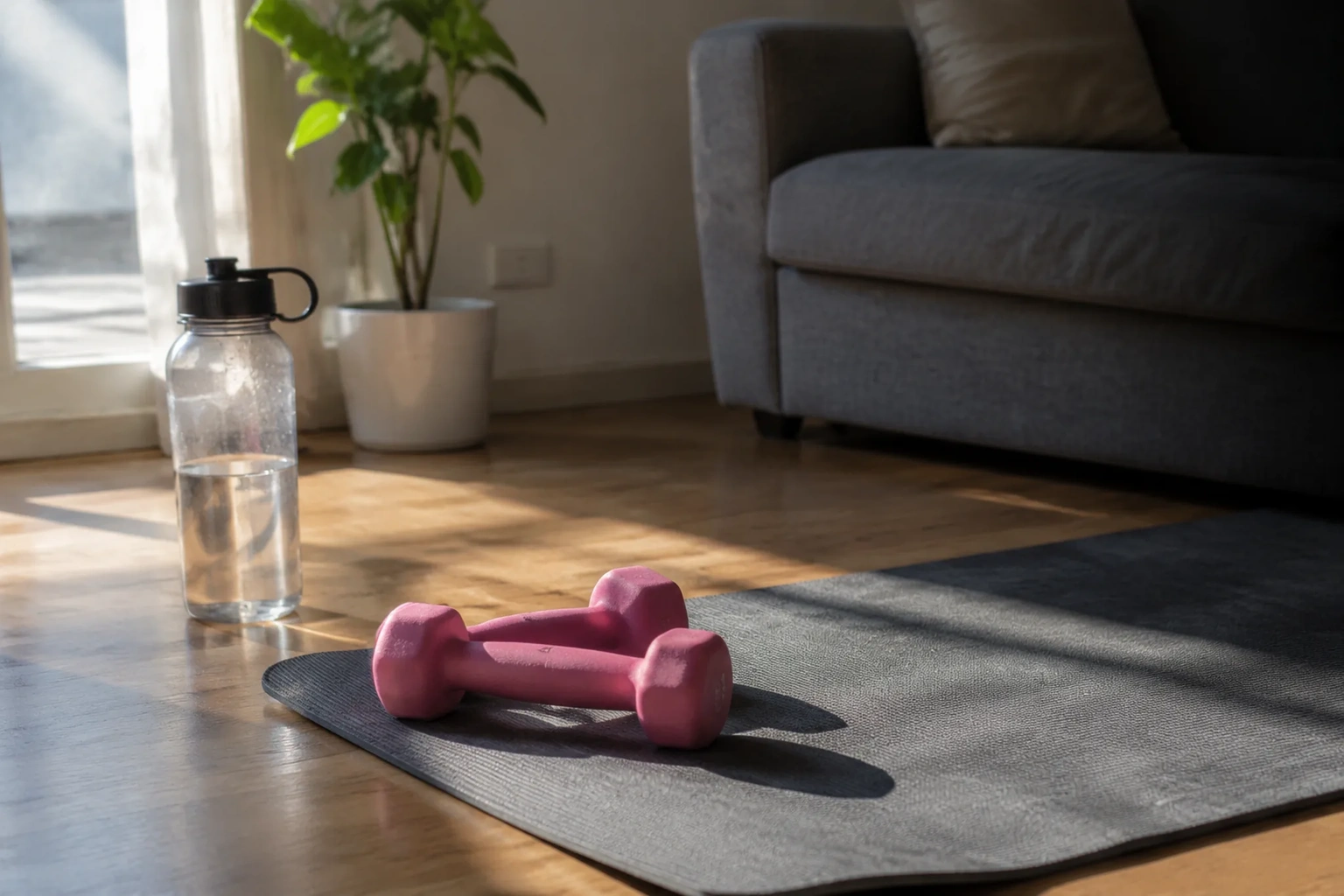
Cardiologists have been saying some version of the same thing for forty years: the heart is a muscle, and muscles respond to load. Walking to the mailbox does not count as load. Neither does folding laundry, though it feels like labor. The workout that protects a heart has to push it hard enough to make it complain a little, then let it recover, then do it again. The good news, for anyone who has priced a gym membership lately, is that almost none of this requires equipment or a commute.
The confusion usually starts with the word "cardio." People hear it and picture a treadmill, a spin class, a rowing machine with a screen. What they are actually being told is simpler: move large muscles continuously, raise the breathing rate, keep it up for a while. A staircase does this. A living room floor does this. A wall does this, if a person leans on it and works hard enough.
What the heart actually wants from a workout
Two different things, mostly, and it helps to keep them separate. The first is moderate, steady effort, the kind where conversation becomes possible but slightly annoying. This is the zone where blood vessels get better at relaxing, where the heart's filling and pumping improve over months, where resting heart rate tends to drift down. The second is short, sharp effort, where the breathing gets genuinely ragged and the effort cannot be sustained for long. This one stresses the heart harder for a brief window and produces a different set of adaptations.
Most home programs fail because they only do the first one, and they do it too gently. A stroll around the kitchen island is not moderate effort. The honest test is a simple one: could a person hold a phone conversation while doing it, or would the person on the other end notice the panting? If the answer is "no notice," the effort is probably too easy to count.
The other honest test is the talk test itself. Recite the alphabet out loud mid-effort. If it comes out smooth, pick up the pace. If it comes out in fragments, that is the short-effort ceiling, and it is fine to visit it briefly.
The living room interval: 30 seconds of stairs, 90 seconds of walking
Stair climbing is the most underrated piece of home cardio equipment, and it is already in most houses. A flight of stairs worked hard for thirty seconds and then walked off for ninety produces a clean little interval session: climb at a pace that makes the thighs burn, then pace the hallway or the landing until breathing settles, then repeat. Ten rounds takes twenty minutes and leaves most people pleasantly wrecked.
For anyone without stairs, a single step works. Step up, step down, alternating legs, at a quick rhythm. The step height matters less than the cadence. A sturdy step stool or the bottom stair of a porch does the job. The one rule is that the surface has to be stable: a wobbly stool is how ankles get sprained, and a sprained ankle ends the program for a month.
This format works because it lets effort spike without demanding that it stay spiked. The recovery walk is part of the workout, not a break from it. A heart that gets pushed and then allowed to settle, repeatedly, adapts better than one that gets pushed continuously for half an hour at a moderate pace.
Marching in place, done with actual intent
Marching in place sounds like a warm-up for kindergarten, and it can be. Done with intent, with the knees driving up to hip height and the arms pumping, it becomes a real cardiovascular stimulus that requires zero floor space and no equipment. Three minutes of vigorous marching, one minute of easy marching, repeated five times, is a legitimate beginner session.
The trick is to stop treating it as filler. People march in place while waiting for the kettle and call it movement. That is fine for circulation but it is not training. The training version has a clock on it and a target pace. Arms drive, knees lift, breathing deepens, and the person knows exactly how many minutes are left.
This is also the safest entry point for anyone coming off a long sedentary stretch or recovering from an illness. The impact is minimal, the space requirement is a bath mat, and the intensity dials up or down simply by changing how high the knees lift and how fast the arms swing.
Shadow boxing for the upper body and the lungs
Boxing workouts have a reputation as gym-class theater, but stripped of the bag and the mirror they are just interval training with the arms. Three minutes of shadow boxing, one minute of rest, four to six rounds. Jabs, crosses, hooks, thrown at a pace that keeps the shoulders working and the breathing heavy. The feet stay light and moving.
What makes this useful at home is that it recruits the upper body in a way walking never does, so the heart has to work harder to supply the working muscle. It also breaks up the monotony that kills most home routines by week three. A person who is bored will quit, and a person who quits gets no cardiac benefit at all.
One caution: shoulders that have not thrown a punch in twenty years will complain. Start with one-minute rounds. Build the round length before the round count. Soreness in the front of the shoulder that lingers past two days is a signal to ease off, not to push through.
The squat-to-press circuit that doubles as strength work
Heart health does not live on cardio alone. Muscle mass helps regulate blood sugar and blood pressure, and a stronger body tolerates cardio better. The cheapest home version is a bodyweight circuit: ten squats, ten push-ups (against a wall or on the knees is fine), ten alternating reverse lunges, thirty seconds of marching. Rest a minute. Repeat four or five times.
The heart rate stays elevated through the whole circuit because the rest is short and the movements are large. This is the format that leaves people surprised at how hard ten squats can be when they are followed immediately by ten push-ups. The goal is not exhaustion. The goal is finishing the last round in roughly the same shape as the first, which means pacing the early rounds.
Two sessions a week of this, alongside two or three cardio sessions, covers most of what a general cardiology guideline would ask of an average adult. It is not a training plan for a marathon. It is a plan for a heart that has to keep working for several more decades.
Warm-up, cool-down, and the ten minutes people skip
The warm-up is not optional and it is not a formality. Five minutes of easy marching, arm circles, and slow bodyweight squats raises muscle temperature and gives the heart a chance to ramp up gradually instead of lurching from rest to redline. Skipping it is how people pull things, and a pulled hamstring is a two-week hole in the schedule.
The cool-down matters for a different reason. Stopping abruptly after hard effort can leave a person lightheaded, because blood pools in the legs when the muscle pump stops. Two or three minutes of easy walking or marching lets the circulation catch up. It is a small courtesy to the body and it costs almost nothing.
Warning signs that end the session immediately
Chest pressure, tightness, or pain during effort. Shortness of breath that does not resolve within a minute or two of stopping. Dizziness, unusual palpitations, or a cold sweat. These are not "push through it" signals. They are stop-and-call-a-doctor signals, and anyone who has not exercised in years should clear the plan with a physician before starting, particularly with a history of heart disease, high blood pressure, or diabetes.
The general rule from exercise physiology is that discomfort in the working muscle is expected and fine, while anything happening in the chest, the throat, or the head is a reason to halt. A person who feels a strange pressure behind the breastbone mid-march should sit down and make a phone call, not finish the round.
Building a week that fits a real living room
A workable home week looks like this: two interval sessions (stairs or marching), two steady sessions (a brisk thirty-minute walk outside or vigorous marching indoors), and two strength circuits. One full rest day. The sessions do not need to be long. Twenty minutes of intervals done hard beats forty-five minutes of half-hearted stepping, and the shorter session is easier to fit between dinner and the evening news.
Consistency beats intensity over a year, and it is not close. A person who does three modest sessions every week for twelve months will have a stronger heart than a person who does one heroic session in January and pulls a calf muscle. The body rewards the boring schedule. The trick is making the boring schedule pleasant enough to keep.
That usually means picking the format that does not feel like punishment. Someone who hates marching will not march for a year, no matter how good the science is. Someone who loves the stair intervals because they are short will do them for a decade. The best home cardio routine is the one that survives contact with a Tuesday evening when the couch is winning. Choose the one that gets done.





















