







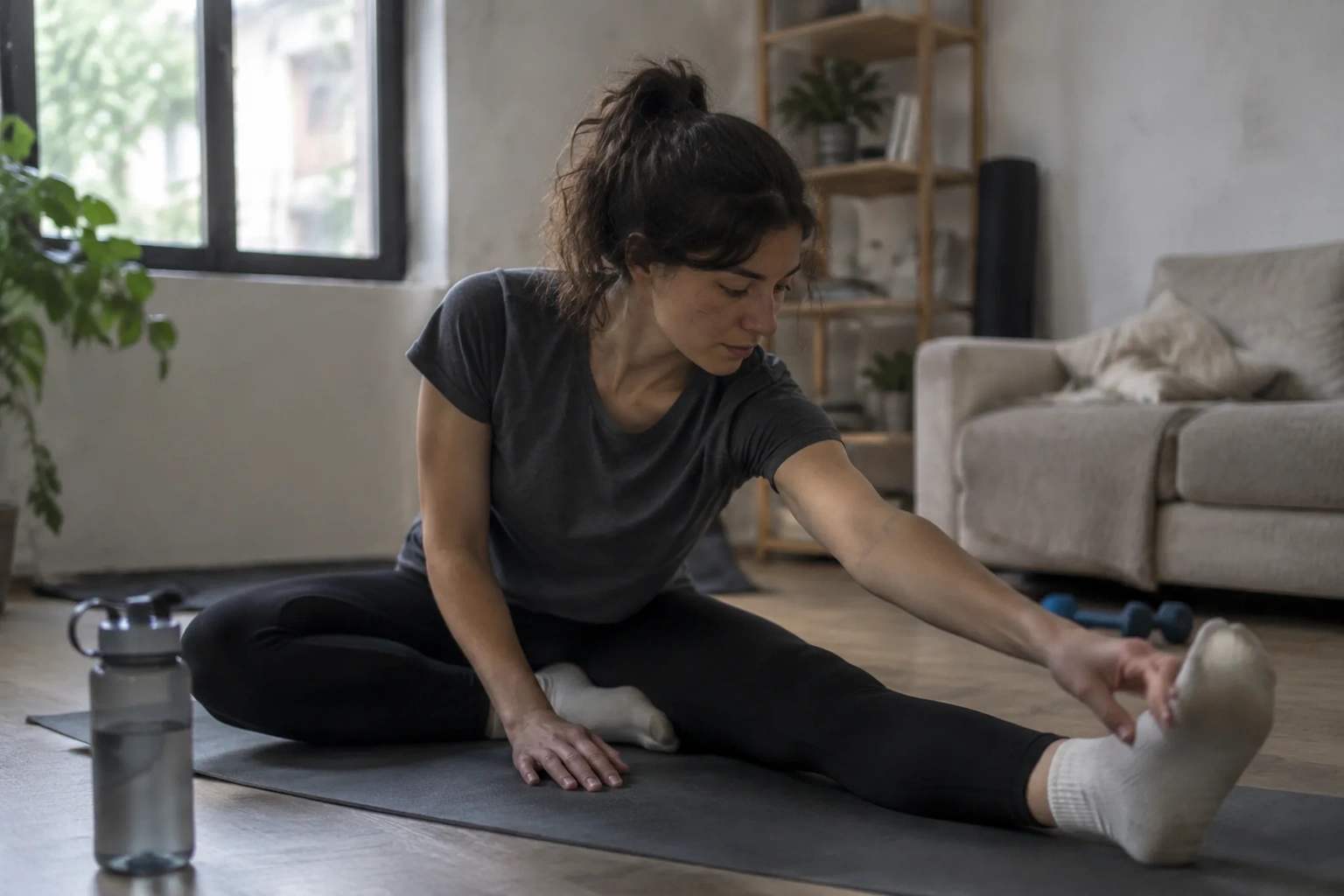
The first honest thing to say about flexibility is that most beginners are already flexible enough to do the thing they actually want to do, and they have simply never tested it. A man in his thirties who cannot touch his toes will often assume his hamstrings are hopelessly short. Then he sits on the floor, folds forward with a rounded back, and gets within a few inches of his shoes without any preparation at all. The gap between where he is and where he thinks he is turns out to be small. That gap is where beginner flexibility work lives, and it is a much narrower territory than the stretching industry suggests.
What follows is a beginner's approach, which means it has to survive contact with a real week: three or four sessions, ten or fifteen minutes each, no equipment beyond a floor and something to sit on. A program that requires an hour and a mat and a video subscription gets abandoned by Thursday. A program that fits into the space between a cup of coffee and a shower gets done.
Range of motion is a skill before it is a tissue property
Watch someone reach for a high shelf. The arm goes up, the shoulder blade rotates, the ribcage shifts slightly, and the reach happens. Now watch the same person try to reach the same shelf while holding a heavy box in the other arm. The reach gets shorter. Nothing about the shoulder changed in the intervening seconds. The nervous system decided how much range was available given the load and the situation.
This is the single most useful idea for a beginner to absorb. A large portion of what feels like stiffness is the body's conservative estimate of what is safe, not a hard limit in the muscle. That estimate responds to repetition, to familiarity, to slow exposure. It does not respond well to force. Yanking on a tight hamstring teaches the nervous system that this position is dangerous, and the hamstring will guard harder next time. Slow, repeated, unremarkable movement teaches the opposite lesson.
The practical consequence is that beginners should spend most of their flexibility time moving in and out of ranges rather than sitting in one. A held stretch is not useless, but it is the advanced move. The beginner move is repetition with control.
The warm-up is thirty seconds of walking, and it is not optional
Cold tissue does not want to lengthen, and a beginner who starts stretching the moment they stand up from a desk is asking for a small pull or a twinge that ends the program in week one. The warm-up does not need to be elaborate. Thirty to sixty seconds of walking around the room, a few slow squats to a chair, a couple of arm circles. The point is to raise tissue temperature slightly and to wake up the joints that are about to be asked for range.
There is a version of this advice that turns into a ten minute mobility flow, and that version is how beginners quit. The warm-up is a bridge, not a destination. Get warm, get moving, get to the actual work.
Four positions that cover most of the body
A beginner does not need a catalog. Four positions, done well and repeated, cover the major areas that most desk-bound adults find restricted: hips, hamstrings, thoracic spine, and ankles. Each one is performed slowly, in and out, for roughly a minute.
The first is a standing hip hinge with a soft knee. Feet hip width, hands on thighs, push the hips back as if closing a car door with the rear end, keep the back long, and return. The range will be short at first. That is fine. Ten slow repetitions.
The second is a kneeling lunge with a reach. One knee down, the other foot forward, then shift the hips gently forward and reach the same-side arm overhead. The reach matters. It connects the hip position to the ribcage and stops the lower back from doing all the work. Five slow reps each side.
The third is a seated spinal rotation. Sit tall on a chair or the floor, cross the arms over the chest, and turn the ribcage slowly to one side and back. The hips stay square. The turn should feel like it comes from the middle of the back, not the neck. Eight slow turns each direction.
The fourth is a standing ankle rock. Hands on a wall, one foot forward, drive the front knee gently over the toes while the heel stays down, then return. This is the least glamorous of the four and the one most people skip, and it is the one that quietly determines whether a person can squat, lunge, or walk downhill without their knees complaining.
Discomfort has a location, and it is not in the joint
Beginners get hurt in flexibility work for a small number of predictable reasons, and almost all of them come down to confusing a stretch with a warning. A stretch is felt in the belly of a muscle, a broad, diffuse pull that fades when the position is released. A warning is sharp, pinpointed, or located in a joint: the front of the hip, the back of the knee, the shoulder socket itself. The first is information about range. The second is a stop sign.
The other common error is breath-holding. A person sinks into a position, forgets to breathe, and the whole system tenses up. Slow exhales through the nose, or through the mouth if the nose is congested, keep the nervous system in a state where it is willing to allow more range. Breathing is not a mindfulness add-on here. It is the mechanism.
Any sharp pain, any numbness or tingling that travels down a limb, any sensation that persists after the position ends: stop and get it looked at by someone qualified. Flexibility work is low risk, but it is not zero risk, and a beginner has no business pushing through a signal the body is sending clearly.
Progress is measured in weeks of consistency, not in inches per session
The beginner's trap is the daily measurement. A person stretches for four days, tests their forward fold, sees two inches of improvement, and concludes that two inches per four days is the rate. It is not. Much of that early gain is the nervous system relaxing its guard, and it will partly recede if the work stops. The real change, the kind that holds, accumulates over six to ten weeks of three or four sessions per week.
A better measure is a task. Can the person put on a sock standing up without holding the wall? Can they get off the floor without using their hands? Can they sit cross-legged for a meal without their knees aching afterward? These are the things flexibility is actually for, and they move in a way that a tape measure does not capture.
Strength at the end range is what keeps the range
Here is where most beginner programs quietly fail. A person stretches diligently for two months, gains range, and then loses it within a few weeks because nothing in their life asks them to use that range under load. The body is efficient. Range that is never used gets reclaimed.
The fix is modest. Once a position is accessible, spend a few seconds at the end of it with a little tension. At the bottom of a deep squat, press the feet into the floor and stand up a few inches, then sink back. At the end of a hip hinge, hold a light weight and pause. This is not a strength program. It is a signal to the body that this range is worth keeping.
Beginners who add this small step keep their gains. Beginners who stretch only, and never load, tend to cycle back to where they started and conclude that they are naturally inflexible. They are not. They simply never told the body to keep the new territory.
A ten minute session that fits between coffee and the shower
Thirty seconds of walking. Ten slow hip hinges. Five slow lunges each side with the overhead reach. Eight seated rotations each direction. Ten ankle rocks each side. Then a minute in a deep squat, holding a doorframe for balance, rocking gently side to side. That is the whole session, and it takes about ten minutes.
Three sessions a week is the floor. Four is better. Five is unnecessary for a beginner and tends to produce the kind of soreness that leads to skipped weeks. The session should feel almost too easy, which is the correct calibration for the first month.
The first month is a negotiation with the nervous system
By week four, most beginners notice something specific: the positions feel less foreign. The hip hinge no longer requires thought. The lunge reach does not produce the same resistance at the top of the movement. The change is not dramatic and it will not photograph well, but it is the change that matters, because it means the body has started to treat these ranges as ordinary.
That ordinariness is the whole game. A person who can fold forward to tie a shoe without grunting, who can sit on the floor at a child's birthday party without planning the exit, who can reach the top shelf without a stool, has gained something more useful than a longer hamstring. They have gained a body that does not flinch at the ordinary demands of a day. The ten minutes between coffee and the shower is where that starts, and it is a smaller commitment than almost anyone expects.





















