







The freezer holds three bags of frozen peas, a single chicken thigh, and a half-empty ice tray. The refrigerator below has mustard, a lemon going soft, and four eggs. This is the state of the average kitchen on a Wednesday night, and it is not a failure of character. It is the result of a planning system that was never designed to survive a real week.
Most meal planning advice assumes a person has an hour on Sunday to sit with a cookbook and a spreadsheet. The advice is not wrong so much as it is misaligned with how weeks actually go. Plans collapse on Tuesday afternoon when a meeting runs long, and the carefully scheduled stir-fry becomes a takeout order. By Thursday the plan is discarded entirely, and the groceries bought for it rot in the crisper drawer.
Meal planning lite is the argument that a plan should survive contact with a bad week. It is a smaller, looser system, built around a handful of decisions made once and repeated, with enough slack to absorb the ordinary chaos of a long Tuesday.
The problem with the full-week plan
A seven-day plan with seven distinct dinners looks impressive on paper. It also requires seven distinct shopping lists, seven sets of leftovers managed correctly, and seven evenings where energy and time cooperate. The failure point is not the cooking. It is the decision fatigue that arrives at 5:40 p.m. when a person has to remember what the plan said and whether the ingredients are still good.
The full-week plan treats dinner as a project to be optimized. Most nights, dinner is a chore to be handled. A system that respects that distinction will outperform a more elaborate one that gets abandoned by Wednesday.
Three slots, not seven
The core move in meal planning lite is to plan three dinners per week, not seven. Three is the number that fits an ordinary schedule without demanding a heroic Sunday. It leaves room for leftovers, for a night out, for a scrambled-eggs-and-toast evening that no one needs to apologize for.
The three planned meals should be the ones a household actually reliably cooks. Not aspirational recipes clipped from a magazine, but the four or five dishes that get made over and over because they work. A person can list them from memory: the sheet-pan chicken, the pasta with whatever vegetables are around, the rice bowl with a fried egg, the soup that freezes well. Those are the real menu. The planning step is simply choosing which three of them get scheduled and buying for them.
Three scheduled meals and four open evenings reads badly on a spreadsheet and works beautifully in a kitchen.
The shopping list that writes itself
Once the three meals are chosen, the shopping list is nearly automatic. Each of the reliable dishes has a known ingredient set. The sheet-pan chicken needs chicken, a vegetable, oil, salt. The pasta needs pasta, garlic, olive oil, a vegetable, cheese. The rice bowl needs rice, eggs, soy sauce, something green. The list writes itself from the menu, and it stays short because the dishes have been cooked so many times their ingredient needs are known by heart.
This is where meal planning lite diverges from the more ambitious version. A person is not shopping for a week of novel recipes. They are restocking a small pantry of staples that support the handful of dishes they already know how to make without thinking.
The list should include a few flexible items beyond the three meals. Eggs, a bag of frozen vegetables, a block of cheese, a can of beans. These are the buffer stock that absorbs an unplanned meal. If a planned dinner falls through, the buffer stock covers the gap without a trip to the store.
Batch cooking one component, not the whole meal
The Sunday meal-prep session that produces five identical containers of chicken and rice is a well-known form of self-punishment. By Thursday the container is a sad reminder of Sunday's ambition. The lite version avoids the five-container approach entirely.
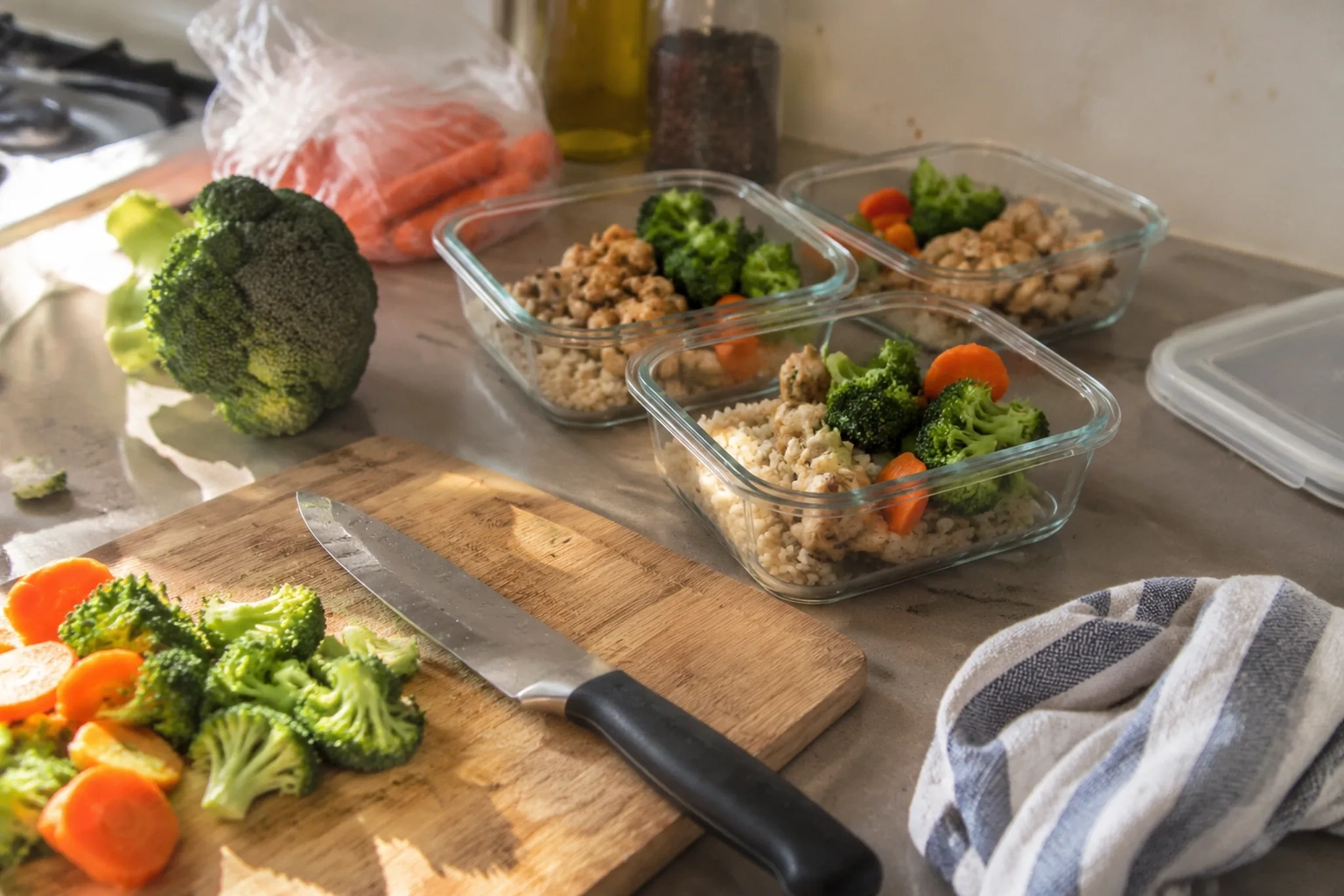
Instead, batch one component. Roast a tray of vegetables, cook a pot of rice, or braise a batch of beans. The component gets used across multiple meals without committing anyone to eating the same dinner four nights running. Roasted vegetables can go into a pasta, a rice bowl, or a frittata. A pot of rice becomes a side, a base, or fried rice later in the week.
This is the single highest-leverage habit in the whole system. One component, prepped once, extends across three or four meals and cuts the active cooking time on weeknights roughly in half. It also keeps the refrigerator populated with something that can become dinner without a recipe.
The freezer as a pantry, not a graveyard
Most freezers hold the same three items: frozen peas, an ice tray, and something unidentifiable wrapped in foil from an earlier era. The freezer is treated as a place where food goes to be forgotten. In the lite system, the freezer is the backup plan.
When a batch of soup or chili gets made, half of it goes into the freezer in single portions. When a loaf of bread is bought, half gets sliced and frozen. When ground meat is on sale, a portion gets browned and frozen. The point is to build a small reserve of meals that can be reheated on a night when the plan has failed entirely.
The reserve only works if it gets used. A simple rule helps: one night per week, dinner comes from the freezer. That keeps the stock rotating and prevents the slow accumulation of unlabeled containers. It also gives the week a built-in low-effort evening, which is often the difference between cooking and ordering in.
The pantry shelf that covers a missed shop
Between the three planned meals, the prepped component, and the freezer reserve, most of the week is covered. The remaining gap is the night when the shop did not happen or the plan fell apart early. This is where a small, deliberately stocked pantry shelf earns its place.
The shelf does not need to be large. A few cans of tomatoes, a bag of pasta, a jar of olives, a tin of sardines, a box of stock, a bag of lentils. These are ingredients that can become a meal with nothing else on hand. Pasta with tomatoes and olives. Lentil soup from stock and a can of tomatoes. Sardines on toast. None of these are impressive, and that is the point. They are the meals that prevent a takeout order on a night when cooking feels impossible.
The pantry shelf should be restocked during the regular shop, not treated as a special project. A can of tomatoes goes into the cart each week, and the shelf stays full without anyone thinking about it.
One flexible night built into the schedule
A three-meal plan leaves four nights open. One of those should be explicitly designated as a flexible night: a night when whatever is in the refrigerator becomes dinner, with no plan and no recipe. This is the night that absorbs the leftovers, the half-used vegetables, and the odds and ends that would otherwise get thrown out.
The flexible night works because it is not a failure of planning. It is a scheduled part of it. A household that expects one improvisational dinner per week stops feeling guilty about it and starts using it to clean out the refrigerator. The meal is often a frittata, a stir-fry, a soup, or a grain bowl, built from whatever is on hand. It is rarely the best dinner of the week, and it is reliably the one that keeps the grocery bill down.
The ten-minute weekly reset
The whole system needs a short weekly check-in, and it should take about ten minutes. Not an hour with a cookbook. Ten minutes, once a week, usually on a Sunday evening or a Monday morning, to answer three questions: what three meals are planned, what needs to be bought, and what is already in the refrigerator that needs to be used.
That last question is the one most planning systems skip. A quick survey of the refrigerator before the shop prevents the familiar cycle of buying a second bunch of parsley while the first one wilts in the drawer. The ten-minute reset is less about planning and more about looking at what is already there.
The reset also handles the freezer. A glance at the reserve tells a person whether it needs restocking or whether it has accumulated enough to cover a couple of nights. Either way, the information shapes the week's plan.
When the plan fails, and it will
Some weeks collapse entirely. A illness, a deadline, a family emergency, a stretch of days when cooking is simply not going to happen. The lite system is designed to fail gracefully in those weeks. The freezer reserve covers a night or two. The pantry shelf covers another. The flexible night absorbs the rest. Nothing rots, because nothing was bought for a plan that assumed a perfect week.
The measure of a meal planning system is not how well it performs in a good week. It is how much damage it prevents in a bad one. A seven-day plan with seven novel recipes produces a refrigerator full of spoiled ingredients and a household that orders takeout for five days. A three-meal plan with a freezer reserve and a pantry shelf produces a week of ordinary dinners and a grocery bill that did not balloon.
The Wednesday-night refrigerator with three bags of peas and four eggs is not a crisis. It is a kitchen with a reserve and a plan that knows how to use it. Dinner that night might be a frittata, or pasta with peas and whatever cheese is left, or sardines on toast. None of it requires a spreadsheet. All of it counts.





















