







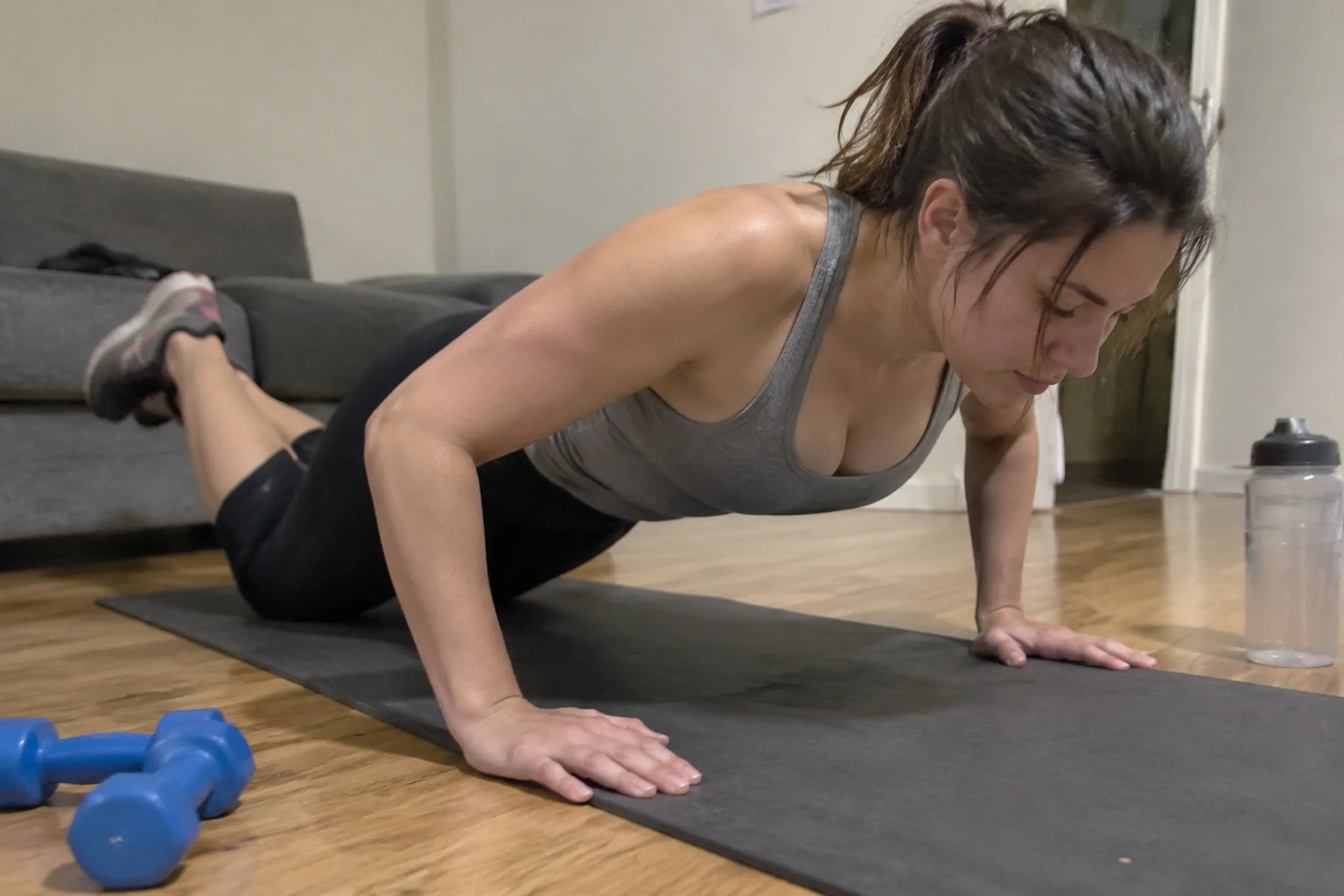
Every exercise comes with a default setting, and the default is almost never the individual. A push-up is written for a body that can lower itself to the floor and press back up with a straight spine. A pull-up assumes a certain grip strength and shoulder mobility. A squat on the gym floor assumes ankles that bend far enough and hips that open cleanly. The movement is the template; the person is the variable. Modifying an exercise means adjusting the template until the person can actually perform the intended pattern, at the intended joint angles, without the body improvising a workaround.
That distinction matters because most people modify the wrong thing. They shrink the range of motion, lower the weight, or cut the reps, and call it a regression. Sometimes that works. Often it just hides the problem, letting a stiff shoulder or an unstable knee keep coasting through a movement it cannot control. A good modification changes the leverage, the base of support, or the angle so the target tissue gets loaded correctly while the weak link gets protected.
The five levers that actually change a movement
Almost every useful modification pulls one of five levers. The first is leverage: moving the load closer to or farther from the body's pivot points. A push-up with hands elevated on a bench shortens the lever arm of the body, reducing the load at the shoulder and chest. The second is base of support: widening the feet in a squat, splitting the stance, or holding a rail during a single-leg movement. The third is range of motion: a partial rep, a box squat to a set height, a floor press instead of a bench press. The fourth is tempo and pause: slowing the eccentric, pausing at the sticking point, or adding an isometric hold. The fifth is load placement: a front-loaded squat instead of a back-loaded one, a dumbbell instead of a barbell, a band instead of a cable.
These five levers are not equally useful for every exercise. A person who cannot do a single pull-up will not fix it by slowing the descent of a pull-up they cannot perform. They need a different lever entirely: an inverted row, a band-assisted pull-up, or a negative rep that starts at the top. The lever has to match the limitation.
Why "just do less" usually fails
Scaled-down versions of an exercise tend to preserve the same joint angles and the same coordination demand. A half-depth squat still asks the ankles to dorsiflex and the hips to hinge in the same way as a full squat. If the limitation is ankle mobility, the half squat does not solve it. It just trains the body to stop at the point where the ankle runs out of range, reinforcing the restriction over time.
The better move is to change the angle of the whole movement. Elevating the heels on a small wedge or a weight plate during a squat lets the knees travel forward without demanding as much ankle range. The person can then reach full depth, load the quads and glutes through a complete range, and gradually reduce the heel elevation as ankle mobility improves. That is a real modification: same pattern, adjusted geometry.
This is where gym culture gets it wrong. There is a quiet prestige attached to doing the "real" version of a lift, as if a box squat or a band-assisted pull-up is a lesser exercise. It is not. It is the same exercise performed at a difficulty the body can absorb. The person who spends six months on box squats and inverted rows will usually out-progress the person who spends six months grinding out ugly half-reps of the full version.
Reading the body for the right adjustment
Before modifying anything, watch the movement fail. Where does the rep break down? A push-up where the hips sag first points to a core or glute limitation, not a chest limitation. A push-up where the elbows flare wide and the shoulders shrug points to scapular control. A squat where the heels lift and the torso pitches forward points to ankle or hip mobility. A deadlift where the bar drifts away from the shins points to a setup or lat issue.
The point of failure is the diagnostic. Modify to address that specific point. If the hips sag in a push-up, elevate the hands so the body is more upright and the core demand drops, or perform the push-up from the knees with a hard glute squeeze. If the shoulders shrug, switch to an incline push-up and cue the shoulder blades down and back before each rep.
This diagnostic habit is more valuable than any single modification. It teaches a person to see their own movement clearly, which is the skill that lasts long after a coach or a program is gone.
Modifications for the three most common sticking points
Three movements account for a disproportionate share of modification questions: the push-up, the pull-up, and the squat. Each has a small toolkit worth knowing.
For the push-up, the progression runs from wall push-up to incline push-up to knee push-up to full push-up to feet-elevated push-up. The key is that the incline should be high enough that the person can complete eight to twelve clean reps with a straight line from ear to ankle. If the hips still sag at that height, the hands go higher or the movement shifts to a wall. A push-up performed against a kitchen counter is a legitimate exercise, not a consolation prize.
For the pull-up, the path usually runs through inverted rows, band-assisted pull-ups, and negatives. The inverted row is the workhorse: it trains the same pulling pattern with the feet on the floor, and the angle of the body sets the difficulty. A row performed with the torso at 45 degrees is easier than one performed nearly horizontal. The band-assisted pull-up is useful for practicing the full range, but the band should be light enough that the top of the rep still requires effort. A heavy band that does most of the work teaches the body to coast.
For the squat, the box squat, the heel-elevated squat, the goblet squat, and the split squat cover most limitations. A box squat controls depth and teaches the hips to sit back. A heel-elevated squat addresses ankle range. A goblet squat shifts the load to the front, which often makes it easier to keep the torso upright. A split squat reduces the balance demand and lets each leg work independently, which is useful when one side is clearly weaker.
The trap of permanent regression
A modification is a temporary address, not a new home. The person who spends two years on knee push-ups because they never tested the full version has stopped modifying and started avoiding. The rule should be simple: every four to six weeks, retest the harder version. If the person can now perform three clean reps of the full movement, the modification has done its job and should be retired or reduced.
This retesting is where most people fall down. They get comfortable with the box squat or the band-assisted pull-up and never revisit the standard. The body adapts, the modification becomes the ceiling, and progress stalls. A short note in a training log, a single set of the harder version once a month, is enough to keep the door open.
There is also a subtler trap: modifying so aggressively that the target tissue never gets challenged. A push-up performed on a wall for months will not build much chest or triceps strength. The modification should sit right at the edge of what the body can do, not far below it. The right difficulty is the one where the last two reps are genuinely hard but still clean.
When the modification should be a different exercise entirely
Some limitations cannot be solved by tweaking the same movement. A person with a shoulder that cannot reach overhead without pain will not fix an overhead press by lowering the weight or reducing the range. They need a different exercise: a landmine press, a floor press, or a dumbbell press at a lower angle. The pattern is preserved, the joint demand changes, and the shoulder gets loaded in a range it can tolerate.
The same logic applies to the lower back. Someone whose back rounds under a heavy deadlift may not need a lighter deadlift; they may need a trap bar deadlift, a rack pull from a higher starting position, or a hip hinge drill with a dowel to relearn the pattern. Changing the exercise is sometimes the cleanest modification available.
The judgment call is whether the limitation is a range or a pattern problem. A range problem responds to elevation, partial reps, or a different angle. A pattern problem often responds better to a different movement that trains the same muscles in a cleaner way. Telling the two apart requires watching the movement and asking a simple question: does the body break down because it cannot reach the position, or because it cannot control the position once it gets there?
What a good coach actually does
The best coaches spend more time adjusting exercises than prescribing them. A program on paper is a starting point; the real work happens when the person walks in and the movement does not match the plan. A good coach watches the first rep, sees where the body compensates, and changes one variable before the next set. That is the whole job in miniature.
The people who make steady progress over years are usually the ones who learned to do this for themselves. They know that a push-up against a counter is a real push-up, that a box squat is a real squat, and that the standard version is a target, not a gate. They also know to retest the target regularly, because the whole point of a modification is that it should eventually become unnecessary.
A gym that treats every exercise as a fixed standard will produce people who plateau or get hurt. A gym that treats every exercise as a template to be fitted will produce people who train for decades. The difference is not the equipment. It is whether someone is willing to look at the movement, find the point of failure, and turn one of the five levers until the rep becomes honest again.





















