







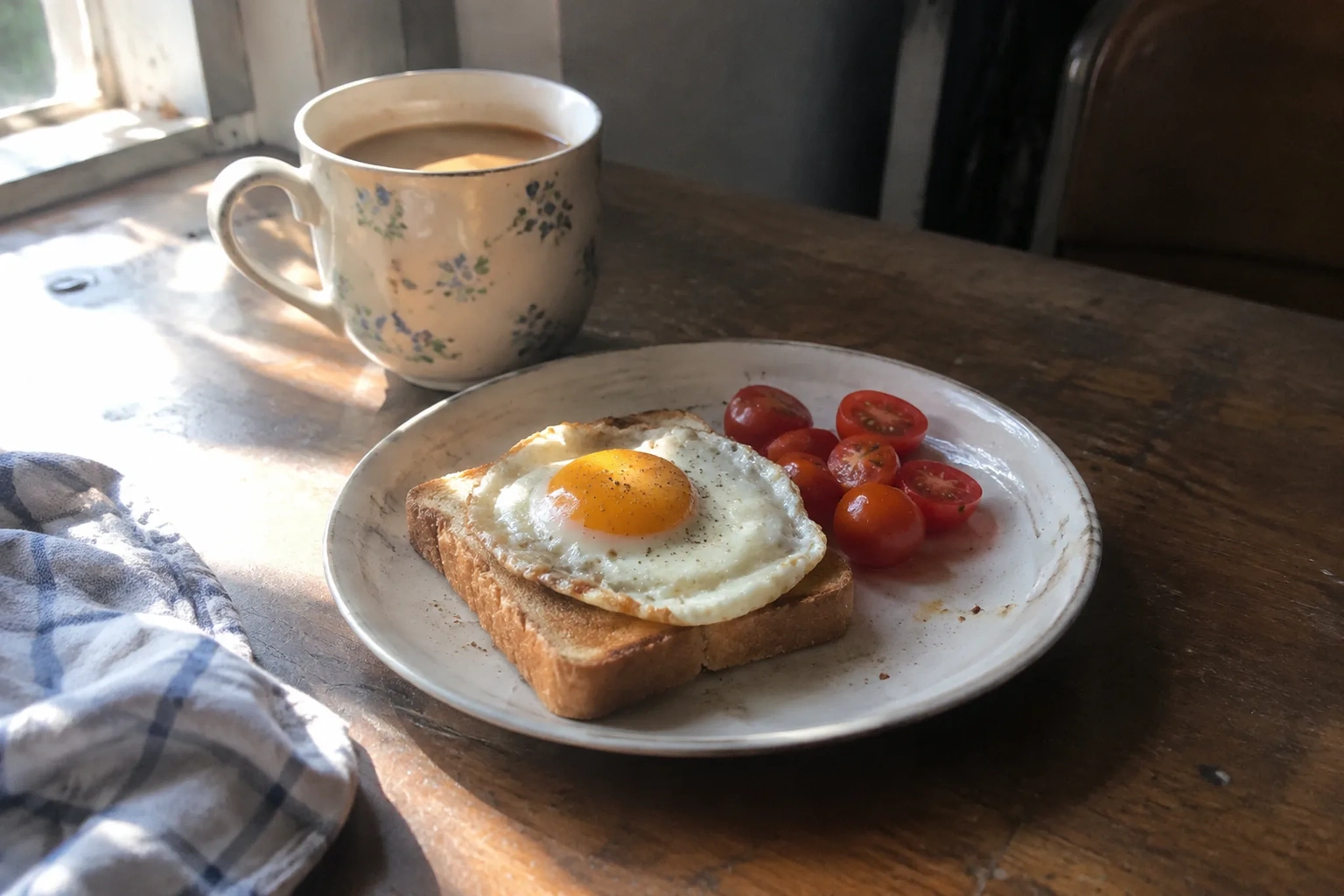
Cereal is the most honest breakfast in America, and also the most depressing. A bowl of it takes ninety seconds and leaves a person hungry by ten. The toaster promises more but demands attention: bread that must be watched, butter that must be soft, a crumb tray that must be emptied. Between those two poles sits the real morning, the one where a person has eleven minutes and a low tolerance for decisions, and the question is what can be assembled in that window without turning the kitchen into a project site.
Low-effort breakfast has a bad reputation, largely because the food industry has spent decades selling convenience as a flavorless trade-off. Frozen waffles that taste like cardboard. Protein bars that chew like drywall. Instant oatmeal packets that collapse into paste. The assumption is that speed and pleasure cannot share a plate before nine in the morning. That assumption is wrong, and it is worth dismantling piece by piece, because the alternative is a lifetime of mornings that start with disappointment.
The eleven-minute window is the real constraint
Most breakfast advice assumes a person has time to cook. Real mornings do not work that way. The actual window, measured from the moment the coffee starts to the moment the door closes, is usually somewhere between eight and fifteen minutes, and much of that is spent doing other things: finding a shoe, answering a message, staring at the fridge with no plan.
So the useful question is not what tastes best. It is what can be made while distracted, with one eye on the clock and one hand on a mug. Anything requiring a thermometer, a timer, or a technique is out. Anything that punishes inattention is out. Eggs Benedict is out. A fried egg is borderline, because the difference between runny and rubbery is about forty seconds of daydreaming.
What survives the window is a short list, and it is longer than most people think.
Toast is a technique, not a food
The most underrated breakfast tool in any kitchen is the toaster, and the most underrated skill is knowing what to put on the toast. Plain buttered toast is fine. Buttered toast with a sliced hard-boiled egg and a shake of salt is a meal, and the egg can be boiled the night before in a batch of six, which turns a two-minute assembly into a thirty-second one.
The trick is to treat toast as a platform rather than a finished thing. Good bread, toasted dark enough to hold up, then something with fat and something with acid. Ricotta and sliced tomato. Peanut butter and a drizzle of honey. Mashed avocado with lime and salt, which sounds like a cliché until a person realizes it takes ninety seconds and costs less than a coffee shop version by a factor of five.
A toaster oven widens the options further. It can melt cheese on a piece of bread while the coffee brews, and it does not require the stovetop attention that a pan does. A slice of bread with cheese and a cracked egg in the middle, baked until the white sets, is a complete breakfast that asks for about four minutes of actual work and produces something that looks like it came from a restaurant.
Overnight oats are worth the five minutes they cost the night before
The overnight oat has become a wellness cliché, which is a shame, because underneath the Instagram presentation is a genuinely efficient breakfast. Equal parts oats and milk, a spoon of yogurt, a pinch of salt, stirred in a jar before bed. In the morning it is soft, cold, and ready, and it can be eaten standing up while the kettle boils.
The reason it works is texture. Rolled oats soaked overnight soften without turning to paste, and the yogurt gives the mixture a slight tang that keeps it from tasting like breakfast porridge left out too long. A spoon of jam or a handful of frozen berries stirred in the night before stains the whole jar and sweetens it without requiring morning effort.
The five minutes happen at night, when the kitchen is calm and the stakes are low. That timing matters. A person who cannot face cooking at seven in the morning can usually manage a small, quiet task at ten at night, and the payoff is a breakfast that requires opening a fridge and finding a spoon.
The freezer is a legitimate pantry
Frozen fruit is the single best investment a breakfast routine can make. A handful of frozen berries stirred into yogurt at night thaws by morning and releases enough juice to sweeten the whole bowl. Frozen mango chunks blended with milk and a spoon of honey become a smoothie in under a minute, though the blender is a commitment that many mornings cannot support.
Frozen spinach deserves a mention for a different reason. A handful thrown into a hot pan with a little oil and a cracked egg wilts in under two minutes and turns a plain egg into something with a vegetable in it. The cleanup is one pan. The effort is minimal. The result is a plate that feels like a real breakfast rather than a concession.
Frozen waffles, meanwhile, remain a disappointment, and no amount of syrup fixes the fundamental problem, which is that they taste like the box they came in. The freezer is a good pantry for ingredients. It is a bad pantry for finished breakfasts.
Batch cooking that does not feel like batch cooking
The phrase "meal prep" conjures images of Sunday afternoons spent portioning rice into identical containers, which is a lifestyle choice rather than a breakfast strategy. The useful version is smaller and less ambitious: boil a half dozen eggs while doing something else, and keep them in the fridge for the week. Hard-boiled eggs are the most portable protein in the kitchen, and they turn a piece of toast into a meal.
Another small batch task: cook a pot of steel-cut oats on the weekend and reheat portions through the week. The texture holds up better than instant oats, and a spoon of brown sugar and a splash of milk makes it indistinguishable from something made fresh. The reheating takes two minutes in a microwave, which fits the window.
The principle is not efficiency for its own sake. It is that a person who has already done one small task on a calm evening has removed one decision from a rushed morning, and decisions are the real cost of breakfast. A fridge with boiled eggs and a jar of soaked oats in it removes several.
What to drink when coffee takes too long
Coffee is non-negotiable for most people, but the ritual around it can eat the whole window. A pour-over requires attention. An espresso machine requires a warm-up and a cleanup. The French press is the reasonable middle ground, because it asks for four minutes of waiting and almost no technique, and the cleanup is a rinse and a knock into the bin.
For mornings when even that is too much, cold brew made in a batch on the weekend is the answer. Coarse grounds steeped in cold water overnight, strained once, and kept in the fridge for several days. In the morning it is a pour and a splash of milk, and the flavor is smoother than anything a rushed hot brew produces.
Tea deserves a brief defense here. A strong black tea with milk takes the same three minutes as a French press but requires no equipment beyond a kettle and a mug, and it does not punish a person who walks away and forgets about it. On the worst mornings, that forgiveness is worth more than the caffeine.
The case for eating the same thing every day
Variety is overrated at breakfast. The people who eat well in the morning tend to eat the same two or three things on rotation, because the decision has already been made and the ingredients are always in the kitchen. A person who eats toast with peanut butter and a boiled egg every weekday is not stuck in a rut. That person has solved the problem and moved on to other things.
The rotation can shift with the season without much effort. Berries in summer, sliced apple in winter. Cold oats when it is warm, warm oats when it is not. The structure stays and the details change, which is a far more sustainable pattern than trying to invent a new breakfast every morning.
A plate that takes four minutes and asks nothing else
There is a breakfast that hits the window almost perfectly, and it is worth describing in full because it demonstrates the principle better than any list. A slice of bread goes into the toaster. While it toasts, a small pan heats with a little oil, and a handful of frozen spinach goes in. The spinach wilts, the toast pops, and an egg is cracked into the pan next to the spinach. The egg sets in about ninety seconds if the pan is covered, and the whole thing lands on the toast with salt and a shake of hot sauce.
Four minutes of work, one pan, one plate, and a breakfast with a vegetable, a protein, and a carbohydrate. The cleanup is a rinse. The cost is less than a dollar. And the result is a plate that a person would be happy to be served, which is the real test of a low-effort breakfast: it should not look like a compromise.
Most mornings will not allow even that. Some will allow only a jar of overnight oats and a spoon. The point is that the kitchen holds more options than the cereal box suggests, and the difference between a good morning and a bad one is often a single decision made the night before, or a toaster that was already warm.





















