







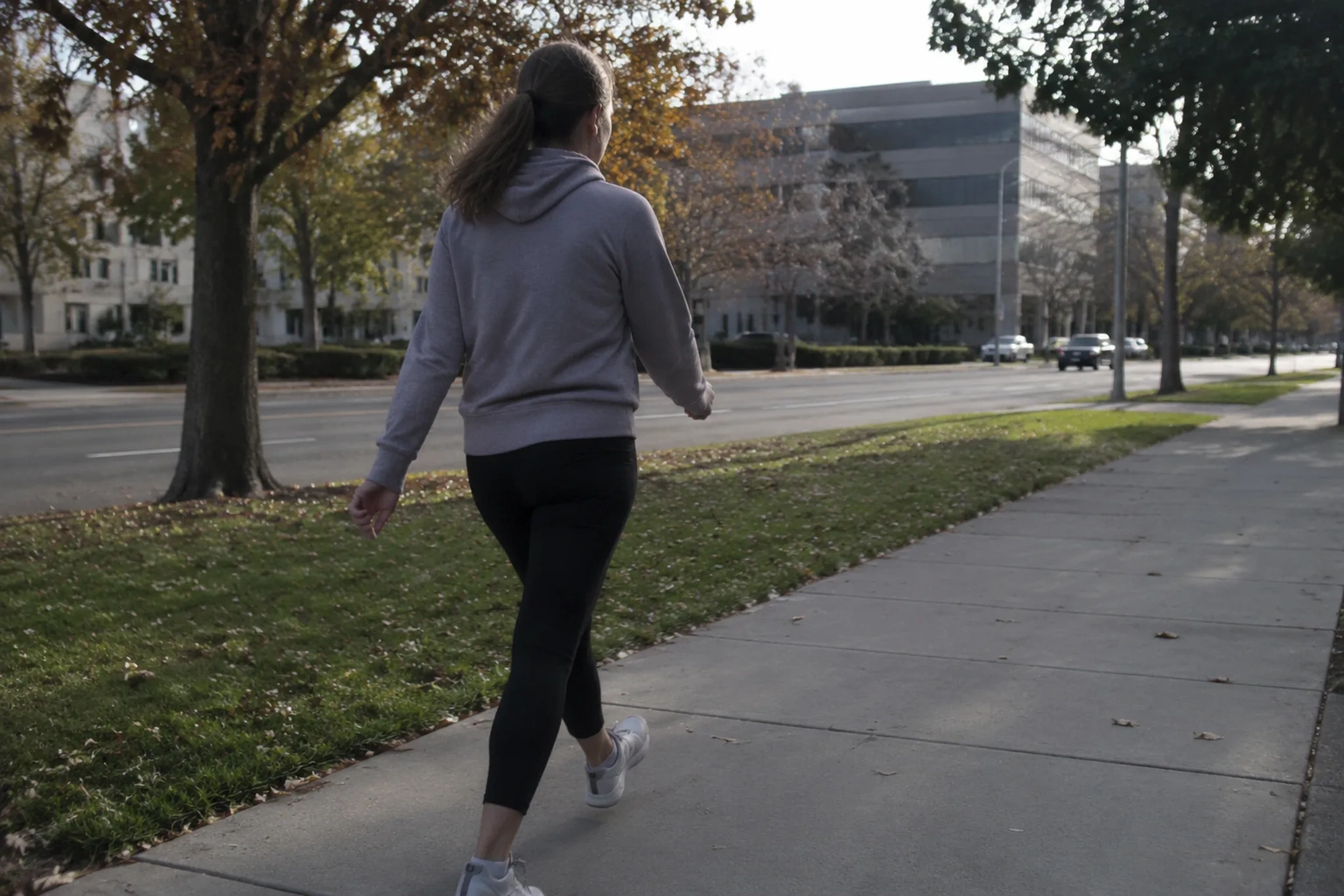
Walking breaks at work have a reputation problem. They sound like something a wellness committee recommends, right alongside ergonomic keyboards and a poster about lifting with the legs. The advice is so mild, so obviously good for everyone, that it slides off. Nobody argues against a walk. Nobody takes one, either, at least not with any regularity. The gap between knowing a short walk would help and actually standing up at 2:40 in the afternoon is where the whole habit lives or dies, and it is a wider gap than most people admit.
The case for movement during the workday is not complicated. Sitting for long stretches leaves the body stiff and the mind foggy, and a few minutes on foot interrupts both. That much is broadly understood, and repeating it does not help anyone. What matters is the mechanics of the habit itself: how a walk gets scheduled, what it replaces, how long it lasts, and why so many attempts collapse by the second week. The useful question is not whether walking is good. It is how a person turns it into something the day actually accommodates.
The break that never gets taken
Most office schedules contain no official walking time. There is a lunch hour, which tends to get eaten at a desk or compressed into errands, and there are the small gaps between meetings that fill themselves with email. A walking break has to be carved out of territory that already belongs to something else, and whatever already owns that time will defend it. This is the first reason the habit fails: it enters the day as an extra, and extras get cut first when a deadline lands.
The fix is to attach the walk to something already fixed in the schedule. A person who always has a 10 a.m. call can walk for eight minutes before it. Someone who eats lunch at a desk can take fifteen minutes after the last bite, before opening a single tab. The walk borrows the anchor's reliability. It stops being a separate decision that has to win an argument with everything else and becomes a passenger on a trip the day was already taking.
Ten minutes beats the ambitious plan
The most common mistake is scale. A person decides to walk thirty minutes at lunch, maybe forty-five, maybe with a podcast queued up. The first two days go fine. On the third, a meeting runs long, the walk gets shortened, guilt sets in, and by Friday the whole project is quietly abandoned. The ambition is what killed it. A plan that requires a rare, generous window of free time will break the first week the calendar turns hostile, which is most weeks.
Ten minutes is a different proposition. Ten minutes fits inside almost any gap, survives a delayed meeting, and requires no change of clothes or route planning. It is short enough that the excuse to skip it feels thin. The point of the ten-minute walk is not fitness in any measurable sense. It is that the walk happens at all, on a Tuesday, when the day is going badly and the body has been folded into a chair since morning. Consistency at a small size builds the habit; a large size that collapses builds nothing but a small residue of failure.
There is a useful rule buried in that: pick a duration that would still feel possible on the worst day of the month. If the answer is ten minutes, the habit is ten minutes. The walk can always run longer when the day cooperates, but the floor should be low enough to clear under pressure.
What a walk actually interrupts
Sitting for hours at a stretch tends to leave the hips and lower back stiff, and the eyes tired from a fixed focal distance. A short walk does not undo a day of that, but it breaks the accumulation. The body changes position, the legs do the work they were built for, and the eyes focus on things at a distance instead of a screen a foot away. These are modest effects, described in general terms because the specifics vary from person to person and no single number captures them honestly.
The mental side is often more noticeable. A walk taken mid-afternoon, especially outdoors, tends to loosen the grip of whatever problem has been circling for the past hour. Part of this is the change of scene; part is the simple fact of moving. A person who steps out stuck on a draft or a decision frequently comes back with the next sentence or the missing piece, not because walking is magic, but because staring harder at the same screen rarely produces anything new.
There is also the matter of what the walk replaces. Fifteen minutes on foot is fifteen minutes not spent refreshing a feed or rereading an email that does not need a reply. The break does double duty: it moves the body and it removes a small slice of low-value screen time. That trade is worth naming, because it makes the walk easier to justify to a skeptical inner accountant.
The route problem, and why it matters more than motivation
Motivation is unreliable. It shows up on Monday and vanishes by Thursday. A route, by contrast, is a physical fact. A person who knows exactly where the ten-minute loop goes, which door to leave by, which stairs to take, and where to turn around does not have to decide anything in the moment. The decision was made once, in advance, and the walk becomes a matter of following a path already laid out.
The best routes share a few traits. They start and end at the same door, so there is no logistics to solve. They avoid anything that requires a key card, a code, or a conversation. They have a natural turnaround point, a corner or a tree or the end of a block, so the walk has a shape and a length that does not depend on a clock. And they are boring enough to repeat without thought, because the goal is the walking, not the scenery.
Weather complicates this, and pretending otherwise is where a lot of plans die. A route that only works in dry, mild conditions is a seasonal habit. The practical answer is a second route, indoors, for the days when the sky does not cooperate: a loop through the building's corridors, a lap of the parking structure, a walk to a farther coffee machine. It sounds ridiculous until the first rainy week, when the indoor loop is the only reason the habit survives.
Walking with a purpose hides the awkwardness
Some people feel self-conscious leaving the desk for no visible reason. The office is a place of apparent busyness, and a person strolling out the door at 3 p.m. can feel like an announcement that they have nothing to do. This is a real friction, and it is worth addressing directly rather than dismissing as vanity.
Attaching a purpose to the walk solves most of it. A walk to fill a water bottle, to drop something in a mailbox, to grab a coffee from the shop two blocks away, or to take a call that does not need a desk all provide a visible reason to be in motion. Nobody questions a colleague heading out with a reusable cup. The errand is the cover, and the walk is the point. Over time the cover stops mattering, but in the first few weeks it lowers the social cost enough for the habit to take root.
Walking meetings, where two people take a call or a conversation on foot, work the same way for some teams. They are not for every discussion; anything needing a shared screen is out. But a one-on-one check-in done while circling the block tends to be shorter and more focused than the same conversation in a conference room, and both parties get the movement without anyone having to justify it.
The shoes left under the desk
A surprising number of walking habits die over footwear. The dress shoes are fine for the commute and the meeting, but a ten-minute walk in them is unpleasant enough that the walk gets skipped. The fix is almost too simple: keep a pair of comfortable walking shoes under the desk, and change into them for the break. This is the kind of small logistical detail that separates a habit that lasts from one that fades, and it is routinely overlooked in favor of bigger, more inspiring advice.
The same goes for the jacket. A light layer kept on the back of the chair means the weather is one less reason to stay inside. The desk becomes a small staging area for the walk: shoes, layer, maybe a bottle. When the equipment is already present, the friction of starting drops to nearly nothing, and a person is far more likely to stand up when the clock hits the agreed time.
Counting days, not steps
Step counters and fitness apps push toward a daily number, usually a large one, and that framing works against the walking break. A ten-minute walk contributes a modest number of steps, which can look discouraging next to a target of ten thousand. The result is that the short walk feels like it does not count, and a thing that does not count is a thing that gets dropped.
A better measure is the number of days the walk happened, full stop. A calendar with a mark for each walking day, kept somewhere visible, tracks the habit rather than the distance. Ten minutes on a Wednesday and ten minutes on a Friday count the same as a longer weekend hike for the purpose of building the routine. The metric rewards the behavior that matters, which is showing up, and it stops the short walk from being judged against a standard it was never meant to meet.
The colleague who walks at 2:40
Habits spread in offices through visible example. A person who leaves at the same time each afternoon, reliably, without apology, becomes a small piece of the office's furniture. Colleagues notice. Some ask where the walk goes. A few join. The habit stops being a private quirk and becomes a small social fact, and social facts are much harder to abandon than private resolutions.
This is why the timing should be fixed and public rather than flexible and secret. A walk that happens whenever there is a gap happens rarely. A walk that happens at 2:40, every working day, becomes something a person's colleagues can predict and even protect. The meeting organizer learns not to book over it. The habit gains defenders it did not have before.
By the end of a few months, the walk is no longer a decision. It is a feature of the afternoon, as ordinary as the coffee run and considerably better for the body. The person who started it does not need motivation anymore. They need only the shoes under the desk and the door at the end of the corridor, and the small, repeatable fact of ten minutes spent on their feet while the rest of the office sits.





















