







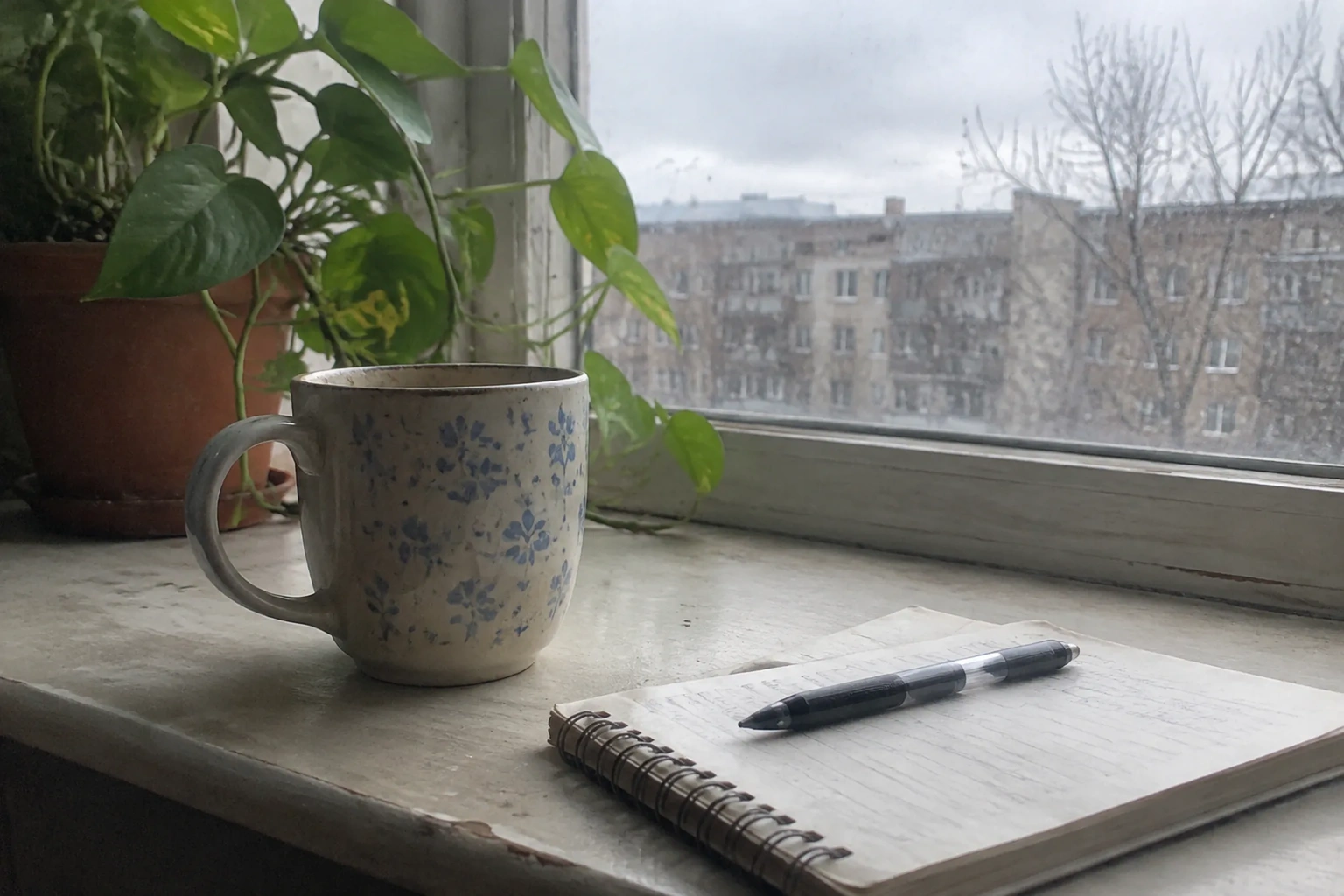
Gratitude journals sell by the million, and most of them end up in a drawer by February. The failure is rarely a failure of will. It is a failure of method. A person writes "I am grateful for my family" three hundred times and learns nothing, because the sentence contains no information. The mind cannot hold a category. It can hold a cup of coffee going cold on a windowsill while a dog waits by the door.
The practical approach to gratitude starts with a hard admission: the vague version does not work. What works is noticing, which is a skill, and like any skill it can be trained badly or trained well. The distinction matters more than the journal.
Why the Standard Advice Fails
The standard instruction is to list three things each morning. The list fills up with abstractions within a week: health, shelter, the people who love me. These are true and useless. They sit at the level of category, and categories do not register in memory. Ask a person what happened on a Tuesday three weeks ago and the answer is blank. Ask what they ate for lunch and a specific image surfaces. The brain keeps the concrete and discards the summary.
A gratitude practice built on summaries therefore trains nothing except a mild guilt about skipping days. The fix is to lower the altitude of attention until it reaches things small enough to be seen.
The Unit of Gratitude Is the Moment, Not the Blessing
Good noticing has a scale. It operates at the level of a single moment: fifteen seconds, one exchange, one small mechanical mercy. The good part of a morning commute is not "having a job." It is the traffic light that turned green at exactly the right instant, the one that let a person roll through without touching the brake.
That light is trivial. It is also real, and it happened, and it is the exact size of thing the mind can hold. A daily practice built on green lights and warm mugs will outlast a practice built on the word "family" by years.
The test for whether an item qualifies: could it be photographed? "A good conversation with a friend" cannot. "The friend leaning back in the chair and laughing at the exact moment the waiter set down the water" can. If the thing cannot be pictured, it is too big to be noticed, and too big to be felt.
Sensory Anchoring: The Three-Second Scan
Noticing is easier with a physical trigger. The most reliable one is a three-second sensory scan, done at the same moment each day, attached to a routine that already exists: the first sip of coffee, the walk to the car, the moment the office door closes behind a person.
The scan asks three questions in sequence. What is the temperature on the skin right now? What is the loudest sound, and what is the quietest? What is the texture of the nearest surface under a hand? The answers take seconds. They also produce an inventory, and the inventory usually contains something worth keeping: the radiator's warmth on the back of a hand, the low hum of a refrigerator, the grain of a wooden desk worn smooth at the edge.
The scan works because it bypasses the part of the mind that decides what a day was worth. Judgment is slow and biased. Sensation is immediate and honest.
The Specific-Memory Exercise
For anyone who wants a written practice, the exercise that survives is the specific-memory drill. Each evening, write one sentence about a single moment from the day. One sentence, no more, and the sentence must pass the photograph test. "Grateful for my health" fails. "The ache in the left knee eased on the third block of the walk home" passes.
Thirty days of this produces a document of small true things, and a document of small true things is worth more than thirty days of "grateful for my family." It also produces a side effect: after a few weeks, the mind starts hunting for the next day's sentence during the day itself. The practice stops being a chore performed at night and becomes a lens worn all afternoon.
The sentence does not need to be positive in the cheerful sense. A person can be grateful for an argument that finally cleared the air, for a rainstorm that canceled a meeting, for the moment a headache broke. Gratitude here means noticing what registered, not performing satisfaction with everything.
Noticing What Went Wrong, and What It Reveals
There is a counterintuitive move that makes the practice sturdier: notice the small failures too, then look at what they expose. The bus that came late revealed a driver who waited an extra ten seconds at the stop for a person running up the street. The burned toast revealed a toaster that still works after eleven years. The missed phone call revealed a friend who called back within the hour.
This keeps the practice from curdling into forced cheer. It also trains a specific perceptual habit: looking past the annoyance to the mechanism underneath. Most days contain at least one thing that worked quietly in the background, and the background is where most of life's actual support lives.
The Social Version: Naming the Small Favor Out Loud
Gratitude practiced only in private misses the largest available source of material: other people, and specifically the small favors they perform without being asked. The colleague who refilled the printer paper. The neighbor who moved a package out of the rain. The stranger who held a door with a shoulder while carrying groceries.
The practical version is to name one of these out loud, once a day, with enough specificity that the other person knows it was seen. "Thanks for the help earlier" lands as noise. "Thanks for grabbing the paper tray before I got to it, I was already running late" lands as a small gift returned. The specificity is the whole point. Anyone can say thanks. Noticing is saying thanks for the exact thing.
This has a compounding effect that the private journal cannot match. People who are noticed tend to keep doing the noticing. A kitchen where small favors get named is a kitchen where small favors keep happening.
When the Practice Goes Flat
Every noticing practice goes flat eventually. The sentences start repeating. The scan turns up the same radiator and the same hum. This is normal and it is information: the practice has become a routine, and routines stop generating attention.
The remedy is to change the channel, not to abandon the practice. If the daily scan has been auditory, switch to texture for a week. If the sentences have all been about home, spend three days writing only about the walk between the car and the office door. If the practice has been solitary, make it social for a week and count only favors received from other people.
Flatness is also a signal that the bar has dropped. A sentence about "a nice lunch" is a summary. A sentence about the specific crunch of a specific apple at a specific desk at 12:40 on a Tuesday is a moment. The difference is not talent. It is the willingness to be boring and precise.
The Two-Week Experiment and What It Actually Changes
Anyone skeptical of the whole enterprise can run a cheap test. For fourteen days, keep a single sentence per day, photograph-test only, no abstractions allowed. At the end, read the fourteen sentences in a row.
What tends to happen is not a transformation of mood. It is a change in the raw material of memory. The fortnight stops being a blur and becomes a list of fourteen small, specific, verifiable moments, several of which would have been forgotten entirely. The list is evidence. It says: this is what the days actually contained, and most of it was ordinary and most of it was fine.
That evidence is the whole product. A person who can produce fourteen concrete moments from a fortnight has a working relationship with their own attention. The notebook is incidental. The noticing is the thing.
On the fifteenth day, the exercise can be skipped. The habit is not the point, and the sentence is not the point. The point is the moment a person reaches for the notebook and finds that the day already wrote its own line: a green light, a warm mug, a driver waiting ten extra seconds for someone running up the street.





















