







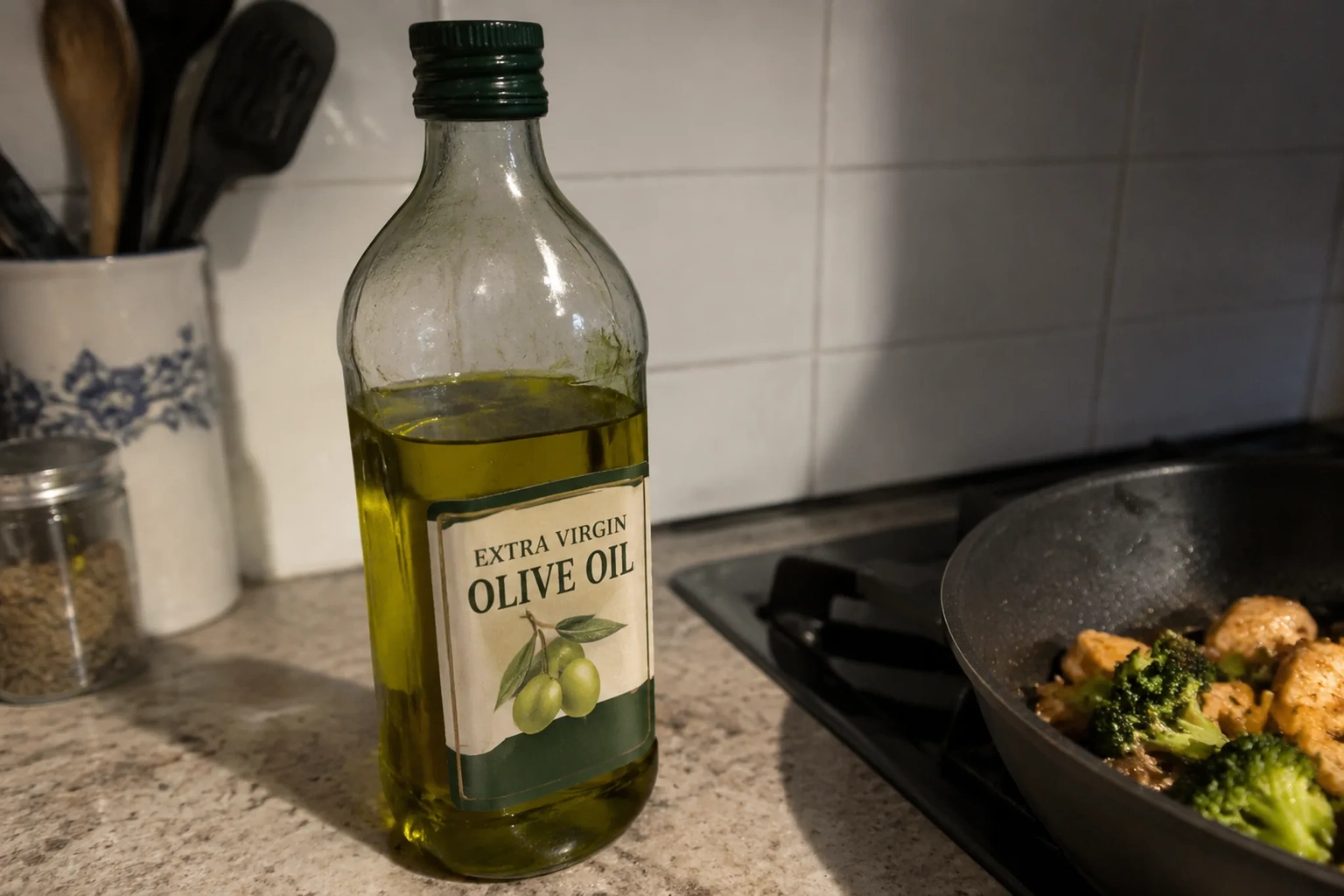
Extra virgin olive oil is a fruit juice. That single fact explains most of what goes wrong with it in home kitchens, and almost nobody cooks as if it were true. Apple juice left uncapped on a sunny counter goes flat and sour within days. Olive oil behaves the same way, just more slowly and with less drama, which is precisely why the damage goes unnoticed. A bottle can be years past its best and still look perfectly respectable, pouring out golden and glossy while the flavor has already left the building.
The mistakes tend to be quiet ones. Nobody ruins a dish by dumping in a cup of rancid oil; that would be obvious. The failures are subtler: a faint waxy aftertaste in a vinaigrette, a roasted vegetable that tastes of nothing in particular, a bottle that cost twenty-two dollars and performed like the eight-dollar one from the supermarket. These are the small erosions that make cooking feel like more effort than it should.
The Countertop Bottle Is a Slow Leak
Heat, light, and oxygen are the three things that break olive oil down, and a clear glass bottle sitting beside the stove delivers all three at once. The stove throws off heat every time a pot boils. The window above the sink sends light through the glass. Every pour introduces a fresh hit of oxygen. Repeat that cycle for six weeks and the oil has aged a year.
The practical fix is ugly and inconvenient: keep the working bottle in a cabinet, decant a week's worth into something small and dark, and leave the rest in the pantry. A cook who refuses to do this will still improve matters by moving the bottle off the stove and away from the window. Tinted glass, a metal tin, or an opaque ceramic cruet all slow the decline. It is a small chore that pays off in every salad and every drizzle.
Buying by the Gallon Because It Seemed Economical
A three-liter tin costs less per ounce than a 500-milliliter bottle, and the math makes it look like a bargain. The math ignores the calendar. Olive oil does not improve with age the way wine does. Once pressed, the clock runs, and a large container opened in March will be pouring tired oil by autumn.
For a household of two that cooks a few times a week, half a liter lasts roughly a month or two. That is the right size to buy. Bulk purchasing rewards only the kitchens that go through oil fast enough to finish the container before it fades, and those kitchens are rarer than the bulk bins suggest. Splitting a large tin among neighbors or family members is one workaround. Hoarding it is not.
Trusting the "Best By" Date Without Looking for a Harvest Date
Olive oil bottles carry dates that mean different things, and the difference matters more than most labels admit. A "best by" date is set by the seller and can run two years past bottling. A harvest date tells the buyer when the fruit was pressed, which is the number that actually predicts how long the oil has left.
An oil pressed eighteen months ago and bottled well can still disappoint. An oil pressed six months ago and stored properly tends to taste bright and green and alive. Shoppers who scan for a harvest date, usually printed in small type near the lot number, will consistently get better oil than those who scan for a fancy label and a high price. The best bottles want the buyer to know when they were made.
Cooking Extra Virgin at a Rolling Boil
There is a persistent belief that extra virgin olive oil cannot take heat and should be saved for finishing. That belief has been overstated. Good extra virgin oil has a smoke point around 400 degrees Fahrenheit, which is hotter than most sautéing and roasting requires. The oil is fine in a pan.
The trouble starts at higher temperatures and at longer durations. Searing a steak in a dry pan until it smokes hard, or deep-frying at 425 degrees, will scorch the oil and leave a bitter, acrid edge on the food. So will reusing the same oil through several sessions of high heat. The honest rule is that most everyday cooking is well within range, and the punished bottle is the one used for a screaming-hot pan and then left in that pan to cool.
Reusing the Fry Oil Until It Turns Varnished
A cook who fries occasionally will often strain the leftover oil back into a jar and keep it for the next batch. This is a reasonable economy up to a point, and the point arrives faster than most people think. Each heating cycle breaks the oil down further. The color darkens, the texture thickens toward syrup, and the flavor turns faintly fishy or soapy.
Two or three uses is a generous ceiling for oil used to fry at moderate temperatures, and one or two for anything hot. Oil that smells off, foams at the edges, or leaves a tacky film on the pan has already told the cook to stop. Throwing it out feels wasteful. Cooking with it is worse.
Storing the Bottle in a Hot Pantry Above the Oven
Cabinets above or beside the oven are the worst storage in the kitchen, and they are where a surprising number of people keep their oil. The oven radiates heat for hours after it is turned off. A bottle stored there experiences a slow roast every time dinner is made. The same is true of the shelf over the refrigerator, where warm air rises, and of any spot within reach of a radiator.
A cool, dark cabinet away from appliances is the correct home. If pantry space is tight, a lower shelf or a closet in an adjoining room works. The bottle does not need to be refrigerated, and in fact refrigeration causes the oil to solidify into a cloudy gel that is annoying to pour; a cool room is enough.
Choosing One Bottle for Every Job
There is a real difference between the oil a cook wants for a finishing drizzle and the oil that goes into a hot pan. A peppery, grassy extra virgin from an early harvest is spectacular raw over beans or tomatoes, and its complexity gets wasted in cooking, where the heat flattens the aromatics. A milder, more neutral oil for cooking is not a compromise; it is the right tool.
A practical kitchen keeps two bottles: one modest oil for the pan and the oven, and one better oil for the table. The better oil does not have to be expensive. It has to be fresh, opaque, and pressed within the last year. Once that distinction is in place, the twenty-dollar bottle stops getting burned and starts getting tasted.
Believing That Color Signals Quality
Deep green oil looks serious. It photographs well and sells at a premium. Color, however, depends mostly on the variety of olive and the ripeness at harvest, and it says very little about freshness or flavor. Some excellent oils are pale gold. Some murky green oils are past their prime. Buyers who chase color end up choosing with their eyes instead of their palates.
The reliable test happens after purchase. Pour a spoonful, warm it against the palm, and smell. Fresh oil smells of cut grass, green almond, sometimes a faint tomato leaf. Stale oil smells waxy, of crayons or old peanuts. A sip should bring a peppery tingle at the back of the throat; that sharpness is a sign of the polyphenols that fade first as oil ages. A bottle that tastes flat has already lost most of what made it worth buying.
The Bottle Left Open for Weeks
Oxygen is half of the aging equation, and an open bottle welcomes it. A pour spout without a cap, a bottle left uncorked overnight, a jar with a loose lid: each lets air exchange with the oil and accelerates the same breakdown that heat causes. The effect per day is small. Over a month it is noticeable.
Capping the bottle between uses is the simplest habit in this entire category, and the least practiced. A pour spout with a flip cap, or simply making sure the lid is screwed down, keeps the oil closer to what it was on the day it was opened.





















