







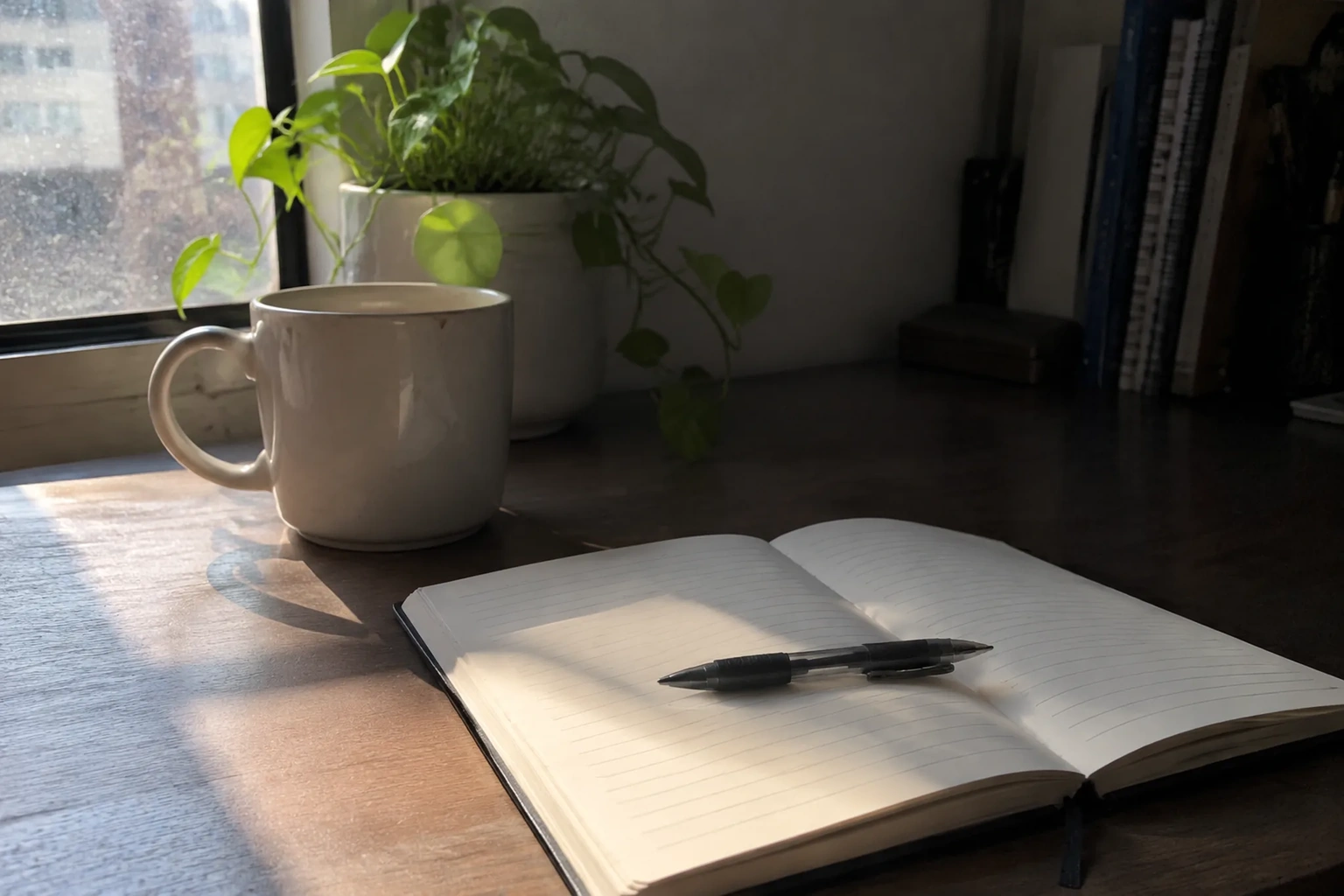
The notebook costs less than a sandwich and asks nothing of the person who opens it. A paper notebook and a working pen, set on a nightstand or a kitchen counter, make up one of the few tools for calm that has no battery, no subscription, no software update, and no opinion about how it should be used. That simplicity is the whole point, and it is also why so many people buy one and abandon it by February.
A journal kept with paper and pen is a specific practice, distinct from a diary of events and distinct from a productivity system. It is a place to put the contents of a head that has gotten loud. The paper does not sort, rank, or notify. It receives, and the hand does the rest.
The physical act is doing more than people assume
Writing by hand is slow in a way that matters. A person can type far faster than they can think, which is why a keyboard invites the mind to race ahead and fill space with noise. A pen moves at roughly the speed of a calm sentence. The hand cannot outrun the thought, so the thought has to arrive in order.
There is a texture to it as well. The drag of a nib across cheap paper, the small scratch at the end of a line, the pause when the ink runs thin. These are tiny events, and they anchor attention in the room rather than in the loop of worry that sent the person to the desk in the first place.
None of this requires belief in anything mystical. The mechanism is ordinary: a slow physical task occupies enough of the mind to quiet the part that keeps rehearsing the same unfinished conversation from Tuesday.
What belongs on the page, and what does not
The most common failure is treating the journal as a record. People sit down expecting to document the day, find the day unremarkable, and close the book. A journal for calm works better when it holds whatever is currently taking up room, whether or not that thing is interesting.
A grocery list belongs. So does the sentence a person wishes they had said to a coworker, written out in full and then crossed through. So does a single line about the light at four in the afternoon, or a complaint about a knee that has been aching since a long walk. The page has no standards. That is its chief advantage over a conversation.
What tends not to help is the performance of journaling: the gratitude list written because it is supposed to be written, the reflection composed for an imagined reader. The moment the page becomes a stage, the calming effect drains out of it. Private and unpolished is the working condition.
Five minutes beats thirty
A short session done most days outperforms a long session attempted rarely. The reason is dull and practical: a habit survives on low friction. Five minutes at the kitchen table with a mug going cold is easy to repeat. A half hour of deep reflection scheduled for Sunday evening is easy to skip, and once skipped twice, it stops existing.
Five minutes is also enough to notice a change. The first minute is usually clutter, the second is complaint, and somewhere around the third the hand starts writing about the thing that was actually bothering the person all along. Most sessions do not need to reach a resolution. Getting the real item onto the page is the work.
A timer helps at the start, mostly to stop the mind from negotiating about when it can leave. After a few weeks, the timer becomes unnecessary because the five minutes start to feel like a place to sit rather than a task to finish.
The blank page problem and three ways around it
The empty page is intimidating for a reason that rarely gets named: it looks like an exam. A person opens the notebook, sees all that white space, and assumes something worthy has to go there. The fix is to remove the exam feeling before the pen touches down.
One approach is to start mid-sentence. Write the date and then the first half of a thought, even a dull one, and let the sentence finish itself. Another is to copy a single line from whatever book is nearest and continue from there. A third is to write the day's weather and the state of the room, which is concrete enough to break the freeze and often leads somewhere unexpected within a paragraph.
All three tricks work for the same reason: they replace the question of what to write with the act of writing. Motion first, meaning later.
Choosing a notebook without turning it into a project
The stationery aisle can swallow an afternoon. A person who wants a calm practice can end up researching paper weight and binding methods for a week and never write a word. The honest guidance is to buy something cheap enough to ruin.
A softcover notebook with ruled pages, roughly the size of a hand, costs very little and fits in a bag. Ruled lines help because they remove one more decision. A pen that writes smoothly and does not smudge matters more than the notebook; a bad pen makes the hand work harder and the session shorter.
Fancy notebooks have their place, but a leather-bound book with gilt edges creates a quiet pressure to be worthy of it. The cheap spiral notebook has no such pretension. It can hold a bad mood and a shopping list on the same page without complaint.
Where the journal lives decides whether it gets used
Placement does more for consistency than motivation. A notebook kept in a drawer gets opened when someone remembers it exists. A notebook left on the table beside the chair where the day usually ends gets opened because it is simply there.
The best spot is wherever the person already pauses: beside the kettle, on the nightstand, next to the phone charger. The pen should live with it, clipped to the cover or lying across the page, so that no step stands between the impulse and the first line.
This is why a pocket-sized notebook often beats a large one. A book that travels in a coat pocket gets written in on a train, in a waiting room, in the ten minutes before a meeting. The calm it provides is available at the moment it is needed, not only at the desk.
Reading back is optional, and often better avoided
Some journaling advice insists on reviewing old entries to spot patterns. For a practice aimed at calm, that advice is shaky. Old entries tend to be either embarrassing or repetitive, and rereading them can turn a private habit into a source of self-criticism.
The page did its job when the ink was wet. Whatever needed to leave the head left it. A person who wants to look back occasionally can, but the practice does not depend on it, and skipping the review removes a reason to edit the present entry for the benefit of a future reader.
There is a small exception worth making. Once or twice a year, a quick flip through can reveal a worry that never came true or a problem that solved itself. That is a useful thing to know about one's own predictions. It is also not a reason to make rereading a habit.
When the practice stalls, the page can hold the stall
Every journal goes quiet for a stretch. A week passes, then a month, and the notebook sits unopened with a growing sense of failure attached to it. The recovery is simple and a little unglamorous: write about the gap itself.
A line explaining that the book has been closed for three weeks and the reason was a bad cold and a work deadline puts the gap on the page where it stops being a debt. The next entry does not need to be profound. It needs to exist.
This is where paper has a clear advantage over an app. A digital journal with streaks and reminders turns a missed day into a broken record, a small failure displayed on a screen. A paper notebook has no memory of the gap unless the writer chooses to give it one. It waits without judgment, which is the whole reason it works.
A pen, a page, and the end of a long day
On a Tuesday in the middle of a hard month, a person sits at a kitchen table with a cheap notebook open to a fresh page. The pen is a plain ballpoint. The first line is a complaint about a meeting that ran long, and the second line is a note about needing to buy milk. By the fifth line, the hand has written something honest about being tired in a way that sleep will not fix.
The page closes. The notebook goes back to the edge of the table, the pen clipped to the cover. The light stays on for another minute, and then it goes off. The problem has not been solved, and nothing has been declared or resolved. It has simply been written down, which is often enough to let a person walk away from the table and get some rest.





















