







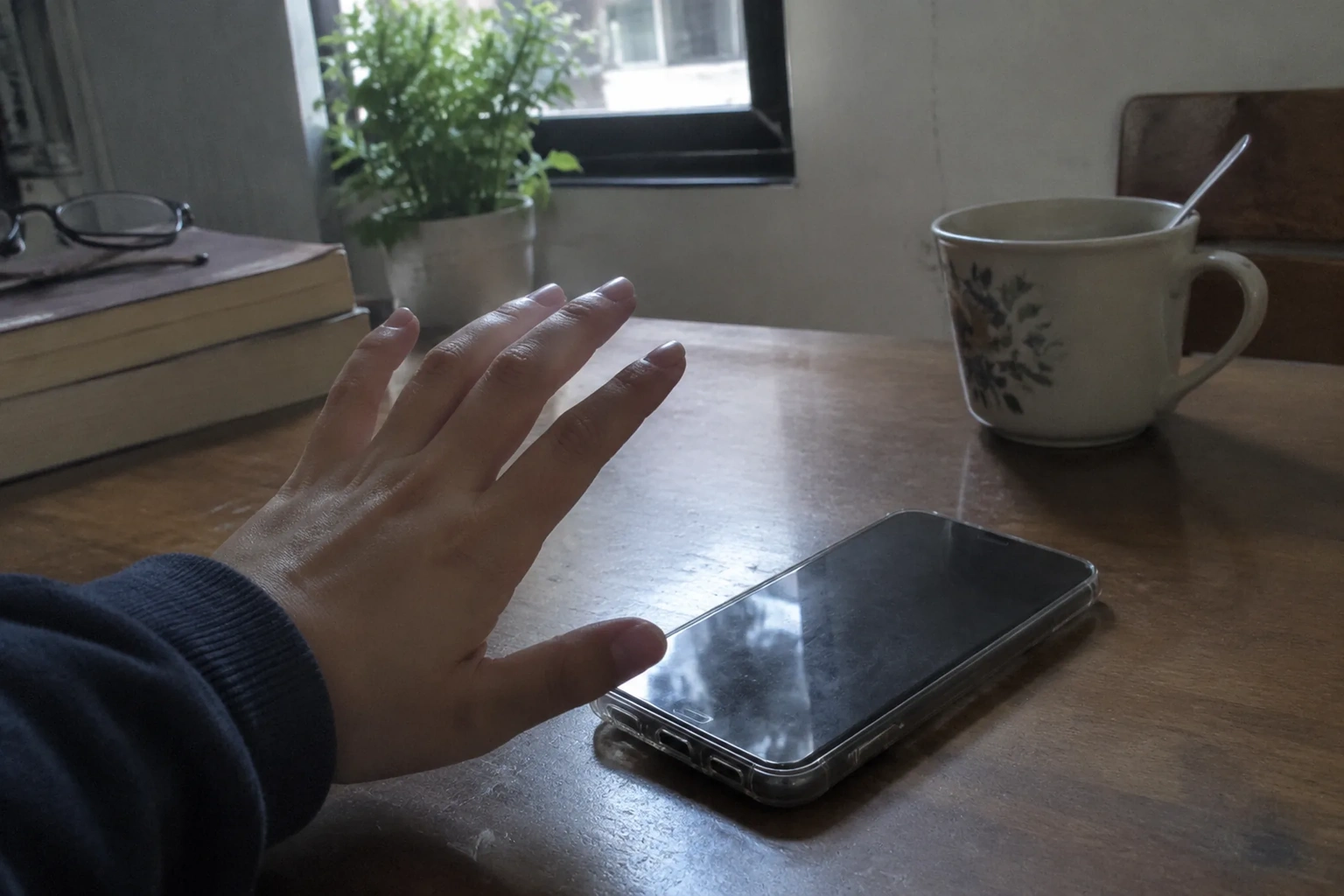
Screen time has become one of those numbers people track the way they once tracked step counts: dutifully, vaguely, and with a quiet sense of guilt that rarely changes anything. The average American adult now logs somewhere north of seven hours of screen use a day, and most of that is not leisure. It is work email, group chats, maps, banking, the small administrative chores of modern life. Telling people to simply use their phones less is like telling them to breathe less. The screen is where the dentist appointment lives.
So the useful question is narrower. Which slices of screen time actually drag mood down, and which can be cut without breaking anything? The research on this has gotten more interesting in the last few years, and it points somewhere less dramatic than a digital detox retreat and more practical than another app that nags about usage.
The short answer, before the details: passive scrolling is the part that hurts. The comparison, the doom, the endless refresh. Active use, the kind with a purpose and an endpoint, tends to be neutral or even fine. Cutting the passive half is where the mood lift comes from.
The difference between scrolling and using
A person checking a train schedule and a person thumbing through Shorts for forty minutes are both looking at a phone. Only one of them finishes feeling worse. The distinction matters because most screen time advice treats all minutes as equivalent, which is why it fails. A phone call with a parent counts the same as an hour of rage-bait in the weekly report. Nobody believes that, and nobody should.
Research on passive social media use, the kind where a user scrolls without posting or messaging, consistently links it to lower mood and more anxiety. The mechanism is not mysterious. Feeds are engineered to show a person the most flattering slice of everyone else's life, edited and lit and posted at the peak moment. Comparing a Tuesday afternoon at a desk to that highlight reel is a rigged game, and the mind plays it anyway.
Active use looks different. Messaging a friend, posting a photo, looking up a recipe, reading a long article on purpose. These have edges. They start and stop. The passive stuff has no natural stopping point, which is exactly the design.
Why the phone wins the fight for attention
Infinite scroll exists because the alternative, a page with a bottom, gives the brain a moment to reconsider. Every time a feed loads a fresh batch of content right as the last one runs out, it removes that pause. The thumb keeps moving because there is no gap in which to stop.
Notifications work the same way. A buzz in a pocket is a small lottery ticket. Most of the time it is nothing, but the occasional good message trains the brain to check, and checking is the behavior that matters. The average person picks up a phone more than a hundred times a day, and most of those pickups are not driven by a need. They are driven by a habit that has been deliberately cultivated.
None of this is a conspiracy. It is just good product design pointed at engagement, and engagement and wellbeing are not the same target. Knowing that changes the framing. A person who feels bad after scrolling is not weak-willed; they are responding exactly as the system was built to make them respond.
Friction is the lever that actually works
Willpower is a poor tool for this job because it has to be applied at the exact moment the brain is least interested in applying it. The better lever is friction: making the unwanted behavior slightly harder and the wanted behavior slightly easier. Small delays compound.
Concrete versions of this are unglamorous and effective. Deleting the social apps from the phone and keeping them on a browser that requires a login each time adds maybe fifteen seconds to each session. That sounds trivial. It is not, because the habit runs on autopilot, and autopilot needs a clear runway. Fifteen seconds is enough time for the prefrontal cortex to catch up and ask whether this is actually what the person wants to be doing.
Moving the phone out of the bedroom is the other big one. Not for sleep hygiene reasons, though those are real, but because the first and last twenty minutes of the day are the ones most likely to be spent in passive scrolling. A phone charging in the kitchen changes the shape of the morning. The day starts with a person's own thoughts instead of someone else's feed.
Turning the screen to grayscale is a strange but surprisingly effective trick. Color is a large part of what makes a feed compelling. Strip it out and the same content feels flatter, less urgent. People who try it often report the apps become boring within a week, which is the whole point.
Replacing the scroll, not just removing it
The trap in screen time reduction is the vacuum. A person cuts an hour of scrolling and then sits there with an hour of unstructured time and a restless feeling, and within a few days the phone is back. Subtraction alone rarely holds. What holds is substitution.
The replacement does not need to be noble. It needs to be available and slightly more appealing than the alternative at the moment of temptation. A book on the coffee table works better than a book on a shelf. A pair of walking shoes by the door works better than a gym membership. The goal is to make the non-screen option the path of least resistance.
Small physical tasks are underrated here. Washing a few dishes, folding laundry, watering plants. These occupy the hands and let the mind drift, which is the state that scrolling was imitating badly. A person who spends twenty minutes doing something with their hands often finishes calmer than one who spent twenty minutes on a feed, and the difference is noticeable within a day.
The social cost of a quieter phone
There is an awkward side effect that rarely gets mentioned. Cutting passive social media means seeing less of what friends and acquaintances are doing, which can feel like falling out of a loop. Group chats move on. Someone's news arrives late or not at all.
In practice this is less painful than it sounds. The people who matter tend to reach out directly, and the relationships that depend entirely on ambient feed presence were often thin to begin with. Still, it is worth naming, because the fear of missing out is real and it is the thing that pulls people back into the scroll.
A workable compromise: keep the messaging apps, cut the feeds. Direct communication stays intact; the broadcast layer, which is where most of the mood damage happens, goes quiet. Most people find they lose very little that they actually miss.
What a week of less looks like
The changes are not dramatic, which is why the process is easy to abandon before it takes hold. The first day is restless. The second day is still restless but with a few moments of noticing things, a bird on a fence, the actual taste of lunch. By the end of a week, the phone starts to feel less like a limb and more like a tool that lives in a pocket.
Mood tends to lift in a specific, unglamorous way. Less free-floating irritation. Fewer moments of comparing a real life to an edited one. A little more patience in line at the pharmacy. These are small gains, but they are the kind that accumulate, and they show up in how a person talks to the people they live with.
The honest caveat: this is not a cure for anything clinical. Screen time reduction is not a treatment for depression or anxiety, and framing it that way sets people up to feel like failures when a bad week arrives anyway. It is a lever, one of several, and it works best alongside sleep, movement, and actual human contact.
The app that counts minutes is not the answer
Screen time trackers have a strange effect on the people who use them. They turn usage into a score, and scores invite gaming. A person might feel virtuous for hitting a daily target while still spending the whole of it on the worst kind of content, or feel defeated by a number that includes an hour of legitimate work calls.
The tracker measures minutes, and minutes are the least interesting variable. A better question runs after the fact, not during: what did that session leave behind? Calm, boredom, irritation, a mild sense of inadequacy, a useful piece of information? A person who can answer that honestly does not need an app to tell them where the problem is.
That question is also the one that survives relapses. Everyone slides back into the scroll sometimes, on a sick day or a slow Sunday. The recovery is the same as the start: notice how it felt, put the phone in another room, and find something to do with the hands. The phone will be there later. It always is.
The thing worth carrying away is smaller than a system and more durable than a resolution. The screen is not the enemy, and the number of hours is not the point. The point is the difference between a person who picks up a phone to do a thing and one who picks it up because the hand was empty. That gap, once noticed, is where the mood actually turns.





















