







Most households own a small pile of screens. A phone on the arm of the couch. A tablet propped against a cereal box. A television that stays on past the point anyone is actually watching it. The devices themselves are not the problem. The problem is the shape an evening takes when the screen is the default center of it, the thing the room arranges itself around without anyone deciding to.
The evening hours are the only unclaimed block of time most working adults get. They arrive after the commute, after dinner, after the last work email. What happens between eight and eleven at night tends to be whatever a person fell into rather than what a person chose. Screens are very good at being fallen into. They ask nothing and offer a lot, and they will fill every minute available if nobody intervenes.
Pulling back from that default does not require a digital detox, a locked box with a timer, or a personality change. It requires a few physical rearrangements and a clearer idea of what the evening is actually for.
The living room arranges itself around the biggest screen
Walk into a typical living room and the furniture tells a story. The couch faces the television. The chairs angle toward it. The coffee table sits between the seating and the screen like a small offering. This arrangement is so standard that it reads as neutral, but it is a decision, made once and then never revisited, and it sets the default activity for every person who sits down in that room.
The fix is not to remove the television. It is to give the room a second center of gravity. A chair turned toward a window. A lamp over a side table with a stack of books. A record player or a radio on a shelf that is not the media console. Small moves, cheap ones, that make sitting down without a screen feel like a real option rather than a slightly awkward one.
Lighting matters more than people expect. Overhead light at full brightness makes a room feel like a waiting area. A single warm lamp in the corner gives the evening a different pace. The physical environment sets the tone before anyone has made a conscious choice about how to spend the next hour.
The phone charges in a room the evening does not use
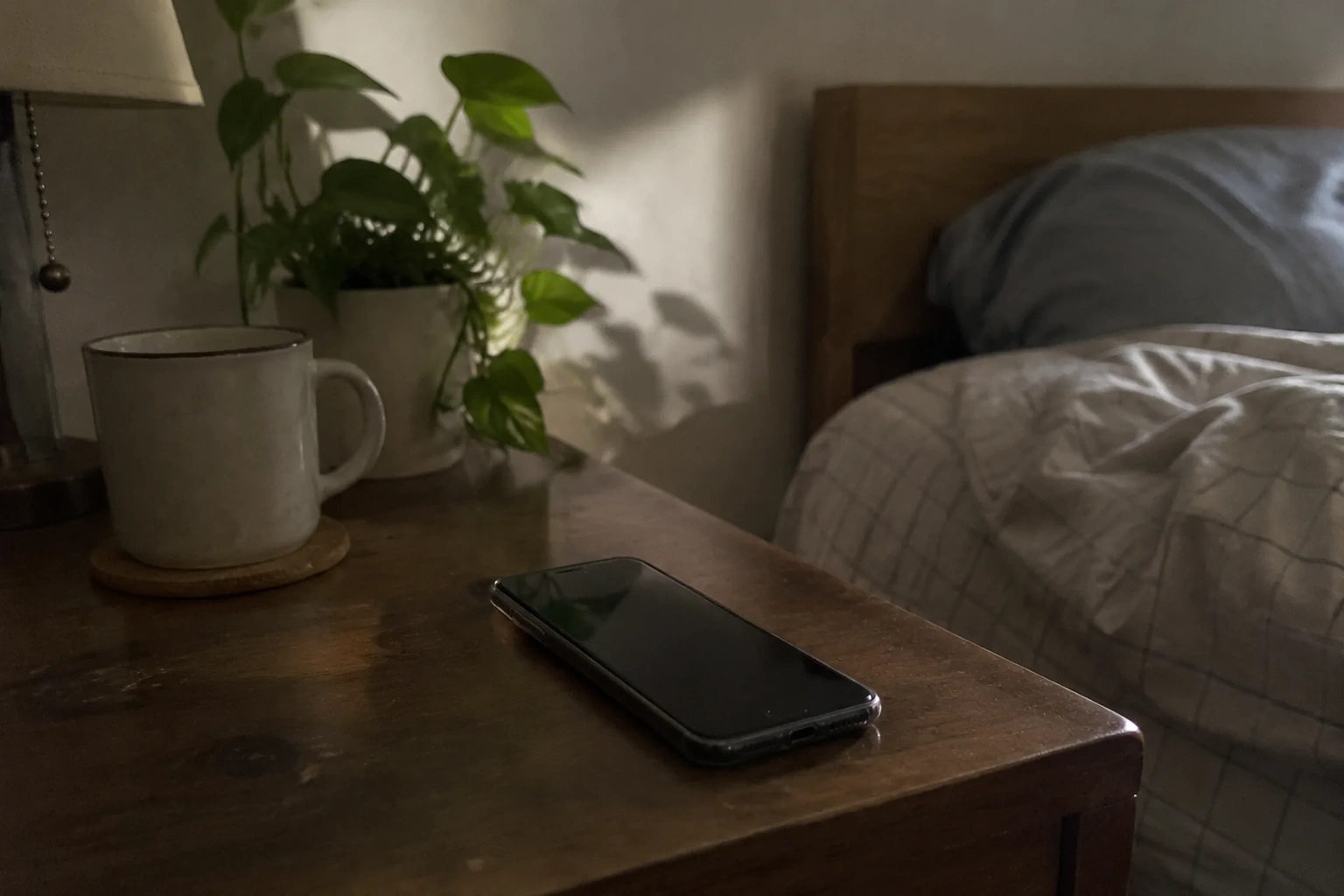
The single most effective change is also the least convenient: the phone sleeps somewhere other than the bedroom and away from the couch. A kitchen counter. A hallway table. Somewhere with a charger that is not within arm's reach of where a person spends the last two hours of the day.
This works because it removes the micro-decision. When the phone is on the arm of the couch, every quiet moment becomes a small choice about whether to pick it up, and the answer is usually yes because the cost is near zero. When the phone is in the kitchen, picking it up requires standing, walking, and a small act of intention. The friction is tiny, but it is enough. Most idle reaches do not survive a twelve-foot walk.
There is a real cost here, and it should be acknowledged: the phone is also the household's clock, its weather report, its camera, and its emergency line. None of that is trivial. A person who moves the phone to the kitchen will discover within a week which of those uses were genuine and which were habit dressed up as necessity. A cheap alarm clock covers the first. A wall calendar and a window cover the second. The camera was never urgent at nine at night.
The tablet is a television and should be treated like one
A tablet gets a pass that a television never would. It sits on the nightstand, on the kitchen counter, in a bag, always available, and because it is small and personal it does not feel like the same category of object as the big screen in the living room. It is the same category. A tablet streaming a show at eleven at night is a television in a smaller case, and it belongs in the same evening rules as the living room set.
This matters most in the last hour before sleep. A tablet propped on a pillow is the most common way a screen colonizes the final stretch of the day, and it is the hardest to notice because the light is close to the face and the content is chosen rather than surfed. Putting it in a drawer at nine is a blunt move, but blunt moves are the ones that survive a tired evening.
The evening needs a replacement, not just a subtraction
Removing a screen from an evening leaves a hole, and holes get filled by the nearest available thing, which is usually another screen. The subtraction only holds if something else is waiting in the same slot. Not a plan for the whole evening, just a first move that a tired person can make without thinking.
For some households that is a specific chair and a book that is already open to the right page. For others it is a kettle, a pot of tea, and ten minutes of doing nothing at all. For families with children it might be a board game that stays set up on the table for a week, so that the effort of starting is nearly zero. The replacement needs to be visible and easy. A hobby stored in a closet is a hobby that will lose to a phone on the arm of the couch every time.
A useful test: if the replacement activity requires getting something out, setting it up, and deciding what to do, it will fail on a Tuesday night. If it can be started in under thirty seconds by a person who has already sat down, it has a chance.
The television stays off until a specific show is chosen
The television is different from the phone. It is a shared object, and for many households the evening ritual of watching something together is genuinely worth keeping. The problem is the ambient television, the one that goes on for background and stays on because turning it off feels like a decision nobody wants to make.
A simple rule handles this: the television turns on when a specific thing has been chosen to watch, and it turns off when that thing ends. The screen does not stay on during dinner, during cleanup, or as a default backdrop. If nothing has been chosen, the screen stays dark and the room gets the lamp and the book and whatever conversation happens without a laugh track underneath it.
This rule is harder than it sounds, because the ambient television is load-bearing in a lot of households. It fills silence. It gives people something to look at when they are not sure what to say. Turning it off will expose a few awkward minutes, and the household will either find a conversation or find a different activity. Both outcomes are fine. The point is that the room gets to decide, rather than the screen deciding by default.
Notifications can wait until morning because they already do
A common worry is that putting the phone away means missing something important. The worry is worth taking seriously for about a minute, and then it collapses. Almost nothing that arrives between eight and eleven at night requires a response before morning. The messages that do are the ones a person would already know were coming, from family or close friends, and those people have other ways to reach a household if something is genuinely urgent.
The notifications that fill the evening are almost all low-stakes: a group chat, a delivery update, a news alert, a social post. None of them improve with immediate attention. All of them will still be there at seven the next morning, and the person reading them at seven will be less tired and less reactive than the person reading them at ten.
The first week is the hardest and the third week is the payoff
The first evening without a screen within reach is genuinely uncomfortable. The hand reaches for a phone that is not there. The room feels too quiet. The television sits dark and accusatory in the corner. This is normal and it passes, but it passes on a schedule measured in days, not minutes.
By the third or fourth evening, something shifts. The quiet stops feeling like a gap and starts feeling like space. A book gets read past the first chapter. A conversation runs longer than it usually does. A person notices they are tired at ten and goes to bed, rather than staying up until midnight scrolling because the phone was there and the sleep was not yet urgent.
The third week is where the change becomes visible from the outside. The evening has a different texture. There is a lamp on and a book open and a phone charging in another room, and nobody in the household is making a heroic effort to keep it that way. The arrangement is doing the work. The willpower was only needed for the first few days, to set the arrangement up.
A small wooden clock on the kitchen counter
The most concrete version of all this is a few objects in specific places. A phone charging on the kitchen counter next to a small wooden alarm clock that cost less than a takeout dinner. A lamp in the corner of the living room that is the only light on after eight. A book left open on a side table, spine cracked, bookmark in. A television that is dark unless something has been chosen. A tablet in a drawer, not on a pillow.
None of these objects is remarkable on its own. Together they describe an evening that belongs to the household rather than to the devices. The clock on the counter is the tell. A person who has bought a separate alarm clock and moved the phone out of the bedroom has made a decision that the evening and the night are worth protecting from the small glowing rectangle, and that decision tends to hold. The clock ticks. The phone stays in the kitchen. The lamp is on, and the room is quiet, and there is still an hour before bed.





















