







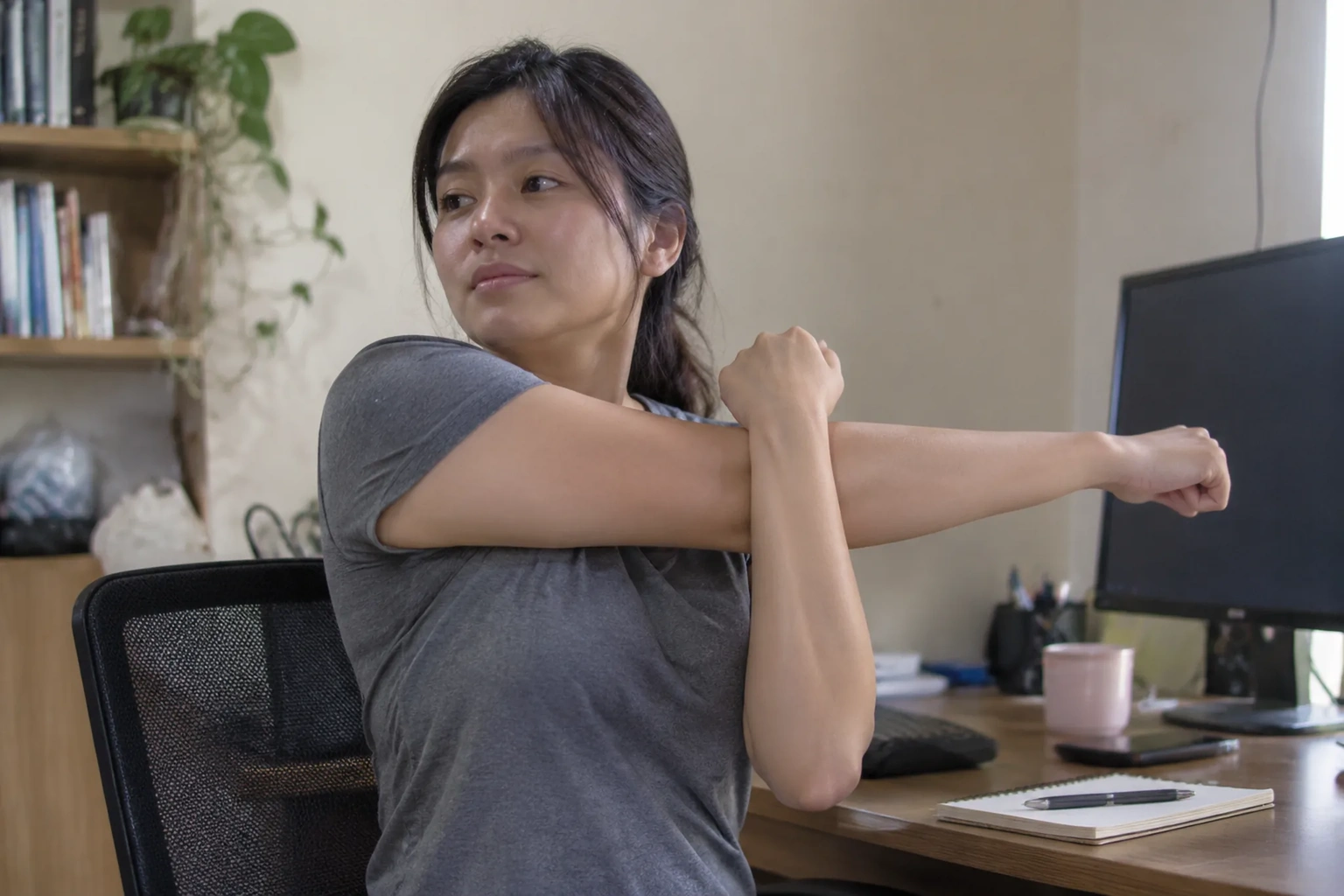
Somewhere in the low thousands, the number of shoulder rotations a desk worker completes in a week settles into a grim range: plenty of forward reach, almost no backward travel. The joint gets one direction of motion for hours and then a weekend to think about it. By Tuesday morning the upper back has the texture of a door hinge that has never been oiled, and the first deep breath of the day comes with a small, private wince.
A stretch routine for this situation does not need to be long. It needs to be early, specific, and repeatable on a bad morning. What follows is a short sequence built for the twenty minutes after a desk is reset, when the laptop is open but the inbox has not yet been answered, and the body is still soft enough to be talked out of its hunch.
Why the shoulders stiffen before the back does
The shoulder is a joint with an unusually wide range of motion, and that range is a liability at a desk. The upper trapezius, the thick strap of muscle running from the neck to the shoulder point, spends the day in low-grade contraction holding the arms up against gravity. It rarely gets a full release. The pectoral muscles at the front shorten, pulling the shoulder heads forward. The muscles between the shoulder blades, the ones that pull the arms back, go quiet.
By mid-afternoon the shoulder girdle has drifted into a shape that looks, from the side, like a parenthesis. The head juts. The upper back rounds. Nothing hurts in a sharp way, which is precisely the problem, because a dull ache is easy to ignore until it becomes the background music of a whole season.
Stretching alone does not fix this. A person can hang from a doorway frame for a minute and feel magnificent and then sit back down and recreate the knot by lunch. The routine below works because it pairs release with a small amount of active work, so the shoulder learns a second position instead of just visiting one.
The reset moment: what to do before the first stretch
Before any movement, reset the desk itself, since the physical setup is half the reason the shoulders are unhappy. Push the monitor back to arm's length. Raise the chair until the elbows sit at roughly a right angle when the hands are on the keyboard. Drop the shoulders once, deliberately, and notice how far they had crept up toward the ears. That single gesture is a diagnostic. If the drop feels like a small relief, the trapezius has been working overtime.
Then stand up. Most of this routine is done upright, because standing removes the chair's invitation to slump and gives the ribcage room to expand. A wall nearby helps but is not mandatory. Athletic shoes are not required. The whole sequence takes eight to ten minutes at an unhurried pace, and a person can run through it in three if the morning is already lost.
Doorway chest opener, held long enough to matter
Find a door frame. Place the forearm against the frame with the elbow at shoulder height, the hand pointing up, and step the same-side foot forward until a stretch arrives across the front of the chest and the front of the shoulder. The sensation should be a broad pull, not a pinch. Hold it for thirty to forty-five seconds, breathing slowly through the nose, and let the ribcage widen on each inhale.
The common mistake is holding for five seconds and calling it done. Connective tissue responds to time under gentle tension, and a short hold mostly irritates the muscle without convincing it to lengthen. Forty-five seconds feels long. That is the point. Count slowly, or watch a clock, because the internal sense of time collapses the moment a stretch becomes uncomfortable.
Repeat on the other side. Notice which side feels tighter; most people have one. The tighter side is not necessarily the problem side, but it is worth a second, shorter hold after the first pass through the full routine.
The wall angel, done slowly and badly at first
Stand with the back against a wall, feet a few inches away, knees soft. Press the lower back gently toward the wall and bring the arms up so the elbows and the backs of the hands touch the wall, forming a goalpost shape. Then slide the arms upward and downward through a small range, keeping contact where possible. Most people discover immediately that the backs of the hands will not stay on the wall, or that the ribs flare to compensate, or that one shoulder refuses the position entirely.
That failure is useful information. Do the movement badly, in a small range, six to eight times. The point is not to achieve a perfect wall angel on the first morning. The point is to remind the mid-back muscles that they exist and are expected to work. After a week of doing this poorly, the range grows, and the shoulder starts to feel less like a hinge and more like a joint with options.
Keep the movement slow. Fast reps turn this into a shoulder-shrug exercise and skip the part that matters. Two seconds up, two seconds down, with a pause at the top.
Neck releases that avoid the tempting crack
The neck and the shoulders share a border, and a stiff upper back usually drags the neck along with it. Tilt the head gently toward one shoulder, letting the opposite shoulder stay down, and hold for twenty seconds. Then rotate the chin toward the collarbone and hold again. Avoid the urge to roll the head in a full circle, which feels productive and mostly just grinds the joints.
For the upper trapezius specifically, reach one hand over the head and rest the fingertips on the opposite side of the skull, adding a small amount of weight. No pulling. The hand is a suggestion, not a lever. Thirty seconds on each side, with slow exhales, and the muscle usually lets go in a way that a quick crack never achieves.
If a sharp sensation appears, or numbness travels down an arm, stop. That is a signal to see a clinician, not to push through. General stiffness responds to gentle movement; nerve symptoms do not, and treating them as ordinary tightness is how small problems become larger ones.
Thread the needle on the floor for the mid-back
The upper back, the thoracic spine, is where the shoulder's foundation sits. When it stiffens, the shoulder pays. A simple floor move addresses this: come onto hands and knees, then slide one arm under the body, palm up, letting the shoulder and the side of the head rest on the floor. The other arm can extend forward or stay planted. Hold for thirty seconds and breathe into the back of the ribcage.
This one is worth keeping even on mornings when the rest of the routine gets skipped, because the mid-back is the region most desk workers never move at all. A person can spend an entire day reaching forward without ever rotating the spine. Threading the needle reintroduces rotation in a low-stakes way.
Switch sides. Notice the difference. The side that feels tighter is usually the side that has been doing the mouse work.
A thirty-second version for mornings that have already collapsed
Some mornings do not allow ten minutes. A meeting starts early, a child needs something, the inbox is on fire. For those days, a compressed version exists: one doorway chest opener per side, held for twenty seconds, followed by five slow wall angels and a single thread the needle per side. That is roughly ninety seconds and covers the largest gaps.
The compressed version is not as good as the full routine. It is dramatically better than nothing, and the habit of doing something small is what keeps the routine alive across a busy month. The full sequence is for the mornings with room. The short one is for the mornings that need mercy.
What to change after two weeks of the routine
After roughly ten to fourteen days of consistent practice, the routine should start to feel easier in a specific way: the doorway stretch arrives sooner, the wall angels cover more range, and the mid-back rotation stops feeling like a negotiation. When that happens, the routine can shorten. The chest opener can drop to one hold per side, and the wall angels can move to a maintenance set of four or five.
If nothing changes after two weeks, the problem is probably not the routine. It is likely the chair, the monitor height, or the number of hours spent without standing. A stretch cannot outrun eight hours of a bad setup. The routine buys relief; the desk setup decides whether the relief lasts past lunch.
The desk chair adjustment that makes the stretches hold
One small change makes the whole routine more durable: set a timer, once an hour, to stand and drop the shoulders deliberately. Not a full stretch break. Just a stand, a shoulder roll backward, and a slow breath. The routine in the morning resets the tissue; the hourly stand keeps it from re-knotting before the afternoon.
This is unglamorous and it works. The shoulders stiffen because they are held in one position for a long time. The fix is not a heroic stretch session once a day. The fix is a morning routine that opens the range and a small hourly habit that keeps it open. Together they cost less than fifteen minutes across a full workday.
By the end of the second week, the first deep breath of the morning stops arriving with a wince. The shoulders drop on their own when the chair is pushed back. The desk is reset, the laptop is open, and the inbox is still there, patient and terrible, waiting for the day to begin.





















