







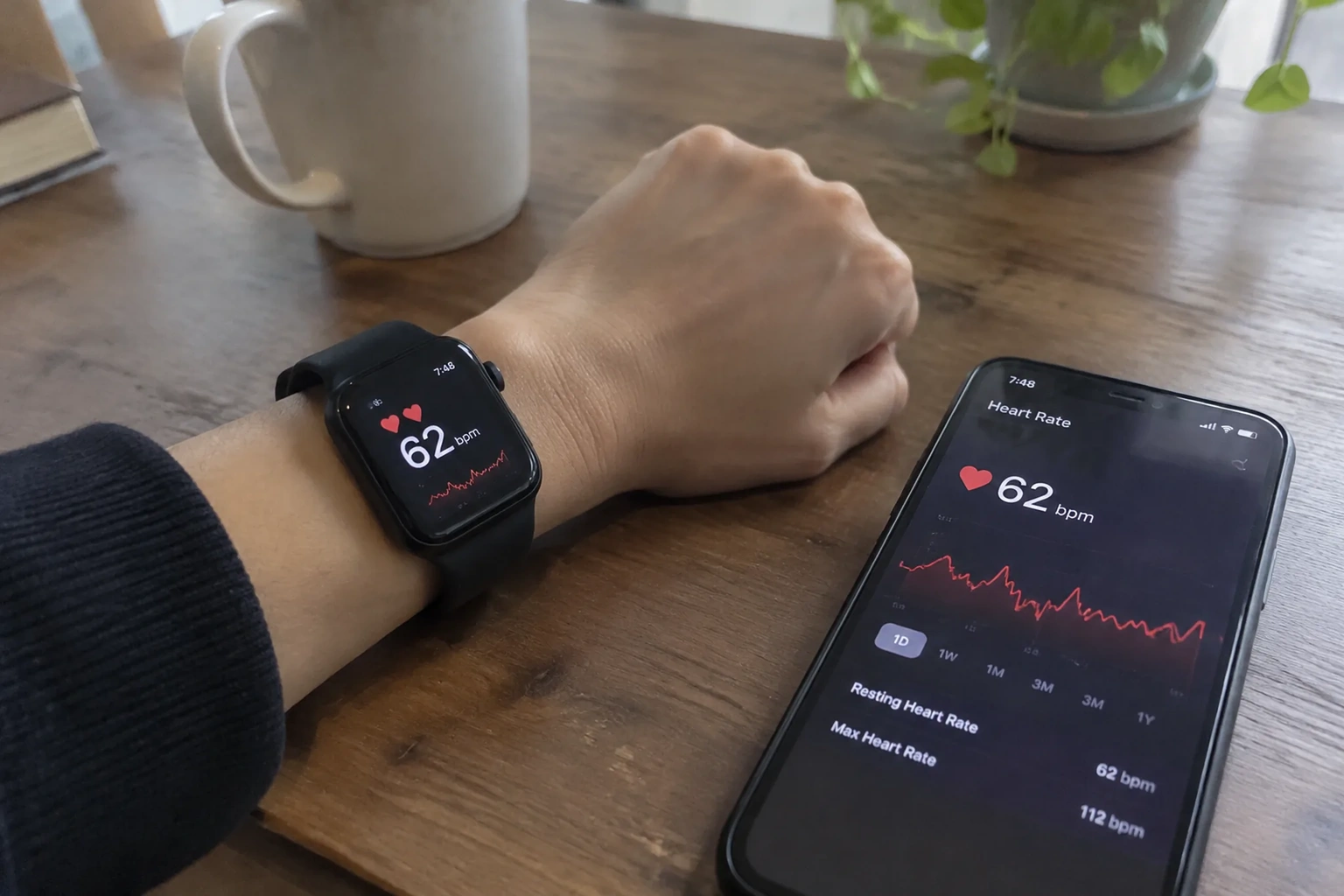
A resting heart rate of 48 beats per minute and a resting heart rate of 92 beats per minute can belong to two people of the same age, same weight, same job. One is a distance runner in his thirties. The other is a man who has not exercised deliberately since high school and sleeps five hours a night. The number on the fitness tracker looks equally authoritative in both cases. It is not equally meaningful.
Resting heart rate has become one of the most visible numbers in ordinary life, sitting on wrists and phone screens, reported with the same quiet confidence as the time of day. That visibility has outpaced understanding. A number gets noticed, screenshotted, worried over, compared in group chats. What it actually measures, and what it can and cannot say about a person's health, tends to stay blurry.
The short definition: resting heart rate is the number of times the heart beats per minute while a person is awake, calm, and has not recently eaten, exercised, or consumed caffeine. It is distinct from heart rate during sleep, which runs lower, and from heart rate variability, which measures the spacing between beats rather than the count. Those distinctions matter more than they sound.
What the Beating Actually Reflects
Every heartbeat is a pump stroke, and the heart's job is to move enough blood to meet the body's demand for oxygen. When demand is low, at rest, a strong heart can meet it with fewer strokes. When demand rises, during a climb up stairs or a difficult conversation, the rate climbs to compensate. Resting heart rate is essentially the idle speed of that engine.
For most adults, a resting heart rate somewhere between 60 and 100 beats per minute is considered normal. That range is very wide, and it is wide for a reason. Age, genetics, fitness, body size, medication, hydration, temperature, and how the measurement was taken all push the number around. A single reading is a snapshot of a moment, not a verdict on a body.
The more useful framing is comparative and longitudinal. A person's own baseline, tracked over weeks and months, says far more than any population average. A rate that drifts upward by ten beats over a month of poor sleep and heavy work stress is telling a story. A rate that has sat at 58 for two years and then suddenly reads 74 for a week is telling a different, and more urgent, one.
The Fitness Signal, and Its Limits
Among the clearest and most reliable patterns in cardiology is that regular aerobic exercise tends to lower resting heart rate over time. The heart muscle, like any muscle trained consistently, becomes more efficient. It pumps more blood per stroke, so it needs fewer strokes. Endurance athletes routinely record resting rates in the 40s, sometimes lower. That is a well-documented adaptation, not a myth.
The mistake is reading the number backward. A low resting heart rate does not automatically mean good fitness, and a high one does not automatically mean poor fitness. A naturally low rate can run in families. Some medications, notably certain blood pressure drugs, slow the heart. And in rare cases, an unusually low rate in someone who is not an athlete can signal a problem with the heart's electrical system, which is why a doctor's evaluation matters when the number is surprising.
Treat the fitness signal as a slow-moving trend, not a daily score. Someone who begins walking briskly four times a week may see the resting rate ease down by a handful of beats over two or three months. That gradual shift is the honest version of the story. The dramatic single-day drops that show up in fitness apps usually reflect a quiet evening and a good night's sleep, not a new level of conditioning.
Why Sleep, Stress, and Alcohol Show Up in the Number
The autonomic nervous system runs the heart's idle speed, and it has two branches with opposite jobs. The sympathetic branch speeds things up, the parasympathetic branch slows them down. Resting heart rate is the visible outcome of the tug-of-war between them. Almost everything that shifts that balance shows up in the number within a day or two.
Poor sleep is one of the most consistent movers. A night of fragmented sleep, or a stretch of short nights, tends to elevate the next morning's reading. Alcohol does the same, often dramatically. A few drinks in the evening can push the overnight and morning rate up by several beats, a pattern many wearable users notice long before they read about it anywhere. Illness, dehydration, and psychological stress push it up as well. So does a fever, which is one reason a rising rate during a cold is expected rather than alarming.
This responsiveness is what makes the number worth tracking. It functions as a crude but useful early-warning system, a physiological echo of the previous day. When the rate is up several beats for no obvious reason, the sensible first questions are about sleep, alcohol, stress, illness, and hydration, in roughly that order.
Measuring It Without Fooling Yourself
The most accurate readings come from the same conditions repeated: shortly after waking, before getting out of bed, before coffee, before the phone. That is the closest most people get to a controlled measurement. Doing it at the same time each day matters more than doing it perfectly once.
Manual measurement is simple and needs no device. Two fingers on the wrist, just below the thumb side, or on the side of the neck, count the beats for thirty seconds and double. Sixty seconds is more accurate for a slow rate. The technique is old and unglamorous and it works.
Wearables add convenience and a problem. Optical sensors on the wrist measure blood flow, not electrical signal, and they struggle with movement, cold skin, loose straps, and dark tattoos. The result is a number that can be off by several beats and can vary from device to device. That is fine for trend tracking as long as the same device is used consistently. Comparing one brand's reading to another's is close to meaningless.
Chest straps, which measure the heart's electrical activity, are more accurate and are the standard for exercise. For resting measurement, a wrist device worn snugly and read at the same time each morning is good enough. The goal is a consistent series of numbers, not a perfect single one.
When a Number Deserves a Doctor
Most variation in resting heart rate is ordinary. Some patterns are not. A resting rate that stays persistently above 100 beats per minute, a condition called tachycardia, warrants medical attention, particularly if it comes with palpitations, shortness of breath, dizziness, or chest discomfort. A rate that is persistently very low in someone who is not an endurance athlete, especially with fainting or fatigue, deserves the same.
Sudden changes matter too. A jump of twenty or more beats that persists for several days, without an obvious cause like illness or a new medication, is worth raising with a clinician. So is a rate that climbs steadily over weeks in someone whose routine has not changed. These are general guidelines, not diagnostic rules, and a doctor is the right person to interpret them in context.
One caution worth stating plainly: a normal resting heart rate does not rule out heart problems, and an unusual one does not confirm them. The number is one signal among many, and it should be read alongside blood pressure, symptoms, family history, and how the person actually feels.
The Number That Isn't a Score
The deepest problem with resting heart rate as a consumer metric is that it invites comparison. A friend posts a screenshot of 52. A colleague mentions hers is 61. The impulse to rank follows immediately, and the ranking is close to useless. A 52 in a lifelong cyclist and a 52 in a person on a beta blocker mean entirely different things.
The number is a private instrument. It is most informative when compared to itself, over time, under consistent conditions. It is least informative when compared to someone else's, or to a population average pulled from a device's dashboard. The people who get the most from tracking tend to treat it as a quiet diary entry rather than a leaderboard position.
There is a practical way to hold all of this. Check the resting rate a few mornings a week, at the same time, with the same device. Note it, and note the night before. After a month, a pattern emerges that no single reading could show: the Friday-morning bump after Thursday drinks, the elevated week during a deadline, the slow downward drift after a month of regular walks. That pattern is the actual information. The individual number is just the ink.





















