







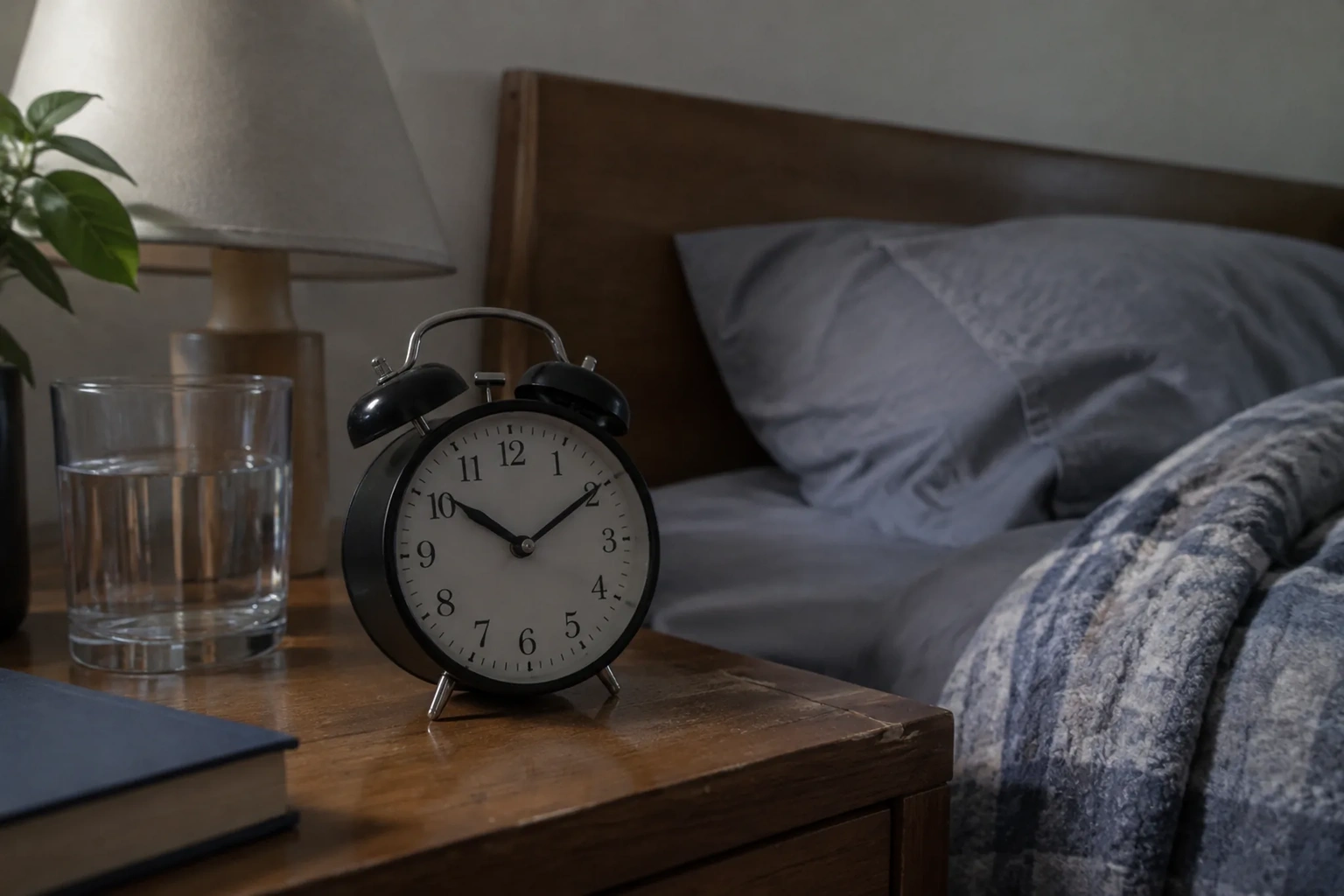
A sleep schedule is a contract a person makes with the clock. Most people break it within four days. The average bedtime drifts later by roughly an hour and a half between Friday and Sunday, and Monday morning arrives like a small tax audit. The problem is rarely motivation. It is that the schedule was built on a foundation of sheer will, and will is the least reliable structural material available to a human being at 11:40 at night.
A schedule that survives contact with a real week looks different from the one people design on Sunday afternoon. It has slack built in. It has a fixed wake time and a flexible bedtime. It has a plan for the 9 p.m. screen problem that does not involve moralizing. And it treats the first hour of the day as the anchor, not the last hour of the night.
The Wake Time Is the Load-Bearing Wall
Almost every sleep book and clinic worth reading starts in the same place: the wake time holds, the bedtime floats. This is the single most useful piece of advice in the entire field, and it is also the one people resist hardest, because it feels backwards. The instinct is to fix the bedtime, since that is the part that feels voluntary and controllable. The wake time feels like it belongs to the alarm clock and the job.
The body's internal clock, the cluster of neurons that keeps roughly a 24-hour rhythm, takes its cue primarily from light hitting the eyes in the morning. That first exposure sets a timer for the day. Drag the wake time around by two hours across the weekend and the timer resets, which is why Sunday night insomnia has a physical cause and not just a psychological one. The clock is confused about what morning means.
Pick a wake time that a person can actually hit seven days a week, including Saturday. That last part is the whole trick. A 6:15 alarm on Tuesday and a 9:00 alarm on Saturday is two different time zones, and the body will notice. The honest number is often later than the aspirational one. A 7:30 wake time held every day for a month will do more for sleep quality than a 5:45 that collapses by Thursday.
Twenty Minutes Earlier, Not Two Hours
The second mistake is scale. People try to move their bedtime from 1 a.m. to 10:30 in one decisive stroke, usually after a bad week, and the attempt fails with a kind of theatrical inevitability. The body's sleep drive is a pressure system, not a dial. It builds at its own rate.
A workable shift is roughly 15 to 20 minutes earlier every few nights, with the wake time pinned. That is slow enough that the person barely notices, and fast enough that a 1 a.m. bedtime becomes 11:30 within a few weeks. The wake time is what enforces the shift: if the alarm goes off at the same hour and the bedtime creeps earlier, the sleep pressure accumulates and the earlier bedtime eventually sticks on its own.
The pace matters more than the method. A schedule that takes three weeks to install will outlast a heroic one that takes three days.
The Last Hour Is a Different Kind of Hour
Most failed schedules die in the final 60 minutes of the evening. The day is done, the household quiets, and the phone becomes the only thing left that is asking for attention. Scrolling in bed is a nearly universal habit and it does two unhelpful things at once: it delays the moment of lying down, and it floods the eyes with bright light that tells the brain it is still midafternoon.
The useful move is not to ban the phone, which tends to produce a small rebellion. It is to give the last hour a destination. A shower, a few pages of a book, the dishes, a walk around the block, a boring television show watched from the couch rather than the bed. The point is that the body needs a runway, a sequence of small signals that the day is closing. People who sleep well at a consistent time almost always have one, and they rarely describe it as a routine. It is just what they do after dinner.
Keep the bed for sleeping. This is standard advice and it holds up, but the reason is practical: if lying in bed is where the phone gets checked and the email gets answered, the bed becomes a place where the brain stays alert. Reserve it and the association flips.
A Temperature, a Dark Room, and the Right Number of Hours
The environmental pieces are unglamorous and they work. A bedroom a couple of degrees cooler than the rest of the house helps the body drop its core temperature, which is part of the sleep onset process. Blackout curtains or a decent sleep mask do real work in the summer, when sunrise arrives before a 7 a.m. alarm. A fan or a white noise machine covers the neighbor's dog and the early garbage truck.
The number of hours matters and it is individual. Adults generally do best somewhere between seven and nine, and the honest way to find the figure is to hold the wake time steady for two weeks and notice at what time the body starts to get sleepy on its own. That evening drowsiness is the signal. If it arrives at 9:30 and the alarm is at 6:30, the math is already done.
The Weekend Problem Has a Specific Fix
Saturday morning is where most good schedules go to die. After five days of a 6:45 alarm, the body wants to sleep in, and sleeping in feels earned. The trouble is that a two-hour Saturday lie-in is a small westward flight, and Sunday night pays for it.
A compromise works: keep the wake time within about 45 minutes of the weekday one, and take the lost rest as an afternoon nap instead. A 20-minute nap around 2 p.m. restores more than an extra hour of morning sleep, and it does not scramble the clock. The nap is the pressure valve that makes the seven-day schedule tolerable.
When the Schedule Breaks, and It Will
A late flight, a sick child, a deadline, a wedding that runs to 1 a.m. These things happen and a schedule that cannot absorb them is a schedule that will be abandoned. The recovery move is simple and boring: return to the standard wake time the very next morning, even if the night was short. One bad night costs a person some sharpness the following day and very little else. The clock resets with a single normal morning.
The people who keep a consistent schedule for years are not the ones with iron discipline. They are the ones who treat a disruption as a minor event rather than a verdict, and who are back at the same wake time the next day without ceremony.
What a Good Night Actually Feels Like
The reward for all of this is not a dramatic transformation. It is quieter than that. It is waking up a few minutes before the alarm and lying there for a moment, not anxious, not foggy, just awake. It is the 3 p.m. slump that used to require a second coffee and now requires a glass of water. It is the evening where the eyes get heavy at a reasonable hour and the bed looks like the obvious next move.
None of those things are spectacular, and that is the point. A sleep schedule that sticks produces a kind of steady, unremarkable competence during the day, the feeling of a machine running at its normal speed rather than being pushed. The schedule itself fades into the background, which is exactly where a good habit belongs. The person stops thinking about sleep at all, and that is the sign it is finally working.





















