







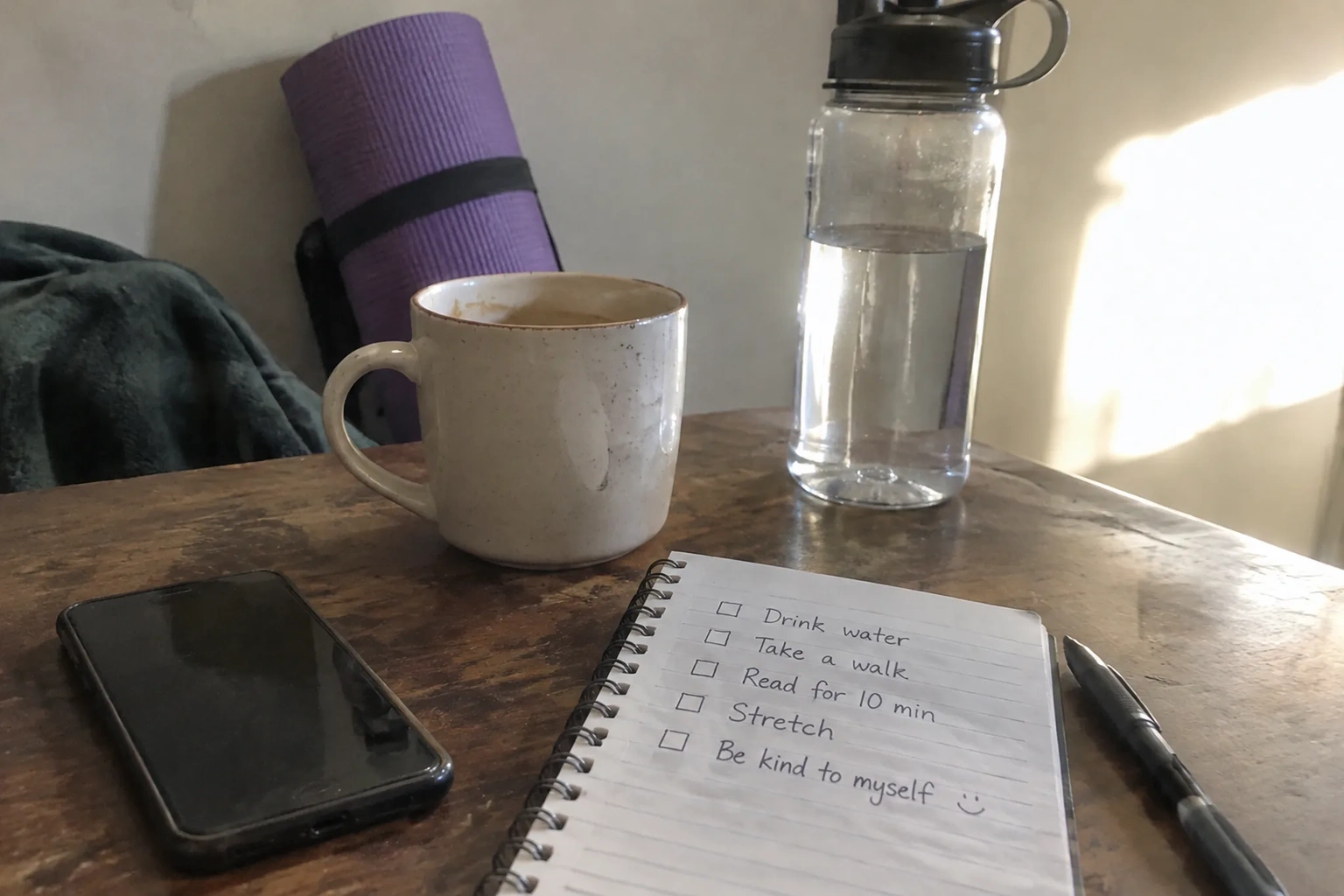
The week that breaks a self-care routine is rarely the dramatic one. It is the ordinary Tuesday when a meeting runs long, the commute home doubles, and the gym bag stays in the trunk. By Thursday the carefully built morning stretch has vanished and the good intentions have curdled into a low hum of guilt. Most advice about self-care assumes a calm, controllable schedule. Real weeks do not cooperate.
What survives a busy week is not a grander routine. It is a smaller one, deliberately undersized, built to be performed badly on the worst days and still count. The difference between a practice that lasts and one that collapses under pressure is almost never discipline. It is scale.
The routine that assumes a calm week is already broken
A forty-five-minute evening routine, a full workout, a from-scratch dinner, a journaling session with three prompts: each of these is a reasonable thing to want. Taken together, they form a house of cards. One late meeting knocks over the first card and the rest follow. The person then concludes they are undisciplined, when the plan was simply too large to survive contact with a normal week.
There is a useful test for any practice. Ask what it looks like at forty percent capacity. If the answer is "it doesn't happen," the practice is a fair-weather habit. If the answer is "it happens, just smaller," it has a chance. A ten-minute walk is the forty percent version of a workout. A single glass of water is the forty percent version of the elaborate morning ritual. The point is to keep the thread unbroken, because a thread is easy to pick back up and a severed rope is not.
Two minutes beats thirty, because two minutes actually happens
The most reliable self-care practice in a busy week is the one that fits into a gap between two obligations. Two minutes of stretching before bed. Three deep breaths at a red light. A minute of quiet with a cup of tea before opening a laptop. These gestures look almost insultingly small next to the version of self-care sold in magazines, and that is precisely why they work.
Small practices have a second advantage: they do not require a decision. A thirty-minute workout demands scheduling, clothing, and a shower afterward. A two-minute stretch demands nothing but a floor. When energy is low, every decision is a toll, and a practice with fewer decisions gets paid more often.
The trap is contempt. People dismiss the two-minute version as not real self-care, skip it in favor of the ideal version they cannot manage, and end up with nothing. The two-minute version is the whole practice on a hard day. It counts fully.
Locate the practice where the week already goes
Habits attach to existing routines more easily than they attach to empty calendar slots. The kettle boils every morning whether or not anyone feels motivated. The commute happens. The teeth get brushed. These anchors are free real estate, and a small practice parked next to one of them will outlast a practice that requires a dedicated block of time.
This is why a stretch during the kettle boil survives and a stretch scheduled for six in the evening does not. Six in the evening is a fiction. The kettle is a fact. A person who wants a durable practice looks at the day as it actually runs, with its fixed points and dead minutes, and tucks the practice into a seam rather than carving out a new room.
The lower bar is the one that gets cleared
There is a counterintuitive arithmetic to busy weeks. A person who commits to ten minutes of reading every night and misses three nights feels like a failure. A person who commits to one page and reads four nights out of seven has succeeded four times. The lower commitment produces more of the behavior, more often, and with less resentment attached.
Self-care that survives a busy week is built around the floor, not the ceiling. The floor is the smallest version that still feels like the practice. Everything above the floor is a bonus, offered freely on the days when there is room. This framing removes the all-or-nothing cliff that turns one missed day into an abandoned routine.
What to cut when the week tightens
Not every practice deserves to survive a hard week. Some are genuinely optional, and trying to preserve all of them is its own form of overreach. A useful exercise is to sort practices into two piles: the ones that keep a person functional and the ones that merely feel virtuous.
Sleep, food, and movement belong in the first pile. A skincare routine with seven steps, a language app streak, and a perfect inbox belong in the second. When the week tightens, the second pile gets set down without ceremony. The first pile gets protected at the smallest possible size. The mistake is treating all practices as equally load-bearing, which guarantees that the important ones get dropped alongside the trivial ones.
Sleep is the practice that pays for all the others
In a genuinely busy week, the single most effective act of self-care is often going to bed half an hour earlier. It is unglamorous, it produces no visible progress, and it improves almost everything else. A tired person reaches for sugar, snaps at colleagues, skips the walk, and scrolls instead of reading. The same person, rested, does none of these things without trying.
The difficulty is that sleep is the first thing sacrificed when time runs short, on the theory that the hours are needed for work. The trade is usually bad. The work done at midnight is slower, worse, and more likely to be redone the next day. Protecting sleep during a hard week is a decision about the following week as much as the current one.
Food that requires no decision
Busy weeks wreck eating not because people stop caring but because every meal becomes a decision made at the moment of hunger, when judgment is weakest. The fix is to remove the decision. A pot of soup made on Sunday. A bag of washed greens. A shelf of the same breakfast every morning. The meal that requires no thought is the meal that gets eaten.
This is not a meal-planning sermon. Elaborate plans fail for the same reason elaborate routines fail: they assume a calm week. What works is a small set of default meals, boring and repeatable, that a person can produce while tired. Boring is a feature. The interesting meals can wait for a week with room in it.
Five minutes of movement, done badly
Movement during a busy week should be judged by whether it happened, not by whether it was good. A five-minute stretch in the kitchen while the coffee brews. A walk to the far bus stop instead of the near one. Ten squats before a shower. None of these will build a physique. All of them keep the body from stiffening into a single posture for five straight days.
The instruction to do it badly is deliberate. The pursuit of a good workout is what prevents a small one. A person who accepts a mediocre five minutes will do it four times a week. A person who holds out for a proper session will do nothing and feel worse for it. The goal during a tight week is maintenance, and maintenance looks unimpressive by design.
The phone as a tool for less, not more
The device that most reliably eats a busy week is also the easiest place to reclaim a few minutes. A person can set one alarm labeled with a single instruction: stretch, breathe, drink water, step outside. The alarm does the remembering that a tired mind cannot. It is a small piece of scaffolding, and scaffolding is what a busy week needs.
The same device can be pointed the other way. One app removed from the home screen. Notifications off for a single hour in the evening. These are small edits, and small edits are the only kind that survive a week with no slack in it. The ambition to overhaul a relationship with a phone is doomed. The ambition to move one icon is not.
One practice, protected, beats five that flicker
A person emerging from a hard week often tries to restart everything at once, and the restart collapses within days. A better approach is to choose one practice and hold it steady for a month before adding another. One walk. One early bedtime. One default breakfast. A single thread held without breaking is worth more than five threads that keep snapping.
The reason is partly mechanical and partly psychological. A protected practice becomes automatic, which means it stops costing willpower. And a person who has kept one promise to themselves for a month is far more likely to keep a second. Confidence in self-care is built the same way it is lost: one kept or broken promise at a time.
The Tuesday that does not derail the month
Picture the ordinary Tuesday again. The meeting runs long. The commute doubles. But the bag is not in the trunk, because the workout was never the plan. The plan was five minutes of stretching before bed, and it happens, badly. The soup in the fridge becomes dinner without a decision. The alarm at nine reminds a tired person to put the phone down and go to bed half an hour early.
Nothing about that day looks like self-care in the way it is usually marketed. There is no candle, no journal, no long run. There is a small set of practices so undersized they could not fail, tucked into the seams of a week that had no room for anything larger. By Friday the thread is still unbroken, and the person is still standing, which is the only outcome a busy week actually requires.





















