







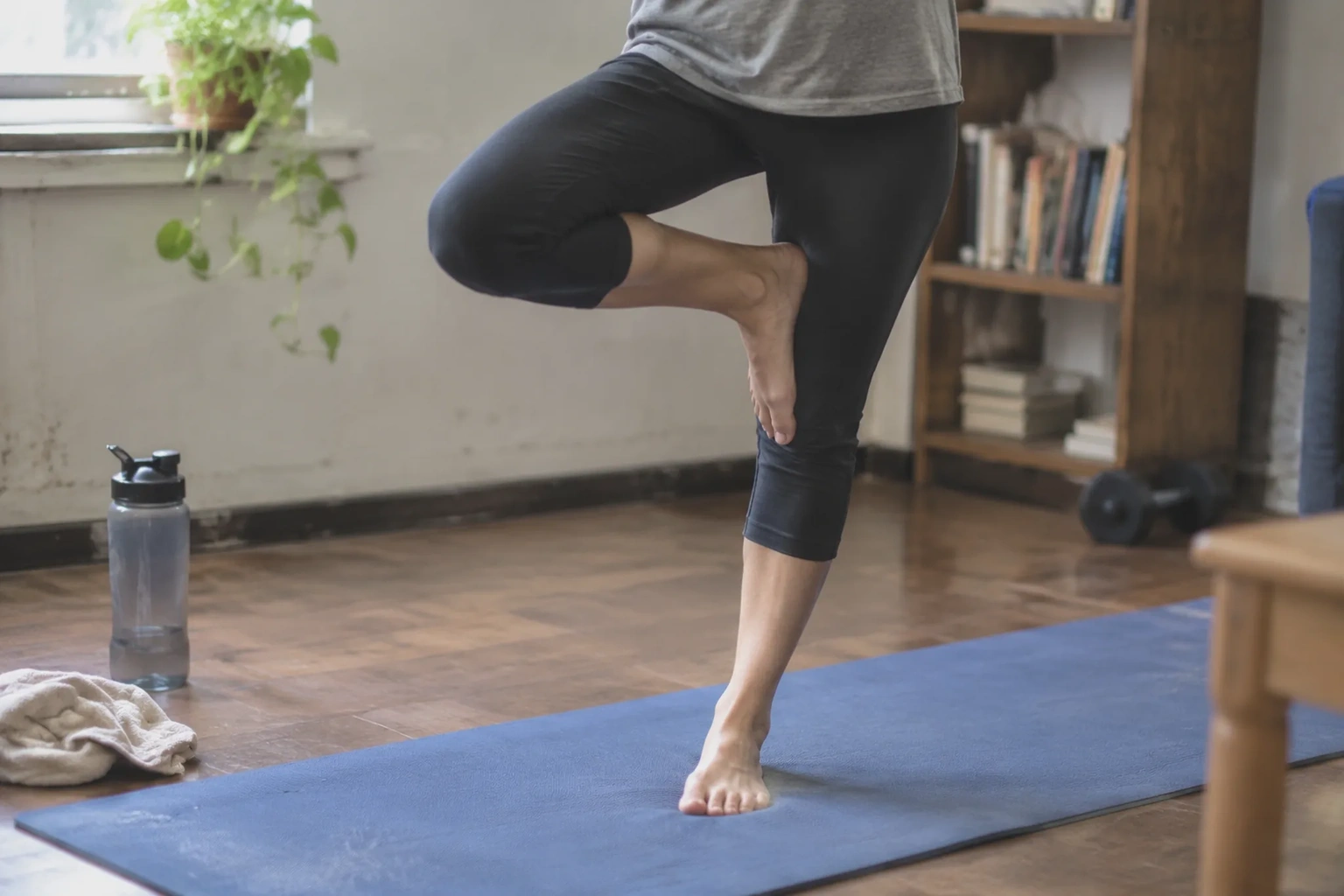
Balance, as a physical skill, has a public relations problem. It gets filed under gymnastics, or yoga, or the kind of exercise that requires a mat and a special pair of socks. The everyday version, the one that determines whether a person can carry a full mug up a staircase without watching their feet, goes almost entirely unexamined. Most adults assume balance is a fixed trait, something handed out at birth like height or eye color, and that whatever they got is what they have to work with.
That assumption is wrong, and it is costing people something they can feel: the quiet confidence of moving through a room without thinking about it. A few minutes of deliberate practice, done in a kitchen or a hallway, can shift how steady a person feels on their feet. The work is unglamorous and takes weeks, not days. But it is among the most portable forms of self-improvement available, because it requires no equipment, no membership, and no change of clothes.
What Balance Actually Is, Mechanically
Standing still looks passive. It is not. The body is constantly making tiny corrections, ankle muscles firing, toes gripping, hips shifting a few millimeters, the eyes and inner ear feeding position data to the brain, which issues adjustments faster than conscious thought. Balance is a loop: sense, adjust, sense again. The loop can be trained, the way any feedback system gets faster with repetition.
The mistake most people make is training only the strength side, or only the stretching side. A calf raise builds muscle but does not teach the ankle to make rapid corrections. A hamstring stretch improves range but does not improve the loop. Balance practice has to look like balance, which means standing on one leg and letting the wobble happen instead of fighting it.
The Single-Leg Stand, Done Properly
The foundational drill is the single-leg stand, and almost everyone does it wrong by doing it too well. The instinct is to lock the standing knee, tense the whole leg, and hold perfectly still. That defeats the purpose. The point is to let the body sway and recover, which is what trains the ankle and hip to work together.
A useful version: stand near a counter or wall, lift one foot a few inches off the floor, and hold for thirty seconds. Let the standing leg stay slightly soft. The lifted knee can point forward. The eyes stay open at first. When thirty seconds feels easy, the drill gets harder by closing the eyes, which removes visual data and forces the inner ear and feet to do more of the work.
Thirty seconds per leg, twice a day, is enough to start. That is one minute of practice. The improvement shows up in about three weeks, usually first as a smaller wobble, then as the ability to stand on one leg while talking or looking around. Both of those are closer to real life than a silent, frozen hold.
Why the Feet Matter More Than the Core
Core strength gets all the credit in balance conversations, and it does matter, but the feet are where the signal starts. The soles of the feet are dense with pressure sensors. Shoes, especially cushioned ones, mute that signal. A person who wears thick-soled shoes all day is training their feet to feel less, and the balance loop gets slower as a result.
A simple countermeasure: spend ten minutes a day barefoot on a hard floor, ideally while doing something else, like making coffee or brushing teeth. Standing on one foot while barefoot on tile is a different exercise than doing it in sneakers. The foot has to grip, the toes spread, the arch loads. None of that happens inside a shoe.
The payoff is not athletic. It is the ability to walk across a wet patio, step off a curb in the dark, or carry something heavy down stairs without a flicker of doubt. That flicker, the small hesitation before a step, is what erodes everyday confidence. It is a balance problem wearing a courage costume.
Walking a Line, Slowly
The second drill is a walking one, and it costs nothing. Find a straight line on the floor, a tile grout line, a seam in the sidewalk, a strip of masking tape. Walk it heel to toe, slowly, for ten steps. The slowness is the point. Fast walking hides balance errors. Slow walking exposes them, and exposing them is how they get fixed.
Most people find that their arms want to fly out, or that they hold their breath. Both are signs the body is treating the drill as a threat. The correction is to let the arms hang, breathe normally, and look at a point a few feet ahead rather than down at the feet. Looking down shifts the head forward, which shifts the center of mass, which makes the whole thing harder.
Ten steps, once a day, is plenty. The drill takes under a minute. It can be done in a hallway, a parking lot, or a kitchen with a long stretch of flooring. The benefit compounds with the single-leg stand: one trains static balance, the other trains balance while moving, and real life requires both in the same afternoon.
The Head Turn That Reveals Everything
Once the single-leg stand is comfortable with eyes open, add a head turn. Stand on one leg and slowly turn the head to look over one shoulder, then the other, keeping the body facing forward. This is a much harder drill than it sounds, because turning the head moves the inner ear fluid, which sends a conflicting signal to the brain. The body has to sort out which signal to trust.
That sorting is exactly what happens when a person steps off a curb while glancing at traffic. The head turns, the ear sends a confusing message, and the body either recovers or stumbles. Practicing the head turn in a safe hallway makes the recovery automatic. Ten slow head turns per leg, once a day, is a reasonable dose.
A note of caution, stated plainly: anyone who has had a recent fall, a concussion, or a diagnosed inner ear condition should treat these drills as something to discuss with a doctor first. Balance practice is low-risk for most healthy adults, but "most" is doing real work in that sentence. Dizziness during a drill is a signal to stop, not to push through.
Two Weeks In, the Stairs Change
The most reliable early sign of progress is not the drill itself. It is the staircase. People who practice balance for a couple of weeks tend to notice, without looking for it, that they no longer touch the handrail on the way down. The handrail was never a conscious choice. It was a small insurance policy taken out by a body that did not fully trust its own feet.
That is the everyday confidence the practice builds. Not bravado, not a new personality. A quiet removal of the small compensations that had become invisible: the hand on the rail, the eyes on the ground, the hesitation at the top of an unfamiliar step. Confidence, in this narrow physical sense, is just the absence of those compensations.
The practice also has a way of surfacing itself in odd moments. Standing in a crowded train, shifting weight as it lurches, the body finds a stability it did not have a month earlier. Carrying a laundry basket up a flight of stairs, the feet land where they are supposed to land. None of it is dramatic. All of it is the point.
What to Do When Progress Stalls
Balance gains tend to arrive in steps, not a smooth line. A person will improve for two weeks, then plateau for a month, then improve again. The plateau is normal and is usually a sign that the current drill has become too easy and the body has stopped learning from it. The fix is to add difficulty, not to practice longer.
Difficulty can be added in small increments: close the eyes, turn the head, stand on a softer surface like a folded towel, or lift the arms overhead. Each change makes the drill slightly harder without making it dangerous. The rule of thumb is that a drill should feel challenging but recoverable, meaning the wobble happens and the body corrects it within a second or two.
A drill that causes a person to grab the counter every few seconds is too hard and will not build much. A drill that produces no wobble at all is too easy and will not build anything. The productive middle is a steady, manageable sway, the same feeling as standing on a gently moving boat.
The Kitchen Counter as a Gym
The reason this practice sticks for some people and not others is location. A balance routine that requires driving to a gym will be abandoned within a month. A balance routine that happens while the kettle boils will survive, because it is attached to something that already happens every morning.
The kitchen is the ideal site. There is a counter to grab if needed, a hard floor, and a built-in daily trigger in the form of coffee or tea. Thirty seconds on each leg while the water heats, ten heel-to-toe steps down the hallway, and the day's practice is done before the first cup is poured. The whole thing fits inside a habit that already exists, which is the only reliable way to add a new one.
Over a few months, the practice becomes invisible. It stops feeling like exercise and starts feeling like a small daily check-in, the way a person might glance at the weather before leaving the house. The body gets the message that it is expected to be steady, and it obliges, mostly. That expectation, repeated often enough, is what everyday confidence is made of: not a belief that nothing will go wrong, but a settled knowledge that the feet will find the floor.





















