







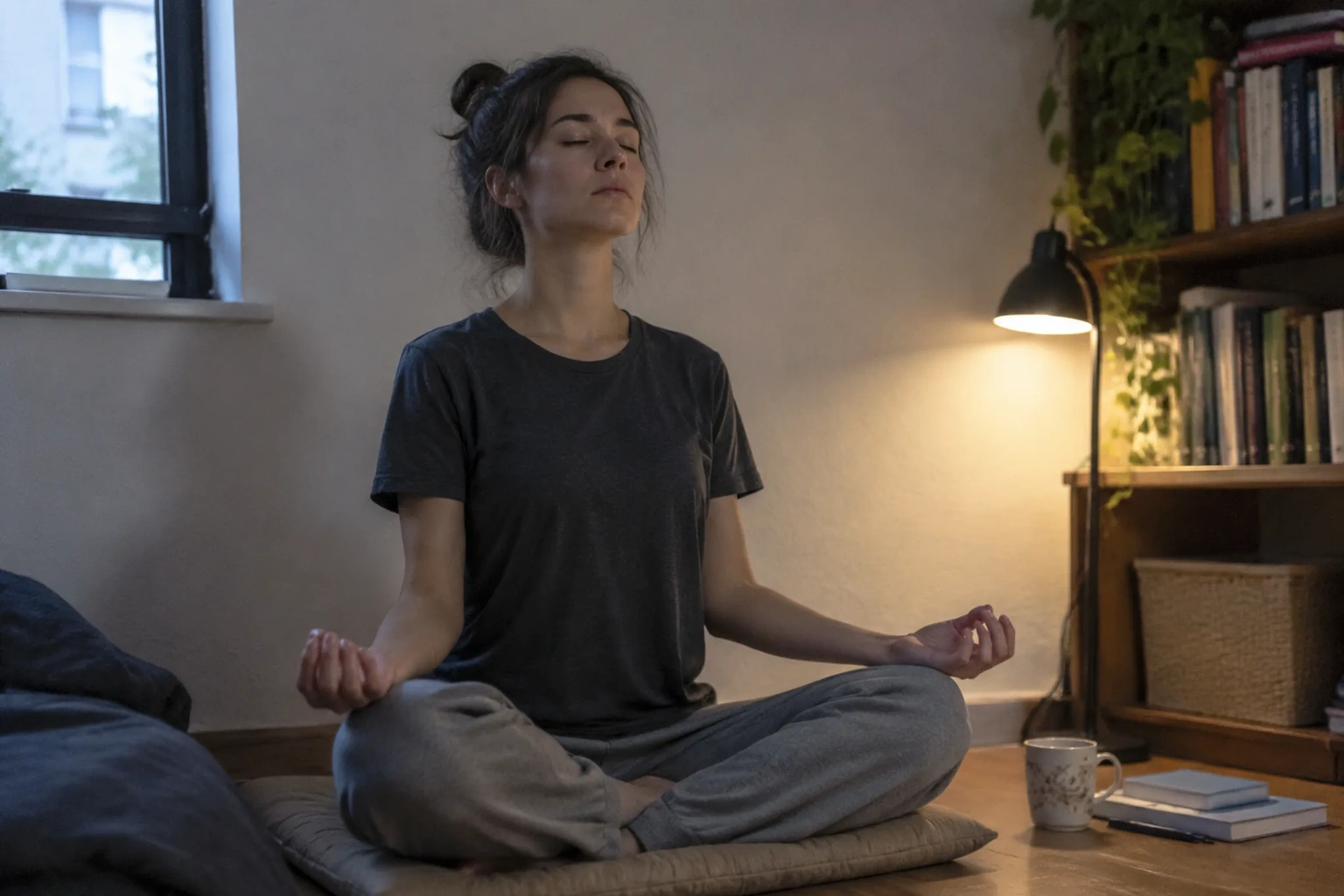
The instruction "sit and watch the breath" ranks among the most misleading pieces of advice in circulation. It sounds passive, almost boring, and most people attempting it for the first time discover within ninety seconds that the mind will not cooperate. The nose itches. A grocery list assembles itself. A work email from Tuesday resurfaces with full emotional force. The breath, meanwhile, has gone strange and manual, as though breathing were a skill newly acquired and badly performed.
None of that is failure. It is the ordinary weather of a first attempt. But certain mistakes recur so reliably across beginners that they can be named in advance, and each one has a practical correction that costs nothing and requires no app subscription. What follows is a working list of those mistakes, drawn from the kinds of errors that show up again and again in meditation halls, living rooms, and parked cars where people try this practice in secret.
Treating the Breath as Something to Control
The single most common error: the moment attention lands on the breath, the breath changes. It deepens, or shallows, or acquires a self-conscious pause at the top of each inhale. The meditator then assumes the breath must be corrected, managed, brought up to some standard of calmness that meditation presumably demands.
The correction is almost embarrassingly simple. The breath does not need supervision. It was running fine during sleep, during conversation, during the walk to the mailbox. The task is to notice the breath already happening, the way a person might notice a fan humming in the next room. Let the inhale be shallow if it is shallow. Let the exhale be ragged if it is ragged. The noticing is the work; the breath itself requires no editor.
There is a useful test for whether this mistake is active. If the breath feels like something being performed, the control has crept in. If it feels like something being observed, the practice is on track. The difference is subtle and takes a few sessions to recognize reliably, but it is unmistakable once noticed.
Chasing the Mind Back Like a Stray Dog
A thought arrives mid-session: a dentist appointment, a half-remembered song, a mild grievance from three years ago. The meditator catches it, feels a flicker of irritation, and drags attention back to the breath with the grim energy of someone retrieving a dog that keeps bolting through the gate.
This approach works for about a week and then produces a low-grade resentment of the practice itself. Every return to the breath starts to feel like a reprimand. The mind becomes an adversary.
A better framing, and one that experienced teachers return to constantly: the moment of noticing that attention has wandered is itself the practice. That moment, brief and unglamorous, is the entire skill being trained. The wandering is not an interruption of meditation; it is the raw material. A session with forty wanderings and forty returns is not a worse session than one with three. It is simply a busier one.
Some traditions describe this as the difference between the dog and the sky. Thoughts are weather passing through. The meditator is not the weather. Dragging attention back with irritation makes the weather into an enemy, and an enemy requires constant vigilance. Letting it pass requires only patience.
Setting a Timer for Forty Minutes and Quitting at Week Two
Ambition has a way of arriving before capacity. A person reads about the benefits of meditation, feels motivated, and decides on a forty-five-minute daily practice. The first session is tolerable. The second is restless. By day nine, the timer has become a small daily punishment, and by week three the cushion is under the bed.
Five minutes, done every day for a month, builds more practice than forty-five minutes abandoned in a fortnight. This is not a motivational platitude; it is the arithmetic of habit formation. A short session is easy to start, easy to finish, and leaves the meditator wanting slightly more, which is a far better state than dreading the next sit.
The length can grow later, and it usually does, on its own schedule. But the growth should feel like the natural expansion of something already established, not like a resolution imposed on an unwilling nervous system.
Believing That a Busy Session Was a Bad Session
Meditators routinely grade their sessions. A quiet mind earns a passing mark; a churning one earns a fail. This grading habit is corrosive, because it turns an observational practice into a performance review, and the mind being observed is well aware of the audience.
The busy session is often the more instructive one. A person who notices, twenty times, that attention has been captured by planning is getting twenty reps of the core skill. A person who sits in pleasant blankness may be getting none. The blankness feels better, and that feeling is precisely the trap, because it teaches the meditator to chase a state rather than practice a technique.
Weather changes. Practice continues. Judging the weather is optional.
Fighting Sleep Instead of Noticing It
Drowsiness is the great unsung obstacle of early practice, particularly for anyone meditating in the evening or after a poor night's sleep. The eyelids grow heavy, the breath softens, and within minutes the meditator is nodding forward, jerking awake, and feeling vaguely ashamed.
The instinct is to fight the drowsiness with willpower, which rarely works and often produces a strange, tense half-sleep. A more practical set of corrections: open the eyes slightly, sit up straighter, meditate earlier in the day, or stand up for the remainder of the session if the fog refuses to lift. None of these are defeats. They are adjustments to conditions.
There is also a quieter value in simply noticing the drowsiness as another passing state, the same way one notices an itch. The heaviness has a texture, a weight, a direction. Watching it without fighting it sometimes dissolves it. Sometimes it does not, and the meditator stands up. Both outcomes are fine.
Sitting Through Physical Discomfort Out of Grit
There is a persistent image of the meditator as someone who sits cross-legged through pain, immovable, serene. Beginners try to live up to this image and end up with aching knees and a quiet conviction that meditation is not for them.
The image is wrong. Physical discomfort during meditation is information, not a test. A twinge in the back means the posture needs adjusting, or the session needs to move to a chair. Numbness in a foot means the circulation wants attention. Shifting position mid-session is not a failure of discipline; it is the ordinary response of a body communicating with its occupant.
For anyone with knee, hip, or back issues, a chair is not a lesser seat. The cushion is a cultural artifact, not a requirement. What matters is that the spine is relatively upright and the body is at ease enough that attention is not constantly pulled toward the ache.
Meditating to Make Thoughts Stop
Somewhere in the popular imagination, meditation is a switch that turns off the internal monologue. Beginners sit down expecting silence and find instead a radio left on in another room, playing every station at once.
Thoughts do not stop. Not in meditation, not in daily life, not for anyone who has ever lived with a human brain. The practice changes the relationship to thought, not the volume. A meditator learns to watch a thought arrive, note it, and let it leave without following it down the hallway. The thoughts keep coming; the chasing stops.
This distinction matters because the expectation of silence creates a false standard. A person waiting for the mind to go quiet is waiting for something that will not happen, and every ordinary thought becomes evidence of failure. A person who expects thoughts and practices not following them has a workable task from the first minute.
Skipping the Part Where the Practice Leaves the Cushion
Twenty minutes on a cushion, followed by twenty-three and a half hours of complete inattention, produces a very thin sort of training. The formal sit is the practice field; the rest of the day is the game. A meditator who only notices the breath during the session is like a musician who only plays scales.
The transfer is unglamorous and takes specific forms. Noticing the breath during a red light. Noticing the arrival of irritation during a meeting and feeling it in the chest before speaking. Noticing the impulse to check a phone and choosing, once, not to. Each of these is a small return, indistinguishable in kind from the returns happening on the cushion, and together they are where the practice actually lives.
Formal sitting builds the capacity. The rest of the day spends it. A practice that never leaves the cushion is a practice that has not quite started.
Measuring Progress by the Quality of the Last Sit
A final mistake, and one that quietly undoes months of steady work: using today's session as the scorecard. A calm sit this morning becomes evidence of progress; a restless one this evening becomes evidence of decline. The meditator rides this emotional rollercoaster daily and eventually concludes the practice is unreliable.
Session quality is noise. It fluctuates with sleep, caffeine, stress, the temperature of the room, and a hundred other variables that have nothing to do with skill. The signal is subtler: whether the meditator is more likely, this month than last, to notice when the mind has wandered during an argument or a commute. Whether the gap between stimulus and reaction has widened by a beat.
These changes are almost invisible from the inside, which is why they are so easy to miss. They show up sideways, in a moment of unexpected patience, in a choice not to send a message, in the ability to sit with an uncomfortable feeling for ten seconds longer than before. The cushion does not grade these things. The day does.





















