







Sleep hygiene has a marketing problem. The phrase conjures a shelf of lavender sprays and a phone set to grayscale, and the advice attached to it tends to arrive in the same flat voice: cool room, dark room, no screens, consistent schedule. All of that is broadly reasonable. Most of it also fails the first night it meets an actual human life, because the recommendations assume a person has full control over the hour before bed and the willpower to spend it on a regimen.
The changes that survive contact with real evenings are smaller and stranger than the standard list. They tend to be physical adjustments to the room and the body's clock rather than moral ones about discipline. What follows is an account of the ones with the best ratio of effort to effect, and the reasoning behind each.
The Bedroom Temperature Nobody Believes Until They Try It
Core body temperature has to drop for sleep to begin, and a room that sits around 65 to 68 degrees Fahrenheit supports that drop without forcing the sleeper to curl up against the cold. Most homes run warmer than that at night, especially in summer and especially on upper floors, where heat collects.
A cheap thermometer on the nightstand settles the question in one evening. Plenty of people discover their bedroom sits at 74 degrees and have been wondering for years why they wake at 3 a.m. with the pillow damp. Dropping the thermostat, adding a fan that moves air across the skin, or simply sleeping with lighter bedding are all reversible, cost almost nothing, and take effect the same night.
The catch is that cold rooms invite cold feet, and cold feet delay sleep for a different reason. The compromise is a warm shower before bed, which pulls blood to the skin's surface and then lets it cool, and a pair of socks for anyone whose extremities run cold. The room stays cool; the sleeper stays comfortable.
Darkness Is a Measurement, Not a Mood
Almost every bedroom has a light leak. The standby LED on the television, the sliver under the door, the streetlight that paints a stripe across the ceiling. None of these feel significant, and individually none of them are. Together, on a sensitive sleeper, they add up to a room that never gets fully dark, and light exposure during the night is one of the more reliable suppressors of melatonin.
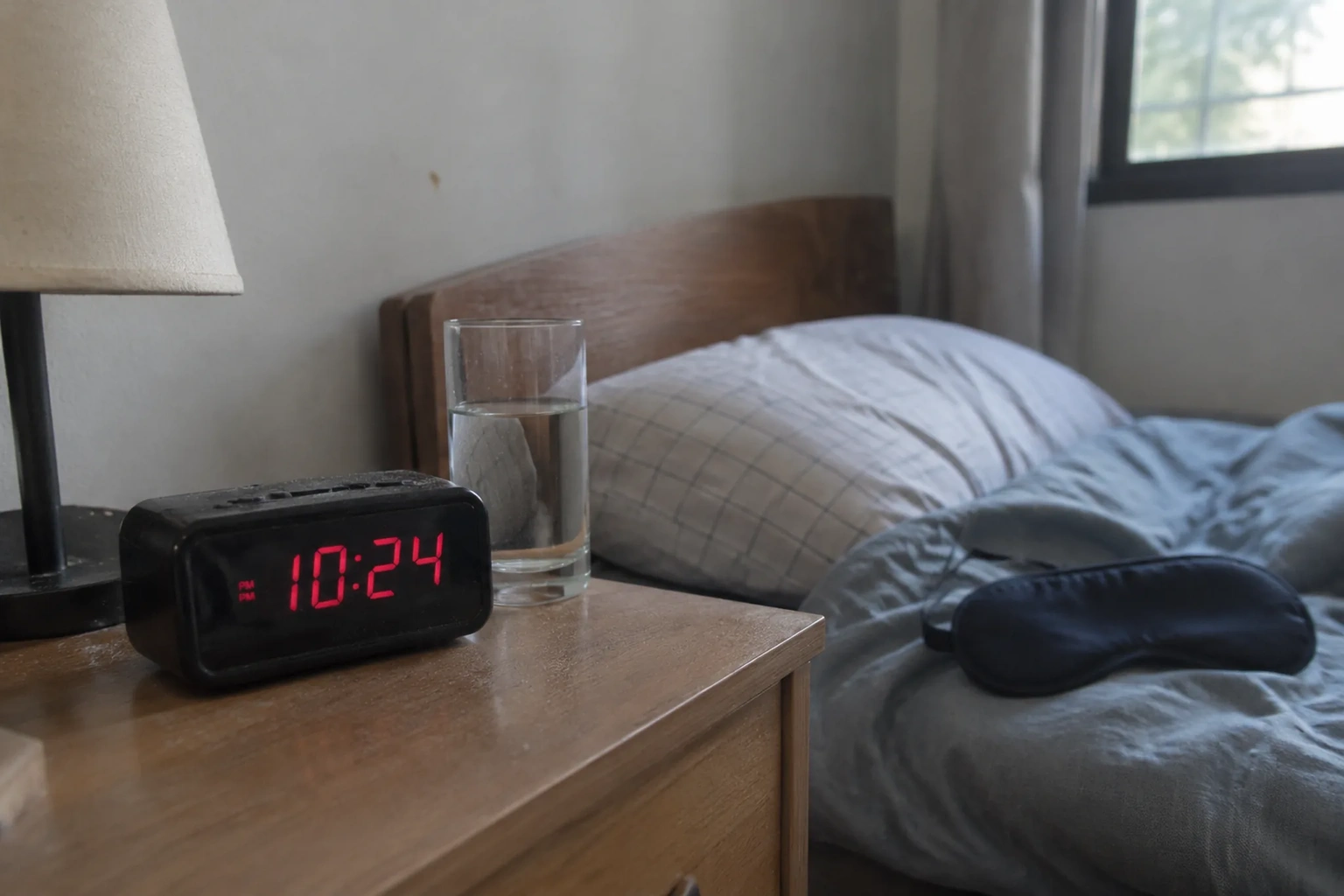
The practical fix is unglamorous: walk into the bedroom with the lights off and look for glow. Tape over the LEDs. Hang a curtain that actually overlaps the window edges rather than one that stops a hand's width short. A sleep mask handles the rest, and the good ones cost less than a takeout dinner. This is the rare intervention that works on the first night and keeps working for years.
The Clock That Runs the Whole System
Of all the levers available, the wake time is the strongest. The body's internal clock takes its cue primarily from morning light and the consistency of when a person gets up, and it will follow that cue even when the bedtime wanders. Sleeping in on Saturday by two hours is the equivalent of flying two time zones west and then flying back on Monday morning.
The adjustment that pays off is dull and absolute: pick a wake time and hold it within about half an hour, seven days a week, including weekends. The first week feels punitive. By the second, sleepiness starts arriving at a predictable hour in the evening, which is the entire point. A fixed bedtime is much harder to enforce; a fixed wake time enforces itself, because the alarm goes off whether the sleeper is ready or not.
Morning light does the rest. Ten to fifteen minutes outside within an hour of waking, even on a gray day, is enough to anchor the clock. A bright window is a poor substitute, and a phone screen is no substitute at all.
What the Last Hour Should Actually Contain
The usual advice is to wind down, which is vague enough to be useless. A more concrete rule: the last hour before bed should contain nothing that raises the heart rate, nothing that requires a decision, and nothing that generates a to-do list. That rules out work email, arguments, online shopping, and the news. It leaves room for a shower, a paperback, a stretch, a conversation about nothing.
Screens get blamed for more than they deserve. The problem with a phone at 11 p.m. is usually not the blue light; it is the content, which is engineered to hold attention and does. A person who reads a novel on an e-ink reader falls asleep fine. A person who opens a social feed at midnight is at the mercy of an algorithm that has no interest in their rest.
For anyone who cannot face giving up the phone, the workable compromise is to charge it across the room. The distance alone breaks the reflex of picking it up during a 2 a.m. wake-up, and the alarm still works in the morning. It is a physical fix to a behavioral problem, which is why it tends to stick.
Caffeine Has a Half-Life, and It Is Longer Than Expected
Caffeine clears slowly. A meaningful fraction of a mid-afternoon coffee is still circulating at bedtime, even for people who swear it does not affect them. The effect is often invisible: the sleeper falls asleep fine but spends the night in lighter stages, wakes unrefreshed, and reaches for more coffee in the morning. The loop is easy to miss because the symptom is a vague flatness rather than obvious insomnia.
A simple test: move the last cup to before noon for two weeks and see what changes. No app, no tracking, no journal required. Most people who try it report falling asleep faster within a week or so. Those who notice nothing can go back to their afternoon espresso with a clear conscience.
The 3 A.M. Wake-Up and the Rule Against Checking the Time
Waking in the middle of the night is normal. Sleep cycles through lighter stages, and brief awakenings are part of the architecture. What turns a two-minute wake-up into a two-hour one is the mental arithmetic that follows: checking the clock, calculating how many hours remain, and starting the day's worrying early.
Turning the clock face away is one of the most effective small changes available, and it costs nothing. Without the time, the brain has less raw material for the calculation. For the nights when the mind still starts running, a low-stakes physical task helps more than trying to force sleep: getting up, walking to another room, reading something dull under a dim light until sleepy, then returning. Lying in bed frustrated teaches the brain that the bed is a place for frustration.
Alcohol, the Most Reliable Sleep Disruptor in the House
A drink before bed does make a person fall asleep faster. It also fragments the second half of the night, suppresses the deeper stages of sleep, and tends to produce an early-morning wake-up around 3 or 4 a.m. as the body metabolizes it. The net effect is a night that feels shorter than it was. Anyone who has had two glasses of wine and woken at 4 a.m. with a racing heart has met this mechanism directly.
The change worth making is not necessarily abstinence. It is moving the last drink earlier, ideally three hours before bed, and keeping the count low. A single glass with dinner is a different proposition from a nightcap at 11 p.m., and the difference shows up in the second half of the night, where the sleep actually matters.
The Mattress Question Nobody Wants to Ask
Sleep hygiene advice rarely mentions the surface itself, which is odd given that a person spends roughly a third of life on it. A mattress that has gone soft in the middle, a pillow that has lost its loft, a duvet that traps heat: these are physical facts about the sleeping environment, and they are often the reason a person wakes with a sore shoulder or a hot neck despite doing everything else right.
Pillows are the cheapest upgrade. A side sleeper needs a pillow thick enough to keep the neck level with the spine; a back sleeper needs less. Most people use the same pillow for years past the point where it holds its shape, and replacing it is a twenty-dollar experiment that can change how mornings feel. Mattresses are a bigger commitment, and the useful test is whether the body feels rested rather than whether the bed still looks fine.
Where the Small Changes Add Up to a Different Night
None of these interventions is dramatic on its own. A darker room, a cooler thermostat, a fixed wake time, an earlier last coffee, a clock turned away, a pillow that holds its shape. Each shaves a few minutes off the time it takes to fall asleep or trims one wake-up from the night. Stacked together, they change the character of a night in a way that no single lavender spray can.
The order to try them is by cost and reversibility: tape over the LEDs and turn the clock around tonight, move the coffee earlier this week, drop the thermostat a few degrees and see what happens. The changes that stick tend to be the ones that required no willpower at all, only a small adjustment to the room and the schedule. A person who makes three of them and sleeps better is far ahead of one who buys the whole shelf and changes nothing.





















