







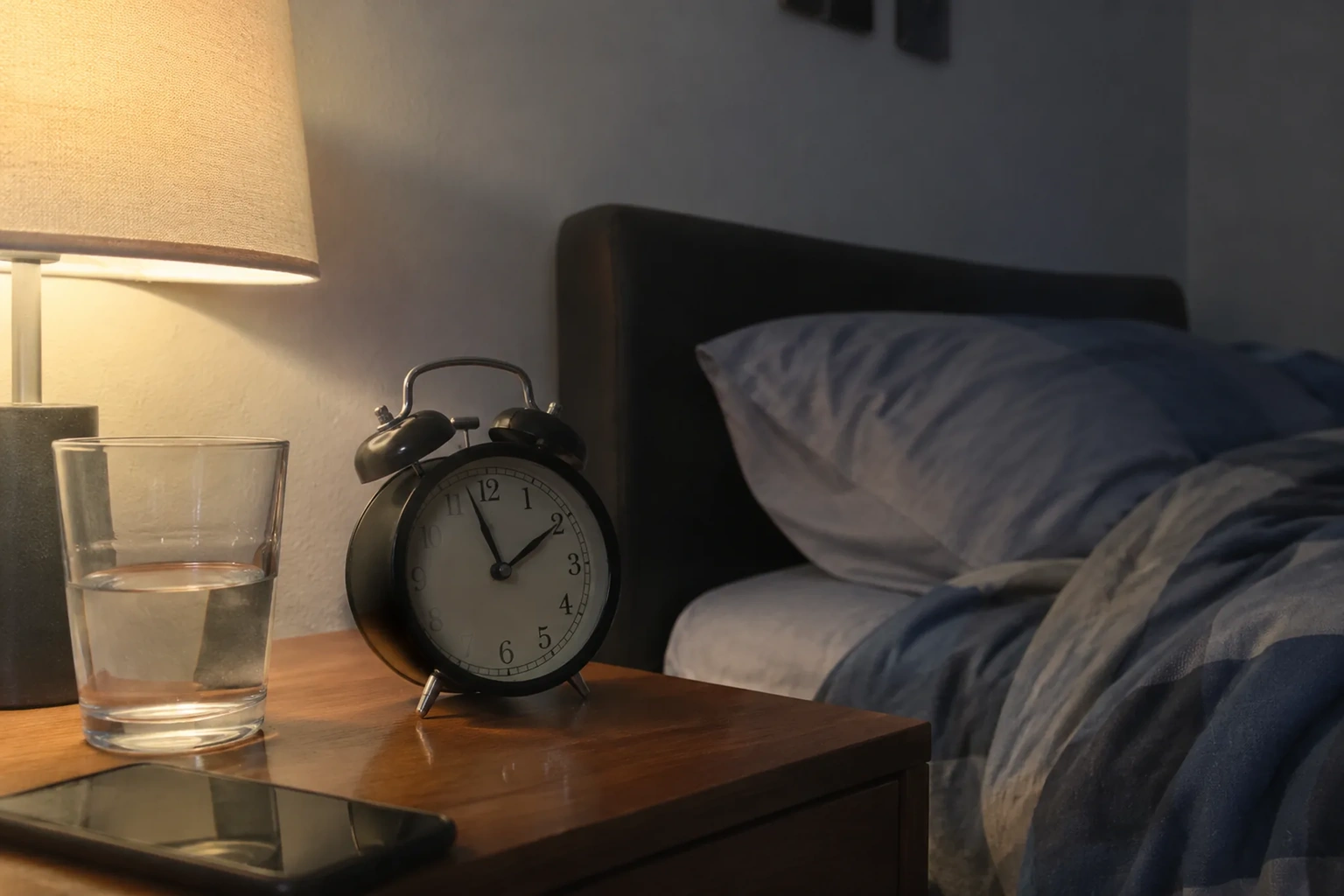
Two levers move mood more than almost anything else a person controls, and they pull in different directions. Sleep hygiene is the set of small disciplines around bedtime: a consistent hour, a dark room, no screens in the last stretch before sleep, caffeine cut off in the early afternoon. Stress management is the looser collection of practices that keep the nervous system from running hot during the day: breathing, walks, boundaries on work, time with people who don't drain the room. Both are sold as mood fixes. They are not interchangeable, and they do not work on the same timeline.
The distinction matters because most advice collapses them. A person wakes up irritable after a bad night and is told to download a meditation app. Someone else grinds through a stressful month and is told to get more sleep. Neither suggestion is wrong, exactly. Both miss the point of which lever addresses which problem.
What sleep hygiene actually repairs
Sleep hygiene is a floor, not a ceiling. Its real job is to keep the sleep system from being sabotaged by the rest of the day. The body's clock runs on light and timing, and a person who goes to bed at wildly different hours, or who sits under a bright screen until midnight, is fighting that clock with every late scroll.
The mood payoff from fixing this is real but unglamorous. Poor sleep tends to show up first as a short fuse, a flatness in the morning, a sense that small annoyances are larger than they should be. Restore the routine and those symptoms often soften within a week or two. The change is not euphoria. It is the return of a baseline that had quietly eroded.
This is why sleep hygiene works best as prevention. It keeps a bad week from compounding into a bad month. A single late night is survivable. Five of them in a row, stacked on early alarms, start to look like a mood disorder to the person living through it.
The catch: sleep hygiene cannot fix a stress load that is already crushing. A person can have perfect blackout curtains and a flawless 10:30 bedtime and still wake at 4 a.m. with a work problem looping in their head. The routine is in place. The sleep still fragments. That is the stress lever's territory.
What stress management reaches that sleep cannot
Stress management works on the daytime load. It targets the arousal that builds between waking and bedtime, the activation that keeps a person braced even when nothing is actively wrong. A short walk after lunch, a hard stop on email at 6, a phone call with a friend, ten slow breaths before a difficult meeting: these are small interventions, and their cumulative effect on mood is larger than their size suggests.
The evidence here is mostly about accumulation. No single breathing exercise changes a life. A person who builds three or four of these practices into a week tends to report a lower resting irritability, a shorter recovery time after setbacks, a greater tolerance for the ordinary friction of a day. The mood shift is gradual and easy to miss.
Stress management also reaches the parts of life that sleep hygiene cannot touch. A person can sleep eight solid hours and still feel ground down by a job that demands too much, a relationship that has gone quiet, a schedule with no slack in it. Sleep restores the body. It does not resolve the situation that keeps generating the tension.
The order most people get backward
There is a sequencing question buried in all this, and most people answer it wrong. The instinct is to chase sleep first, because sleep feels like the foundation. Fix the bedtime, the logic goes, and the mood will follow. Sometimes it does. Often it doesn't, because the stress load is still climbing.
A more useful order runs the other way for many people. Get the daytime load down to something survivable first, then let sleep hygiene do its quiet work. A person who is white-knuckling through a brutal quarter will not sleep well no matter how dark the room is. Address the quarter, even partially, and the sleep routine suddenly starts to take.
This is not a universal rule. Someone whose sleep has been chaotic for years, with no obvious external stressor, should probably start with the bedtime and the light exposure. The point is that the two levers are not ranked. They are sequential in a way that depends on which problem is upstream.
Why the sleep-hygiene advice wears thin
Sleep hygiene has a marketing problem. It has been packaged into lists so tidy they stop meaning anything: cool room, no caffeine, no screens, consistent schedule, done. A person follows the list for a week, sleeps a little better, then hits a stressful stretch and finds the list has no answer for the 3 a.m. wake-up that has nothing to do with room temperature.
The list also tends to ignore the person's actual life. Telling a shift worker to keep a consistent bedtime is close to useless. Telling a new parent to avoid screens in the hour before bed is a small joke. The advice is not false. It is just calibrated to a life with more control over its evenings than many people have.
Stress management advice has the opposite problem. It is so vague that it can absorb any failure. A person tries meditation, finds it doesn't help, and concludes they are doing it wrong. The practice gets defended by its vagueness. The result is a category of advice that is hard to disprove and therefore hard to trust.
The two levers share one mechanism
Underneath the difference in timing, both levers work through the same system. The body's stress response is supposed to rise and fall across a day, peaking in the morning and settling by evening. Mood problems often trace to a response that rises and then fails to fall, or that falls and then fails to rise. Sleep hygiene shapes the fall. Stress management shapes the rise.
A person with a stress response that never fully settles will struggle to sleep no matter how disciplined the bedtime routine. A person whose sleep is chronically short will find their stress response easier to trigger and slower to calm. The two problems feed each other, which is why fixing only one tends to produce partial results.
This is also why the levers can substitute for each other in a pinch. A hard day followed by a solid night's sleep often resolves itself by morning. A stretch of poor sleep followed by a genuinely restful weekend can reset the mood for a week. The system is forgiving in the short term. It is the long term that punishes neglect of either lever.
A practical way to tell which lever is needed
The simplest diagnostic is the morning question. If a person wakes up dreading the day before anything has actually happened, the problem is likely sleep: the body has not restored itself and the mood is running on empty. If a person wakes up fine and then deteriorates across the day as demands pile up, the problem is likely stress: the load is outrunning the recovery.
Another tell is the weekend. A person whose mood lifts noticeably on Saturday and Sunday, before any real rest has accumulated, is probably carrying a stress problem. A person whose mood stays flat through the weekend, even after two slow mornings, is probably carrying a sleep debt that a single lie-in cannot clear.
Neither question is perfect. Both are more useful than the generic advice to "take care of yourself," which is a sentence that has never helped anyone decide what to do on a Tuesday.
Where the two practices overlap and where they don't
Some habits serve both levers at once. Regular exercise is the clearest example: it deepens sleep and it burns off stress, which is why a brisk walk is the most over-recommended and under-used mood intervention available. Morning daylight does double duty too, anchoring the body clock and lifting mood through the same exposure.
Other habits serve only one. Caffeine cutoffs are pure sleep hygiene; a person can drink coffee at 4 p.m. and feel no stress from it, but the sleep will pay. Boundary-setting with work is pure stress management; it does nothing for sleep directly, though better sleep often follows once the evening stops being a second workday.
The overlap is where a person gets the most return for the least effort. A single morning walk in daylight, done consistently, moves both levers at once. So does protecting the last hour before bed from work and from screens, which lowers stimulation and improves sleep timing in the same move.
The mistake of treating one as a substitute for the other
The most common failure is substitution. A person with a stress problem decides the answer is a better mattress and a strict bedtime, and wonders why the anxiety is still there at 2 a.m. A person with a sleep problem decides the answer is more yoga and more journaling, and wonders why the flatness persists through a well-managed day.
Each lever has a domain. Sleep hygiene governs the restoration window. Stress management governs the load carried into it. A person can optimize one to a fault and still feel awful if the other is neglected. The two are not competing philosophies. They are two halves of the same daily cycle.
The practical implication is unglamorous. Most people need both, in proportions that shift with the season of their life. A quiet month needs less stress management and more attention to the bedtime. A brutal one needs the reverse, or at least a willingness to accept that the sleep will be imperfect until the load comes down.
What changes when a person stops choosing
The question "which one helps mood" assumes a contest that does not exist. Sleep hygiene and stress management are not rivals for the same slot. They are two ends of a single loop, and the mood improves when both ends are tended, even imperfectly.
A person who spends a month getting to bed within the same hour each night, and who also builds one reliable decompression habit into the afternoon, will usually notice the change in a specific place: the recovery time after a bad moment. The bad moment still comes. The tail of it gets shorter. That shortened tail is what most people mean when they say their mood is better, and it is the one result both levers can deliver, provided neither is left entirely alone.





















