







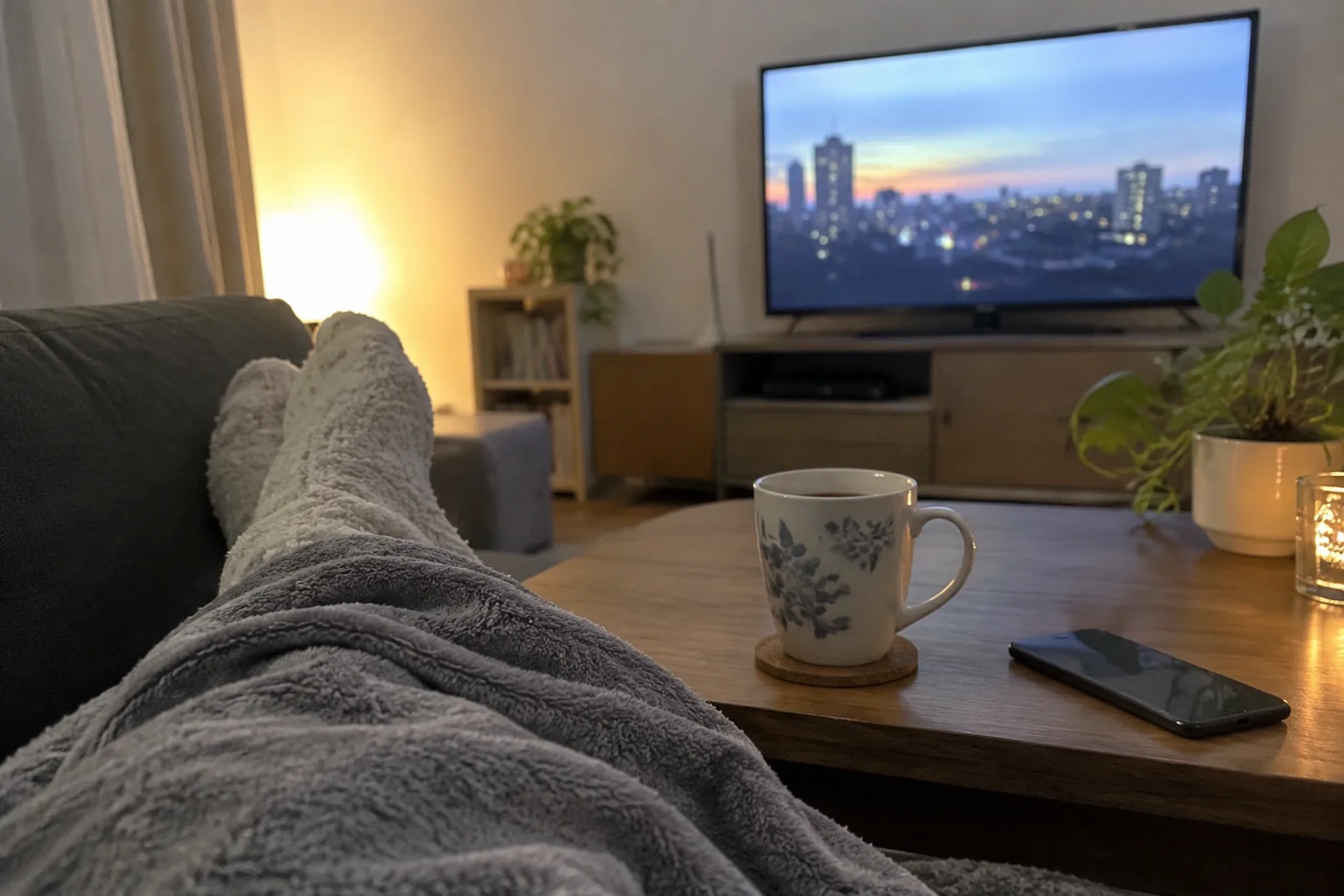
The apartment at 9 p.m. has a particular texture. The dishes are done or they are not. The phone has been face-down for twenty minutes or it has not. Somewhere in the building a door closes, and the sound carries through the wall with a softness that suggests everyone inside is finally sitting down. This is the hour when the day either releases its grip or refuses to, and the difference between those two outcomes rarely comes down to willpower.
Most advice about winding down treats the evening as a problem to be solved with discipline. Put the phone away at eight. Dim the lights. Take the bath. These instructions are not wrong, exactly, but they miss what makes an evening feel slow in the first place. Slowness is not the absence of activity. It is the presence of a rhythm that belongs to the person living it, rather than to the inbox, the group chat, or the next morning's alarm.
A routine that actually helps someone unwind has to be built around their specific life, not a generic checklist. The nurse getting off a twelve-hour shift needs something different from the freelance designer who has been at a desk since seven. What both need is a sequence of small, repeatable actions that signal to the body: the demanding part is over.
The first ten minutes home decide more than the next two hours
Walk through the door and the body is still carrying the day. Shoulders are up near the ears. The jaw is set. The mind is replaying a conversation from four hours ago. This is not a state that a glass of wine or a television remote can dissolve; it needs a transition, a physical marker that separates the outside world from the inside one.
A reliable transition is short, sensory, and repeated until it becomes automatic. Shoes off at the door, coat hung, hands washed. A change of clothes, even into something only marginally more comfortable, does more than it seems: the body registers the swap and begins to downshift. Some people swear by a two-minute stretch against the doorframe. Others run the kitchen tap and stand there while the water warms, doing nothing at all.
The specific action matters less than its consistency. A transition repeated every night becomes a kind of switch. After a few weeks, the body starts to anticipate the unwinding before the mind has caught up.
Light is the quiet lever most evenings ignore
By the time most people think about relaxing, the overhead light has been blazing for hours. Ceiling fixtures at full brightness tell the brain it is still daytime, still time to be alert. The effect is subtle but real, and it costs nothing to change.
One lamp in the corner, switched on while the overhead light goes off, changes the character of a room entirely. The corners soften. The walls stop glaring. A person sitting on the couch under a single warm bulb feels the difference in their shoulders before they can name it. This is one of the cheapest upgrades available to any evening, and it requires no discipline whatsoever, only the habit of reaching for the lamp instead of the switch.
There is a version of this that gets overcomplicated, with smart bulbs and scheduled dimming apps and color temperatures measured in Kelvin. None of that is necessary. A single lamp and the decision to use it will do more than a whole system nobody bothers to configure.
The case for doing one thing with full attention
Evenings often dissolve because they are spent in a state of partial engagement: half watching a show, half scrolling, half listening to a podcast, half thinking about tomorrow. The hours pass and nothing registers. By ten o'clock there is a vague sense of having wasted the only free time of the day.
The antidote is not more entertainment. It is fewer inputs. One show, watched without a phone in reach. One chapter of a book, read under the lamp. One meal, eaten at a table rather than standing at the counter. The point is not productivity; it is the texture of attention itself. An evening spent doing one thing fully feels longer and calmer than an evening spent doing four things badly.
This runs against the grain of how most homes are set up. The television sits in the middle of the room, the phone lives in a pocket, the laptop stays open on the kitchen table. Removing one of those from the evening's path, even for an hour, makes the choice to focus easier.
Why the dishes should not wait until morning
A sink full of plates is a low-grade stressor that hums in the background all evening. It is not the dishes themselves; it is the knowledge that they are there, waiting, and that the morning will begin with a chore instead of a clean start. Leaving them is a choice to carry the day into the night.
Clearing the kitchen right after dinner, before sitting down, takes perhaps ten minutes and removes an entire category of dread from the evening. The reward is not a spotless kitchen. It is the ability to sit on the couch afterward without a small voice listing what still needs doing.
The same logic applies to the other small undone things: the bag left by the door, the mail piled on the counter, the laundry basket in the hallway. Each one is negligible on its own. Together they form a quiet chorus of obligations that makes it impossible to fully settle. Ten minutes of tidying at the start of the evening buys two hours of genuine rest.
A screen curfew that people will actually keep
Most screen-time advice fails because it asks for too much. Telling someone to put the phone away two hours before bed ignores the fact that the phone is how many people read, talk to friends, and wind down at all. The rule is too strict to survive contact with an ordinary Tuesday.
A workable version is narrower: no work email after dinner, and no phone in the bedroom. The first protects the evening from the office. The second protects sleep from the endless scroll that begins with a quick check and ends forty minutes later. Neither rule requires giving up the phone entirely; they simply draw a fence around the parts of the day that should belong to something else.
Charging the phone in the kitchen overnight is the single most effective version of this. It is inconvenient enough to work. The alarm still goes off in the morning, but reaching for it requires getting out of bed, which is a meaningful barrier at six in the morning.
The wind-down that happens before bed, not at it
There is a gap between the end of the evening and the moment of sleep that many people fill badly. The show ends, the phone goes down, and suddenly the bed is right there, and the mind, which has been quiet for two hours, decides now is the time to review the day's mistakes.
A short wind-down sequence closes that gap. Teeth brushed, face washed, a few pages of a book in the same chair every night. The repetition does the work. After a while the body associates the chair, the lamp, and the book with the approach of sleep, and the mind settles faster because it knows what comes next.
Fifteen minutes is enough. It does not need to be a meditation practice or a gratitude journal, though either could fit. It needs to be the same fifteen minutes, in the same place, at roughly the same time.
The evening that does not try to be perfect
The trap in all of this is the pursuit of an ideal evening. The lit lamp, the clean kitchen, the chapter read with full attention, the phone charging in the other room: strung together, they can start to look like another performance to be graded. That is the opposite of unwinding.
A routine that holds up over months is the one with slack built in. Some nights the dishes sit until morning. Some nights the show runs long and the book stays closed. The routine is not a test; it is a set of defaults that carry a person through the ordinary evenings, so that the exceptional ones, the dinner with friends, the late movie, the unplanned conversation on the porch, can happen without guilt.
What a slow evening actually produces is not a perfect night. It is the feeling, around ten o'clock, that the day has been put down rather than abandoned. The lamp is on. The kitchen is quiet. Tomorrow's alarm is set for a reasonable hour. The rest of it can wait.





















