







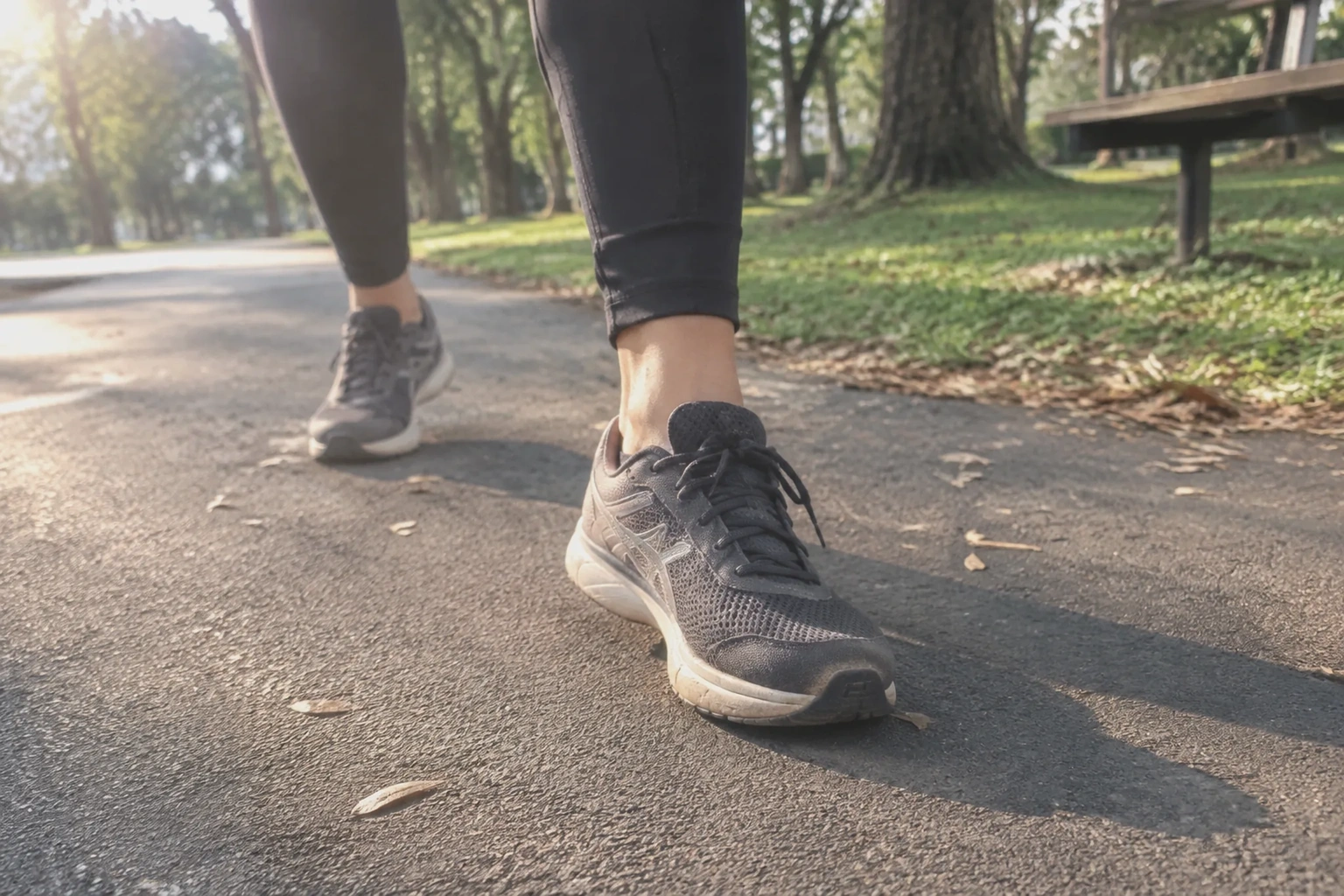
The most common walking mistake is not bad posture or the wrong shoes. It is pace, and specifically the pace people settle into when they walk the same route every day. A person leaves the house, turns left at the corner, passes the same bakery, crosses at the same light, and arrives at the office having walked two miles without once asking the body to do anything new. The mileage looks respectable on a phone. The progress stalls anyway, and the reason is almost always hiding in a handful of small habits that are easy to miss because they feel like walking.
Walking is forgiving enough to tolerate a lot of sloppiness. That tolerance is the problem. A person can shuffle for an hour, lean on a stroller, stop every block to check a phone, and still log the distance. The body adapts to the exact demands placed on it, and if the demands never change, neither does the body. The mistakes below are not dramatic. They are the quiet ones that keep a walk from turning into training.
The same loop walked at the same speed
Familiarity is comfortable and it is also a ceiling. The body gets efficient at a repeated task, which sounds good until the efficiency means the same loop costs fewer calories and less effort each month. A walk that felt mildly challenging in March becomes a stroll by June. The person keeps doing it, feels virtuous, and wonders why the scale and the stamina have gone flat.
The fix does not require a new route. It requires a change in demand. A few minutes at a faster clip, a hill inserted into the middle, a stretch of stairs, a heavier pack on one day a week. The body needs a reason to rebuild. A loop walked at the identical pace for a year is a habit, and habits maintain; they do not progress.
Strolling when the goal requires a brisk pace
There is a real gap between a stroll and a brisk walk, and most people who believe they walk briskly are strolling. A stroll is a pace that allows a full conversation without effort. A brisk walk raises the breathing a little, makes the conversation slightly harder, and warms the body within the first few minutes. The difference in effort is modest. The difference in what the body gets out of it is not.
A useful test is the talk test. If a person can sing through a walk, the pace is too easy for a training effect. If speech comes in short phrases and the breath is audible, the pace is doing work. The gap between those two states is where most walkers spend their entire walking lives without noticing.
Arms hanging still for the whole walk
The arms are the most ignored part of walking. They hang at the sides, sometimes holding a phone, sometimes a coffee, sometimes a leash. A still upper body costs the walker a meaningful share of the effort the legs are producing. The natural counter-rotation of the shoulders against the hips is part of what makes walking efficient and what makes it work the trunk.
Bending the elbows and letting the arms swing naturally, without forcing a march, changes the rhythm of the whole gait. It also makes a faster pace easier to hold, because the upper body is contributing instead of riding along. A phone clutched in one hand for forty minutes throws off that rhythm more than most people realize.
Overstriding to look like a serious walker
New walkers sometimes lengthen their steps on purpose, reaching the front foot far ahead of the body. It looks purposeful. It is also a braking move. The heel lands well in front of the hips, the leg straightens, and the body has to absorb the impact and then haul itself over a foot that is too far away. The stride gets longer and the walk gets slower and harsher at the same time.
A natural step lands closer to under the body, with a soft knee and a quick turnover. Cadence beats length. Most people take more, shorter steps when they walk faster, not fewer, longer ones. Counting steps for thirty seconds and trying to add a few per minute is a more honest measure of speed than trying to stretch the legs.
Shoes chosen for looks on a long walk
A flat canvas sneaker with a thin sole is fine for a walk to the corner store. On a three-mile loop it becomes a different object. The foot rolls, the arch takes the load, and the toes jam into the front of the shoe on every downhill. The walker finishes with sore feet and blames the distance, when the shoe was the variable that changed.
Walking shoes do not need to be expensive or medical-looking. They need a sole with some stiffness through the middle, a heel that holds the foot in place, and enough room in the toe box that the toes do not touch the front on a steep descent. A shoe that fits well at the store and pinches at mile two was the wrong shoe, and no amount of willpower fixes that.
Stopping dead at every crosswalk and phone check
City walking is full of interruptions, and each one resets the body. A walk that stops fully at every corner, waits for a light, checks a phone, and restarts loses the accumulated warmth and rhythm that make the middle of a walk feel good. The heart rate drops, the muscles cool, and the walk becomes a series of short starts instead of one continuous effort.
Some stops are unavoidable. The phone check is not. Keeping the phone in a pocket for the duration and walking a slow loop at a corner instead of standing still preserves most of the rhythm. The point is not to march through traffic lights. The point is to notice how many pauses are optional.
Leaning forward from the waist instead of the ankles
A walker trying to go faster often leans the whole torso forward, hinging at the waist. The chest drops, the lower back arches to compensate, and the hips stop doing their share. The lean feels like speed. It is mostly the upper body falling ahead of the feet and waiting to be caught.
A more useful forward angle comes from the ankles, with the whole body tipping as one piece from the ground up. The difference is subtle from the outside and obvious from the inside: the waist stays long, the back does not ache at mile two, and the legs get to push instead of catch. Standing tall and letting the speed come from cadence keeps the spine out of the argument.
Walking only on flat pavement, week after week
Flat ground is easy to find and easy to repeat, and that repetition leaves the stabilizing muscles around the ankles and hips underworked. A body that only walks on level pavement is a body that has never been asked to manage a slope, a curb, a gravel path, or a set of stairs at walking pace. The first time it is asked, it struggles.
Adding a hill or a flight of stairs once or twice a week changes the demand without changing the activity. The calves, the glutes, and the small muscles of the foot get work they never see on a flat loop. A walker who can climb a gentle slope without slowing down has a different engine than one who cannot, and the difference was built on a grade, not on a treadmill setting.
Treating the walk as a phone call with legs
A walk spent on a call is still a walk, and it is also a walk with divided attention. The pace slows to match the conversation, the posture rounds toward the phone, and the body settles into whatever shape keeps the call comfortable. An hour of that is an hour of standing still with extra steps.
There is nothing wrong with a walking call now and then. The mistake is making it the default, so that most walks become incidental movement between two points rather than a session with its own purpose. A person who wants walking to change something has to give the walk a little of the attention the phone is getting.
Skipping the warm-up because walking feels like a warm-up
Walking is often treated as the warm-up for everything else, which makes it easy to skip warming up for walking. The first five minutes of a walk are the ones most likely to produce a tweak, a tight calf, or a cranky Achilles, because the body is being asked to move before it has agreed to. A slow start and a few easy ankle circles cost almost nothing.
The same logic applies at the other end. A walk that ends abruptly at the front door, with the body still warm and the pace still high, leaves the calves and hamstrings tight for the rest of the day. Two or three minutes of easy walking at the end, slower than the middle, lets the body come down instead of stopping cold.
Measuring the walk by minutes instead of by effort
Thirty minutes is a tidy number and a poor description of what happened. Thirty minutes of strolling and thirty minutes of brisk walking with a hill in the middle are not the same session, yet both get logged as thirty minutes and both get credited equally in the walker's head. The minutes stay constant while the effort quietly falls, and progress falls with it.
A better log records how the walk felt on a simple scale, or how fast the usual loop was completed, or where the breath was by the halfway point. Those measures catch the drift that minutes hide. A walker who notices the same loop getting easier has useful information. A walker who only counts minutes has a number that will never tell the truth.
The small mistakes share a shape. Each one makes a walk slightly easier than it needs to be, and each one is invisible from the inside because it feels like walking. The correction is rarely a new program. It is a faster minute, a bent elbow, a hill, a shoe that fits, a phone left in the pocket. The walk stays the same activity. What it asks of the body changes, and that is the whole difference between a habit that maintains and a habit that builds.





















